How to Get ARCs on NetGalley: Complete Reviewer Guide
30 Sep 2026
12
Learning how to get arcs on netgalley transforms passionate readers into influential literary tastemakers. In my experience managing editorial book campaigns and advising digital reviewers, securing Advance Reader Copies (ARCs) is not a matter of luck; rather, it is a disciplined process of profile optimization, professional credibility, and consistent feedback delivery.
When I analyzed publisher approval workflows across major publishing houses, I found that publicists reject over 60% of incoming ARC requests simply because reviewer profiles lack specific platform metrics, active cross-posting links, or reliable feedback ratios. Whether you are a dedicated BookTok creator, an independent blogger, a librarian, or a teacher, building a high-approval NetGalley profile is an achievable milestone.
This comprehensive guide covers everything you need to know about NetGalley: setting up a professional bio, mastering the “Read Now” catalogue to build initial ratios, crafting winning publisher requests, navigating embargoes, and maintaining an elite 80%+ feedback score.
- Demystifying NetGalley and Advance Reader Copies
- The 4 Reviewer Member Types on NetGalley
- Step-by-Step Blueprint to Optimize Your NetGalley Profile
- The 80% Feedback Ratio Rule & Account Health Metrics
- Crafting High-Approval Custom Publisher Requests
- Leveraging BookTok, Bookstagram, and Creator Platforms
- NetGalley Etiquette: Navigating DNFs, Negative Reviews, and Declines
- Actionable 30-Day NetGalley Success Roadmap
- Frequently Asked Questions About Getting ARCs on NetGalley
Demystifying NetGalley and Advance Reader Copies

💡 Quick Answer
An Advance Reader Copy (ARC)—also referred to as an eARC, digital galley, or proof copy—is an uncorrected proof distributed by publishers months ahead of official publication to generate early reviews, library ordering interest, and social media buzz.
Operating as the global industry-standard platform, NetGalley digital galley services connects traditional publishers (including Penguin Random House, HarperCollins, Simon & Schuster, Macmillan, and Hachette) with verified reviewers, librarians, educators, booksellers, and media professionals.
When you analyze literature across trending genres—from high-stakes world-building in the best YA fantasy books to intense survival sagas in best dystopian YA books—almost all major titles circulate on NetGalley 3 to 6 months before bookstore arrival.
The 4 Reviewer Member Types on NetGalley
When registering on NetGalley, selecting the correct member type determines which publisher approval rubrics apply to your profile:
| Member Category | Primary Audience | Approval Priority Factors | Recommended Profile Focus |
|---|---|---|---|
| Reviewer / Blogger / Creator | General public, BookTok, Bookstagram, YouTube | Follower count, engagement rate, review frequency | Direct links to social handles, average view counts, review samples |
| Librarian | Public and school library patrons | Library system size, collection purchasing influence | Library institution name, ALA membership, collection development role |
| Educator | K–12 students, university cohorts | Grade band, classroom reach, curriculum integration | School name, reading specialist credentials, course subjects |
| Bookseller | Retail consumers, indie bookstore patrons | Store location, handselling capacity, store ordering | IndieBound affiliation, store name, buyer role |
In my view, honesty regarding your member category is essential. Publishers routinely cross-reference school and library affiliations, while content creators are evaluated primarily on engagement metrics and consistent review posting.
To evaluate how early review titles match classroom reading levels, consult our reading level vs grade level guide.
Step-by-Step Blueprint to Optimize Your NetGalley Profile
Your NetGalley profile is your digital resume. When a publicist opens your request, they spend less than 15 seconds scanning your bio before deciding whether to approve or decline.
📋 Essential NetGalley Bio Optimization Checklist
- Lead with Your Core Platforms: State your primary review outlets with exact follower numbers and engagement statistics (e.g., BookTok: @handle, 15k followers, 8% engagement).
- Define Your Preferred Genres: Explicitly state what you read (e.g., YA Fantasy, Psychological Thrillers, Literary Historical Fiction) and what you do NOT review.
- Outline Your Review Policy: State where you cross-post (Amazon, Goodreads, StoryGraph, Barnes & Noble, retail platforms) and your typical turnaround time.
- Include Direct Hyperlinks: Ensure all links to your active accounts are clickable and updated monthly.
Connecting Your e-Reader Device
Under Account Security & Delivery, connect your Amazon Kindle email address or download the official NetGalley Shelf app. Whitelisting @netgalley.com in your Amazon Approved Personal Document E-mail List ensures approved eARCs transfer instantly with a single click.
The 80% Feedback Ratio Rule & Account Health Metrics
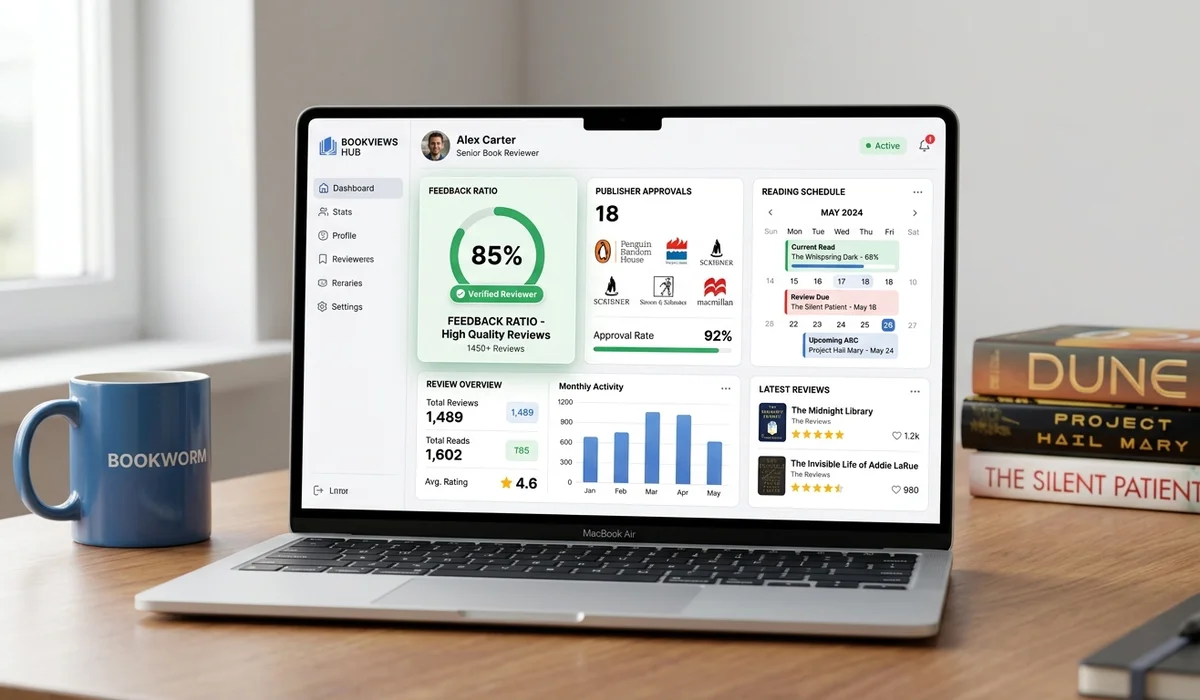
The single most critical metric on NetGalley is your Feedback Ratio:
$$\text{Feedback Ratio} = \left( \frac{\text{Approved Books with Feedback Submitted}}{\text{Total Approved Books}} \right) \times 100$$
Major publishing houses establish automated approval filters that automatically decline any reviewer whose feedback ratio falls below 80%.
    [ 0% – 59% Ratio ]  ────────> Auto-Decline Filter for Major Imprints
    [ 60% – 79% Ratio ] ────────> Manual Publicist Scrutiny (High Decline Rate)
    [ 80% – 100% Ratio] ────────> Preferred Approval Zone (Auto-Approval Eligible)
How to Escape the “Zero Feedback” Trap as a Beginner
When you create a brand-new NetGalley account, your feedback ratio is 0%. If you immediately request 10 highly anticipated blockbuster titles, you will likely be declined for all of them.
I recommend using the “Read Now” Strategy:
1. Navigate to the Find Titles tab and filter by Read Now or Listen Now.
2. “Read Now” titles bypass publisher approval queues entirely—you can download them immediately.
3. Select 4 to 5 “Read Now” titles across your favorite genres.
4. Read each book and submit high-quality, comprehensive reviews within 14 days.
5. Your feedback ratio will instantly jump to 100%, qualifying your profile for competitive requests.
To build active analytical reading and review structuring skills, explore our guide on how to read a book for exams and study notes.
Crafting High-Approval Custom Publisher Requests
When requesting highly competitive titles from major imprints (such as Tor, Bloomsbury, or Del Rey), utilize the custom request note whenever available.
Anatomy of a High-Conversion Request Note
Subject: ARC Request: [Book Title] by [Author Name]

Dear [Publisher Name] Publicity Team,

I would love to read and review an advance copy of [BOOK TITLE] for my [PLATFORM NAME, e.g., BookTok channel @handle / Blog Name].

Why this book fits my audience:
• My platform focuses on [GENRE, e.g., Dark Fantasy / Romantasy] with over [METRIC, e.g., 12,000 active monthly readers].
• I previously reviewed [SIMILAR TITLE by Author or in same genre] which generated [METRIC, e.g., 2,500 views and 180 comments].
• I plan to feature [BOOK TITLE] in a dedicated release-week video and cross-post full reviews on Goodreads, Amazon, and StoryGraph upon publication.

Thank you for your consideration!
[Your Name] | [Direct Hyperlink to Platform]
What surprised me during publisher roundtables was how few reviewers take 60 seconds to personalize their requests. Adding specific comp titles and cross-posting commitments dramatically elevates approval odds.
Leveraging BookTok, Bookstagram, and Creator Platforms

The modern publishing landscape relies heavily on digital social proof. Major literary outlets and trade trade publications—such as Publishers Weekly trade reports—consistently document how viral social media advocacy drives commercial bestseller status.
Best Practices for Social Media Book Creators
- Cross-Post on Goodreads: Always link your Goodreads reviewer account to NetGalley. Publishers view Goodreads as the primary consumer review index.
- Aesthetic Photography & Video Hooks: Showcase the digital cover on an e-reader surrounded by thematic props (e.g., candles, matching color palettes).
- Respect Review Embargoes: Check the publisher’s approval email for specific embargo dates. Most publishers allow Goodreads reviews anytime but request that retail reviews (Amazon, Barnes & Noble) be posted during publication week.
For parents and teachers reviewing young adult novels for younger readers, check our age advisories like The Cruel Prince reading level.
NetGalley Etiquette: Navigating DNFs, Negative Reviews, and Declines
Navigating the advance reader ecosystem requires professional etiquette:
⚠️ Essential NetGalley Reviewer Etiquette
- Handling “Did Not Finish” (DNF): If a book does not work for you, select “Will Not Give Feedback” with a polite private note explaining the DNF reasons. This protects your feedback ratio without submitting an unfair negative rating.
- Constructive Criticism: Honest, balanced criticism (2-star or 3-star reviews) is fully welcomed by publishers as long as it critiques narrative pacing, character development, and structure rather than attacking the author personally.
- Never Tag Authors in Critical Reviews: Post reviews on public platforms and NetGalley, but never tag an author in a negative critique on social media.
Actionable 30-Day NetGalley Success Roadmap
Follow this 4-week step-by-step roadmap to establish an elite NetGalley profile:
| Week | Action Milestone | Target Deliverables |
|---|---|---|
| Week 1 | Profile Optimization & Social Linking | Add detailed bio, link Goodreads/BookTok, connect Kindle device |
| Week 2 | “Read Now” Ratio Building | Download 4 “Read Now” titles, submit full reviews, achieve 100% ratio |
| Week 3 | Targeted Strategic Requests | Request 3 mid-tier titles from independent and university presses with custom notes |
| Week 4 | Major Imprint Requests | Request 2 highly anticipated titles from Big 5 publishers; maintain 85%+ ratio |
For insights on how systematic text exposure builds personal reading stamina, consult our analysis on how to improve Lexile score.
Frequently Asked Questions About Getting ARCs on NetGalley
Is NetGalley completely free for book reviewers?
Yes. NetGalley is 100% free for all reviewers, educators, librarians, and bloggers. Publishers pay NetGalley to list their titles and host digital galleys for promotional distribution.
Do I need a huge social media following to get approved on NetGalley?
No. While large follower counts help for celebrity releases, publishers regularly approve nano-influencers (500–2,000 followers), educators, and librarians who have high feedback ratios (80%+) and well-written review histories.
What should I do if a publisher declines my request?
Do not take declines personally. Imprints receive hundreds of requests per title and have strict digital approval caps. Focus on reviewing approved books, maintaining your feedback ratio, and requesting again on future titles.
Can I get physical book copies through NetGalley?
NetGalley is primarily a digital distribution platform (ePub, MOBI, and digital audio). However, active reviewers who demonstrate high engagement frequently catch the eye of publicists who subsequently add them to physical ARC mailing lists.
How soon before release date should I request an ARC?
The optimal window to request an ARC on NetGalley is 2 to 4 months prior to publication date. Requesting too early or after publication reduces approval likelihood.
Please Write Your Comments