Books by Lexile Level — Complete Grade Chart for Parents and Teachers (K–12)
29 May 2026
2505
A child reading at 600L is in a completely different world from a child reading at 800L — yet both might be in the same third-grade classroom. The Lexile Framework puts a number on that gap. This chart maps the full K–12 reading spectrum: from Kindergarten picture books below 300L to college-ready texts above 1300L, with 70+ specific book recommendations so you can find the right title for any reader at any level.
What Is the Lexile Framework and Why Does It Matter?
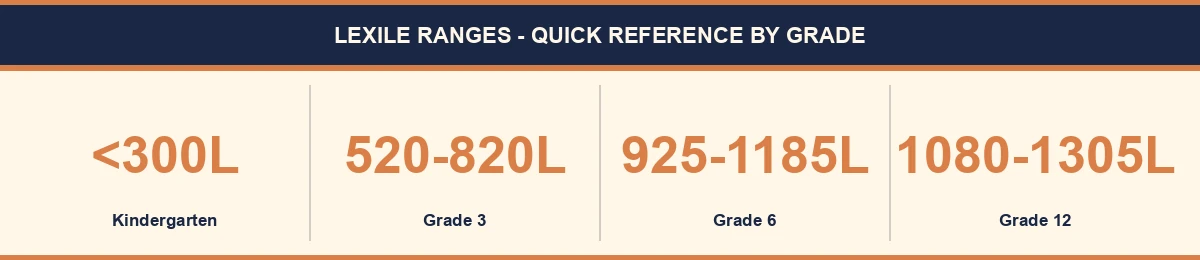
The Lexile Framework, developed by MetaMetrics, is a scientific reading measurement system that matches readers to books using a single number scale — from below 200L for emergent kindergartners to 1300L+ for college and career ready seniors. Lexile ranges by grade run from below 300L (Kindergarten) to 1080L–1305L (Grades 11–12). This guide gives parents and teachers a grade-by-grade book list with verified Lexile scores so you can find books that build reading comprehension at the right challenge level.
Lexile quick reference: Kindergarten typically reads below 300L · Grade 3: 520L–820L · Grade 5: 830L–1070L · Grade 8: 1010L–1185L · Grade 12: 1080L–1305L. A child reading 100L above their grade band is reading at an advanced level. A child reading 200L below may benefit from guided reading support.
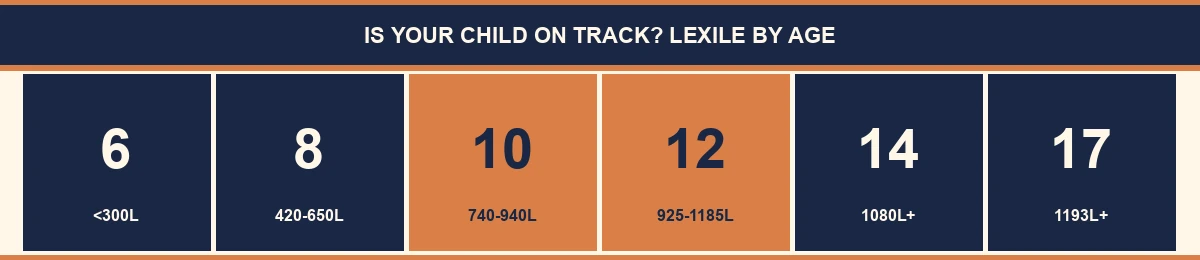
Lexile grade bands set by MetaMetrics run: below 300L (Kindergarten), 190L–530L (Grade 1), 420L–650L (Grade 2), 520L–820L (Grade 3), 740L–940L (Grade 4), 830L–1010L (Grade 5), 925L–1070L (Grade 6), 970L–1120L (Grade 7), 1010L–1185L (Grade 8), 1050L–1335L (Grades 9–10), and 1080L–1305L (Grades 11–12). Use the chart below to find books at any level.
A Lexile measure is two things at once: a reader measure and a text measure. When a student takes a reading assessment — through school programs like SRI (Scholastic Reading Inventory), MAP, or state standardized tests — they receive a Lexile score for their reading ability. Every book in the Lexile database also has a text measure based on sentence length and word frequency. When the two numbers are close, the reader is in their “just right” zone: comprehending about 75% of the text independently, which is the sweet spot for growth.
This makes Lexile a practical tool for teachers building differentiated reading lists and for parents who want to support summer reading without guessing. Unlike AR (Accelerated Reader) levels, which are proprietary to Renaissance Learning, or GRL (Guided Reading Levels), which rely on teacher judgment and multi-factor rubrics, Lexile gives you one objective number that travels with your child from school to school and program to program. For a full comparison of all reading level systems, see our guide to how Lexile and AR levels work.
Lexile Levels by Grade: Quick Reference Chart
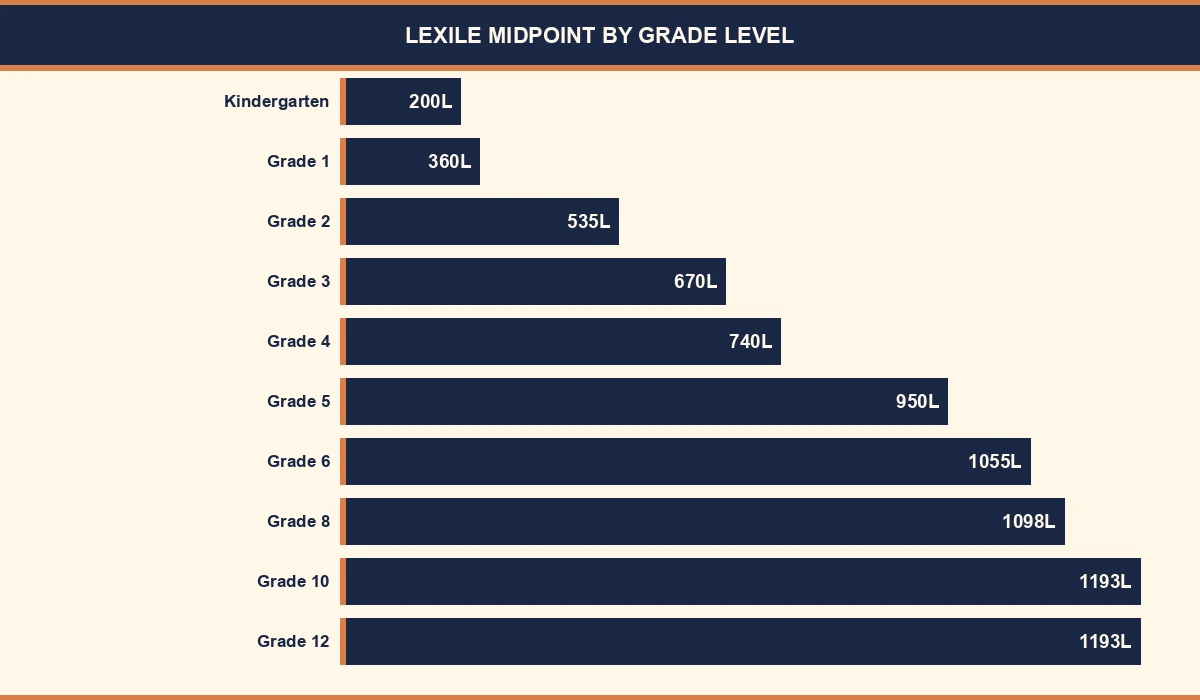
The table below reflects the MetaMetrics Lexile Framework grade bands — the range within which the middle 50% of students in each grade typically score. A student reading at the low end of the range is still grade-level; reading above the range means they may benefit from more challenging texts.
| Grade | Age | Lexile Range | Reading Stage |
|---|---|---|---|
| Kindergarten | 5–6 | Below 300L | Emergent reader |
| Grade 1 | 6–7 | 190L–530L | Early reader |
| Grade 2 | 7–8 | 420L–650L | Developing reader |
| Grade 3 | 8–9 | 520L–820L | Transitional reader |
| Grade 4 | 9–10 | 740L–940L | Fluent reader |
| Grade 5 | 10–11 | 830L–1010L | Fluent reader |
| Grade 6 | 11–12 | 925L–1070L | Independent reader |
| Grade 7 | 12–13 | 970L–1120L | Independent reader |
| Grade 8 | 13–14 | 1010L–1185L | Advanced reader |
| Grade 9–10 | 14–16 | 1050L–1335L | Advanced reader |
| Grade 11–12 | 16–18 | 1080L–1305L | College and career ready |
Source: MetaMetrics Lexile Framework © 2026. Ranges reflect the interquartile band (25th–75th percentile) for typical grade-level readers.
One important nuance: these are bands, not ceilings. A high-achieving third grader reading at 900L isn’t doing anything wrong — they may simply need books that challenge them. The section below on what to do if your child’s Lexile level doesn’t match their grade covers this in detail.
Books for Kindergarten (Lexile: Below 300L)
Most kindergarten books don’t carry a traditional Lexile score because early emergent texts are measured differently — many fall in the BR (Beginning Reader) range, meaning below 0L on the Lexile scale, or in the 0–300L band for slightly more complex picture books. The goal at this stage is print awareness, phonemic understanding, and the joy of story — not hitting a number.
| Title | Author | Lexile | AR Level | Notes |
|---|---|---|---|---|
| The Very Hungry Caterpillar | Eric Carle | 460L* | 2.0 | Repetitive structure builds early fluency; read-aloud staple |
| Green Eggs and Ham | Dr. Seuss | 210L | 1.5 | Only 50 unique words; perfect for early decoding practice |
| Where the Wild Things Are | Maurice Sendak | 740L* | 3.4 | Best used as a read-aloud; vocabulary is rich for discussion |
| Mo Willems: Don’t Let the Pigeon Drive the Bus! | Mo Willems | 120L | 0.8 | Dialogue-heavy; great for engagement and reader participation |
| Elephant & Piggie: We Are in a Book! | Mo Willems | 120L | 0.8 | Comic panel format eases visual tracking for new readers |
| Brown Bear, Brown Bear, What Do You See? | Bill Martin Jr. | BR40L | 1.1 | Predictable pattern text; sight-word reinforcement |
| Hop on Pop | Dr. Seuss | 40L | 1.2 | CVC word families; effective early phonics support |
AR levels shown are approximate and sourced from published references. Values may differ from the current Renaissance Learning database. Verify at renaissance.com or through your school’s AR program.
Note: Some picture books carry Lexile measures higher than expected because Lexile measures vocabulary complexity and sentence length, not pictures. A book like “Where the Wild Things Are” measures 740L but is appropriate for kindergarten as a read-aloud — Lexile is most useful for independent reading, not shared reading.
Note: MetaMetrics lists The Very Hungry Caterpillar at 460L based on isolated text analysis; some older reading databases and early-reader tools categorize it as BR (Below Reader) because it is primarily used as a pre-reader read-aloud. Both designations are defensible.
These books work best when paired with conversation. Ask your kindergartner what they noticed, what they think will happen next, or to point to words they recognize. That interaction is as valuable as the text measure.
Books for Grade 1 (Lexile: 190L–530L)
First grade is where independent reading takes root. Children move from memorizing words to decoding systematically, and books need to meet them exactly where their phonics knowledge is — with controlled vocabulary, short sentences, and satisfying stories. The books below span the 190L–530L range, covering both the early part of Grade 1 (closer to 190L) and readers who finish the year running (approaching 530L).
| Title | Author | Lexile | AR Level | Notes |
|---|---|---|---|---|
| Junie B. Jones and the Stupid Smelly Bus | Barbara Park | 290L | 2.6 | High-interest, funny voice; ideal for emerging chapter book readers |
| Frog and Toad Are Friends | Arnold Lobel | 400L | 2.5 | Five short chapters; classic for building stamina |
| Henry and Mudge: The First Book | Cynthia Rylant | 450L | 2.2 | Dog-and-child stories with emotional depth; controlled vocabulary |
| Fly Guy Presents: Sharks | Tedd Arnold | 380L | 2.7 | Nonfiction + narrative hybrid; great for reluctant readers |
| Magic Tree House #1: Dinosaurs Before Dark | Mary Pope Osborne | 580L | 2.6 | Just above mid-range; excellent stretch text for late Grade 1 |
| Biscuit | Alyssa Satin Capucilli | 140L | 0.8 | Entry-level chapter book; high-frequency words only |
| Owl at Home | Arnold Lobel | 480L | 2.6 | Gentle humor, short chapters, consistent vocabulary |
| Commander Toad in Space | Jane Yolen | 490L | 3.1 | Playful parody; builds vocabulary through wordplay |
Barbara Park’s Junie B. Jones reading level spans 290L–570L across the series — a perfect Grade 1 arc that carries readers from early chapter books all the way to confident independent reading by mid-second grade. Book 1 is one of the most popular classroom library choices at this level.
In practice, many Grade 1 readers land their comfort zone between 300L and 430L, even if the official grade band runs to 530L. Don’t push to the top of the range if your child is reading fluently and happily at 350L — sustained engagement matters more than chasing numbers.
Books for Grade 2 (Lexile: 420L–650L)
Second grade readers are building real stamina. They can handle longer chapters, more complex plots, and characters who carry problems across multiple books. This is the prime age for series reading — same world, same characters, new story — because the repeated vocabulary load accelerates fluency.
| Title | Author | Lexile | AR Level | Notes |
|---|---|---|---|---|
| Charlotte’s Web | E.B. White | 680L | 4.4 | Slightly above mid-range; emotional vocabulary is rich but manageable |
| Magic Tree House #5: Night of the Ninjas | Mary Pope Osborne | 530L | 2.9 | Consistent series vocabulary rewards loyal readers |
| Flat Stanley | Jeff Brown | 520L | 3.1 | Short sentences, high-concept premise, short chapters |
| The Boxcar Children #1 | Gertrude Chandler Warner | 560L | 3.5 | Mystery elements drive engagement; classic vocabulary |
| Nate the Great | Marjorie Weinman Sharmat | 500L | 2.3 | Detective-format; predictable structure helps with comprehension |
| Ramona Quimby, Age 8 | Beverly Cleary | 860L | 5.0 | Above range but widely used as a Grade 2 read-aloud or challenge text |
| Captain Underpants: The First Epic Novel | Dav Pilkey | 670L | 4.3 | High engagement for reluctant readers; humor-driven motivation |
| My Father’s Dragon | Ruth Stiles Gannett | 680L | 5.1 | Adventure structure; vivid world-building for confident readers |
Charlotte’s Web is a perennial Grade 2 choice, though at 680L it sits at the top of the range. Most teachers use it as a whole-class read-aloud rather than independent reading at this level — which is exactly how it should be used. The shared emotional experience of Wilbur and Charlotte is worth every minute.
Books for Grades 3–4 (Lexile: 520L–940L)
The Grades 3–4 band is the widest in the elementary years, and for good reason: this is where reading ability diverges the most. A struggling Grade 3 reader might be at 550L while a strong reader in the same classroom is at 900L. The books below span that full range, so use your child’s individual Lexile score — not just their grade — to find the right fit.
| Title | Author | Lexile | AR Level | Notes |
|---|---|---|---|---|
| Charlotte’s Web | E.B. White | 680L | 4.4 | Classic; emotional vocabulary is rich and instructive |
| Stuart Little | E.B. White | 920L | 5.1 | Near top of range; great challenge text for strong Grade 4 readers |
| Holes | Louis Sachar | 660L | 4.6 | Non-linear narrative teaches inference; a staple Grade 4 novel |
| Diary of a Wimpy Kid | Jeff Kinney | 950L | 5.2 | Slightly above range; hybrid text/graphic format lowers reading load |
| The One and Only Ivan | Katherine Applegate | 570L | 3.5 | Verse novel; emotional intelligence; perfect for mid-Grade 3 |
| Hatchet | Gary Paulsen | 1020L | 5.7 | Above range; commonly used as a Grade 4 stretch or Grade 5 on-level |
| Because of Winn-Dixie | Kate DiCamillo | 670L | 3.9 | Strong character voice; manageable length for Grade 3 |
| Esperanza Rising | Pam Muñoz Ryan | 750L | 5.3 | Rich historical vocabulary; excellent for Grade 4 social studies tie-in |
| The Indian in the Cupboard | Lynne Reid Banks | 770L | 5.1 | Plot-driven; engages reluctant readers with fantasy premise |
| The Trumpet of the Swan | E.B. White | 1010L | 6.1 | Challenge read for advanced Grade 4; beautiful prose model |
Diary of a Wimpy Kid reading level measures around 950L — technically a Grade 4–5 Lexile — but the hybrid text-and-illustration format significantly lowers the cognitive load. Most Grade 3 readers can engage with it successfully even if their Lexile is closer to 700L, because the illustrations carry roughly 40% of the story. It’s one of the most powerful books for reluctant or struggling Grade 3–4 readers.
In our experience working with literacy coaches, Grade 3 readers often find their “just right” book in the 620L–760L sweet spot, even when the official grade band extends to 820L. Books in that middle zone — Because of Winn-Dixie, Holes, The One and Only Ivan — tend to generate the most sustained independent reading.
Books for Grades 5–6 (Lexile: 830L–1070L)
Grades 5–6 is the golden age of middle grade fiction, and the Lexile range reflects it: readers at this stage can handle complex subplots, unreliable narrators, and themes that require some emotional maturity. The books below include some of the most widely read titles in American schools, with verified Lexile scores.
| Title | Author | Lexile | AR Level | Notes |
|---|---|---|---|---|
| Harry Potter and the Sorcerer’s Stone | J.K. Rowling | 880L | 5.5 | Cornerstone Grade 5 text; vocabulary grows across the series |
| Harry Potter and the Chamber of Secrets | J.K. Rowling | 940L | 5.5 | Strong continuity read for HP fans; slightly higher Lexile |
| The Lightning Thief (Percy Jackson #1) | Rick Riordan | 680L | 4.7 | Below-range Lexile but Grade 5–6 content; high-interest mythology |
| Hatchet | Gary Paulsen | 1020L | 5.7 | Top of range; survival narrative; lean, powerful sentences |
| Island of the Blue Dolphins | Scott O’Dell | 1000L | 5.4 | Classic survival story; historical and environmental themes |
| The Giver | Lois Lowry | 760L | 5.7 | Lower Lexile, high conceptual complexity; frequently taught in Grade 6 |
| A Wrinkle in Time | Madeleine L’Engle | 740L | 4.7 | Below numeric range but thematically rich; popular Grade 5 choice |
| Wonder | R.J. Palacio | 790L | 5.2 | Multiple POV; strong for social-emotional learning integration |
| Bud, Not Buddy | Christopher Paul Curtis | 950L | 5.0 | Historical Depression-era voice; excellent for Grade 5 social studies |
| Bridge to Terabithia | Katherine Paterson | 810L | 4.6 | Manages grief with extraordinary craft; often taught Grades 5–6 |
Harry Potter reading level starts at 880L for Book 1 and climbs to 1030L by Book 7, making the series a natural multi-year reading journey from Grade 5 through Grade 7 that simultaneously builds Lexile level. Percy Jackson reading level — The Lightning Thief measures 680L, which is accessible for strong Grade 4 readers and typical for Grade 5 readers who want mythology-driven adventure. The lower Lexile means reluctant readers can access it too, while the content keeps high-ability readers fully engaged.
A practical note for teachers: The Giver and A Wrinkle in Time both carry Lexile scores below the Grade 5–6 band, but they are routinely taught in Grades 5–6 because their conceptual complexity — dystopia, free will, sacrifice — requires emotional and critical maturity that the Lexile scale doesn’t capture. Lexile measures difficulty of text, not appropriateness of themes.
Books for Grades 7–9 (Lexile: 970L–1185L)
Middle school and early high school readers encounter longer texts, layered themes, and the transition from middle grade to young adult fiction. The books below include some of the most assigned novels in American middle and high school classrooms, verified against the Lexile database.
| Title | Author | Lexile | AR Level | Notes |
|---|---|---|---|---|
| The Hunger Games | Suzanne Collins | 810L | 5.3 | Below numeric range but standard Grade 7–8 content; intense themes |
| Harry Potter and the Deathly Hallows | J.K. Rowling | 1030L | 7.2 | Series finale; sophisticated vocabulary and emotional arc |
| To Kill a Mockingbird | Harper Lee | 870L | 5.6 | Often assigned Grade 8–9; thematic complexity requires maturity |
| The Outsiders | S.E. Hinton | 750L | 4.7 | Below numeric range; commonly assigned Grade 7 due to themes |
| The Book Thief | Markus Zusak | 730L | 5.1 | Lower Lexile, high emotional intensity; WWII perspective |
| Speak | Laurie Halse Anderson | 690L | 4.5 | Trauma-focused YA; Lexile is deceptively low — powerful for Grade 8–9 |
| Ender’s Game | Orson Scott Card | 780L | 5.6 | Science fiction classic; strong for reluctant Grade 7–9 readers |
| The Maze Runner | James Dashner | 770L | 5.3 | Fast-paced; excellent for reluctant readers in Grades 7–8 |
| Animal Farm | George Orwell | 1170L | 6.4 | Top of range; allegory requires teacher scaffolding; common Grade 9 text |
| Of Mice and Men | John Steinbeck | 630L | 4.5 | Low Lexile, high thematic weight; standard Grade 8–9 assignment |
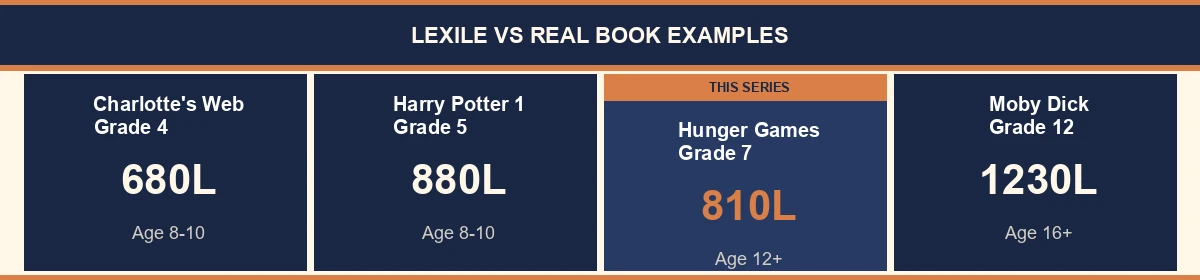
The Hunger Games reading level measures 810L across the trilogy — technically within the Grade 3–5 Lexile band — but its themes of state violence, survival, and trauma place it firmly in Grades 7–9 in terms of content appropriateness. This is one of the clearest examples in all of children’s literature where Lexile score and content maturity diverge. The book reads quickly; what lingers is not the vocabulary but the ideas.
Several of the most commonly assigned Grade 7–9 novels — The Outsiders, The Book Thief, Speak — carry Lexile scores in the 700–750L range, well below the grade band. This reflects a deliberate choice by teachers: powerful literature written in accessible prose, so that nothing stands between the student and the emotional experience of the story.
Books for Grades 10–12 (Lexile: 1050L–1305L)
High school English lists lean heavily on canonical literature, and many of those texts carry Lexile scores in the 1000L–1300L range. The table below includes both classic assignments and contemporary literary fiction that fit this band.
Why some Grade 10–12 classics score below the grade band: MetaMetrics calculates Lexile using sentence length and word frequency — not cultural complexity. Dialect-heavy prose, vernacular syntax, and epistolary formats (short sentences, familiar vocabulary) produce lower Lexile scores even when emotional and thematic difficulty is high. The Color Purple (770L), Their Eyes Were Watching God (830L), and Brave New World (870L) all fall below the 1050L–1305L Grade 10–12 band — the scores are accurate; the mismatch reflects Lexile’s design, not an error in this table.
| Title | Author | Lexile | AR Level | Notes |
|---|---|---|---|---|
| The Great Gatsby | F. Scott Fitzgerald | 1010L | 7.3 | Standard Grade 11 text; dense allusion requires cultural context |
| 1984 | George Orwell | 1090L | 7.2 | Dystopian theory; assigned across Grades 10–12 |
| Brave New World | Aldous Huxley | 870L | 8.0 | Below-range Lexile; often paired with 1984 for comparative analysis |
| The Kite Runner | Khaled Hosseini | 1030L | 5.2 | Contemporary fiction; thematic complexity exceeds Lexile |
| Slaughterhouse-Five | Kurt Vonnegut | 920L | 7.8 | Non-linear structure challenges readers; Grade 11–12 standard |
| Their Eyes Were Watching God | Zora Neale Hurston | 830L | 5.4 | Dialect-heavy; lexical familiarity may underestimate difficulty |
| Crime and Punishment | Fyodor Dostoevsky | 1300L | 13.0 | Top of range; philosophical weight makes it AP or college-level |
| A Raisin in the Sun | Lorraine Hansberry | 970L | 7.0 | Drama format; accessible entry point for American lit units |
| The Color Purple | Alice Walker | 770L | 6.2 | Epistolary format; low Lexile, very mature themes — Grade 11–12 only |
| The Road | Cormac McCarthy | 1190L | 7.0 | Contemporary; sparse punctuation increases cognitive load |
A pattern becomes clear across the high school list: Lexile scores and content maturity are routinely misaligned in literary fiction. Their Eyes Were Watching God measures 830L but belongs in Grade 11. The Color Purple measures 770L but is a mature Grade 11–12 text. At this level, teachers should use Lexile as one data point among many — thematic maturity, cultural context, and classroom discussion scaffolding matter at least as much as text complexity.
What to Do If Your Child’s Lexile Level Doesn’t Match Their Grade
The “5 finger rule” alternative: If your child cannot use the Lexile Finder, try the five-finger rule: open any page of the book and read it aloud. If they stumble on five or more words on one page, the book is likely too hard for independent reading. Two or fewer stumbles means it may be too easy for growth.
This is one of the most common questions literacy coaches field from parents, and the short answer is: a Lexile mismatch is almost never an emergency.
When your child reads above grade level
A Grade 4 student reading at 1100L is a good problem to have — but it comes with its own challenge. Lexile doesn’t measure content maturity. A book at 1100L might be perfectly calibrated for text complexity but contain themes (violence, sexuality, trauma) that aren’t appropriate for a 9-year-old. The solution isn’t to cap their reading at grade-level texts; it’s to use Lexile as a floor (not a ceiling) and layer in content judgment. Look for books in the 1000L–1200L range that are written specifically for middle grade or older middle school audiences, rather than reaching directly for adult literary fiction.
When your child reads below grade level
An interest gap and an ability gap are different problems. A Grade 5 student reading at 600L may simply not have had enough reading volume yet — more books, more time, and more engaging choices will close the gap faster than remediation. The goal is to find books that build reading comprehension at the right challenge level — books they want to read at their current Lexile, not books that feel like work. A 600L book they love will build more reading skill than an 850L book they abandon at chapter two.
The “just right” book formula
Educators use the 5-finger rule for quick assessment: open a book to a random page and read it. Hold up one finger for each word you don’t know. Zero to one fingers: too easy. Two to three: just right. Four or five: too hard. For independent reading, aim for the “just right” zone. For read-alouds or class discussions, teachers intentionally choose books above students’ independent Lexile — the shared context compensates for the additional text complexity.
Stretch books vs. independent books
MetaMetrics recommends thinking in two categories:
- Independent reading level: texts within 50L to 100L below your child’s Lexile score — comfortable, fluent, enjoyable
- Instructional level: texts within the Lexile band or up to 100L above — where real growth happens, especially with teacher or parent support
Building a home library that spans both levels — easy reads for pleasure, harder reads for growth — is the single most effective reading support strategy available to parents.
Lexile ≠ content rating: A high Lexile score measures text complexity — sentence length and vocabulary — not themes or appropriateness. The Hunger Games (810L) is easier to read than Charlotte’s Web (680L) by Lexile measure, but has significantly darker content. Always check content before assuming a high-Lexile book is appropriate for a young reader.
Frequently Asked Questions About Lexile Levels
Q: What Lexile level should a 3rd grader be at?
According to MetaMetrics, a typical Grade 3 student reads between 520L and 820L. Students at the lower end of that range are still on track; students reading above 820L are reading above grade level and may benefit from more challenging texts. The most important thing is that the child is reading independently and with comprehension — the number is a guide, not a verdict.
Q: What is a good Lexile level for 4th grade?
The MetaMetrics target range for Grade 4 is 740L–940L. In practice, a Grade 4 student reading between 700L and 900L is in excellent shape. Popular books in this range include Holes (660L), Because of Winn-Dixie (670L), and Esperanza Rising (750L).
Q: What is a Lexile level of 1000?
A Lexile measure of 1000L corresponds to late Grade 6 or early Grade 7 for a typical reader. Books at this level include Hatchet (1020L), The Trumpet of the Swan (1010L), and Harry Potter and the Deathly Hallows (1030L). It also represents the low end of the Grade 9–10 reader band, so a 1000L text can serve a wide range of ages depending on content maturity.
Q: How do I find my child’s Lexile level?
Most schools report a student’s Lexile score at least once a year through standardized reading assessments — check with your child’s teacher after fall and spring testing windows. Tools like the Scholastic Reading Inventory (SRI), MAP Growth Reading, and many state assessments report Lexile scores directly. If your school doesn’t provide one, the Lexile Hub at hub.lexile.com offers a free reading assessment tool for families. You can also search by title using the Scholastic Book Wizard at scholastic.com/bookwizard to see a book’s Lexile alongside its AR level and grade band.
Q: What is the difference between Lexile level and AR level?
Lexile is developed by MetaMetrics and is used by many state assessments and school districts independently of any reading management program. AR (Accelerated Reader) level is a proprietary metric from Renaissance Learning, most often used in schools that subscribe to the AR program. The two systems measure different things — Lexile uses sentence length and word frequency; AR uses a more holistic rubric and provides a grade equivalent score alongside quiz points — and they don’t convert directly into each other. For a full side-by-side comparison, including GRL and DRA levels, see our guide to how Lexile and AR levels work.
Q: What books have a Lexile level of 800?
Several popular titles land around 800L: The Hunger Games by Suzanne Collins (810L), Bridge to Terabithia by Katherine Paterson (810L), Bud, Not Buddy by Christopher Paul Curtis (950L is close but slightly above), and Island of the Blue Dolphins by Scott O’Dell (1000L — 800L is the lower boundary). For a precise 800L match, check the Lexile Hub’s free book finder at hub.lexile.com, where you can filter by exact Lexile range, genre, and grade level.
How to Use This Chart With Your Child Tonight
Reading level data is most useful when it’s in your hands at the library or bookstore. Here’s a simple three-step process:
1. Find your child’s Lexile score. Ask their teacher, check the school portal, or look at the last reading assessment report. If you don’t have one, the Lexile Hub offers a free online assessment.
2. Set a 100L window. Take their current Lexile and find books from 50L below to 50L above. That’s the independent reading sweet spot — challenging enough to build vocabulary, comfortable enough to finish.
3. Let interest lead. Use the Lexile as a filter, not a mandate. A child who loves dragons will read at a higher effective level in a dragon book than in a realistic fiction book at the same Lexile, because prior knowledge and motivation compensate for unfamiliar vocabulary. Once you’ve confirmed a book fits the range, let your child choose.
The Lexile Framework is one of the most well-validated reading measurement tools in education — but it is a tool, not a ceiling. The best Lexile level for your child is the one attached to a book they can’t put down.
Please Write Your Comments