Demon Copperhead Review & Summary: Kingsolver’s Pulitzer-Winning Masterpiece
29 May 2026
1100
Barbara Kingsolver’s Demon Copperhead won the 2023 Pulitzer Prize for Fiction — the same year it was also named a New York Times Book of the Year and a Goodreads Choice Award finalist. That is a lot of noise for a 560-page novel set in rural Appalachia, following a red-haired boy born to a teenage mother in a trailer. The noise is justified.
Demon Copperhead: Overview and Quick Summary
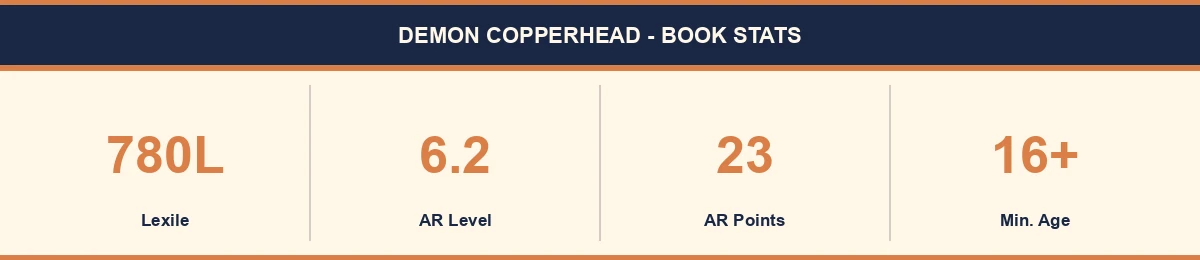
Demon Copperhead by Barbara Kingsolver (HarperCollins, 2022) is a Pulitzer Prize-winning literary novel that retells Dickens’s David Copperfield in the opioid-ravaged hills of rural Virginia. Narrated by Damon Fields — “Demon Copperhead” — the story follows a red-haired boy from birth through addiction, foster care, and hard-won survival. Essential reading for fans of social-issue literary fiction and Appalachian storytelling.
| Detail | Info |
|---|---|
| Author | Barbara Kingsolver |
| Publisher | HarperCollins |
| Year | 2022 |
| Award | Pulitzer Prize for Fiction, 2023 |
| Genre | Literary Fiction |
| Pages | 560 |
At a glance: Demon Copperhead (2022) | Barbara Kingsolver | HarperCollins | 560 pages | Pulitzer Prize for Fiction 2023 | Lexile: 780L | AR Level: 6.2 | AR Points: 23 | Age recommendation: 16+
Damon Fields is born to a teenage mother in a Lee County, Virginia trailer, with a mop of red hair that earns him the nickname “Demon Copperhead” before he’s old enough to know who Charles Dickens is. His mother, Melinda, is already in the grip of addiction by the time Demon can form complete sentences, which means Demon enters the world not as a child so much as a small survivor. Kingsolver opens the novel in Demon’s own voice — colloquial, sharp, occasionally wry — and never lets go of that register for all 560 pages. It’s one of the most sustained narrative voice experiments in recent American literary fiction, and it largely succeeds.
The novel is set in the Appalachian coalfields of southwest Virginia, a region that bore an outsized share of the OxyContin epidemic launched by Purdue Pharma in the late 1990s. Kingsolver spent years researching the area, and the specificity shows: the landscape, the county fair culture, the football Friday nights, the particular shame of poverty that comes with being rural and white and invisible to the national conversation all land with documentary precision.
Before you pick up a copy, if you’re hunting for your next great read, the advanced reader copy websites listed in our ARC guide can help you get early access to literary fiction titles like this one.
Plot Summary: What Happens in Demon Copperhead?
> Spoiler note: The following contains spoilers for the full novel, including the ending. Read the FAQ section at the bottom for a spoiler-light overview.
Act One: Childhood and the Foster Care System
Demon’s early years are shaped by his mother’s addiction and a rotating cast of adults who fail him in imaginative ways. When Melinda remarries a man named Stoner — a fitting name — Demon’s home life deteriorates fast. After his mother dies of an overdose, Demon is placed in Virginia’s foster care system, cycling through a series of placements that range from neglectful to outright abusive.
The most damaging is with a farmer named Crickson who uses foster children as unpaid labor.
The one consistent bright spot in Demon’s young life is Mrs. Peggot, the warm grandmother of his best friend Maggot, who provides something close to unconditional care throughout the novel. Her house is the place Demon returns to mentally even when he can’t return physically, and Kingsolver uses her character to show what functional community support can look like — and how rarely the state provides anything like it.
Act Two: High School, Football, and the Opioid Trap
Demon’s life stabilizes temporarily when he lands with a foster father named Coach — a former player who recognizes Demon’s athletic talent and channels him into football. For a stretch, the novel reads almost like a conventional coming-of-age story: Demon is good at something, he has teammates, he has a sense of belonging. He also develops a serious crush on a girl named Emmy, whose own family history mirrors some of the instability Demon knows too well.
The turning point comes when Demon tears his knee in a game. A team doctor prescribes OxyContin for the pain. Within chapters, Demon’s careful new stability begins to collapse. Kingsolver is precise and unsentimental here: she shows how opioid dependency doesn’t announce itself, how it arrives through legal prescriptions written by people who should have known better, how it fills the same hole that community and family were supposed to fill. Demon eventually falls in with a dealer named U-Haul and slides from pills to stronger substances.
His relationship with Tommy, an older mentor figure who later dies of an overdose, marks the novel’s most devastating stretch. Tommy is one of several characters drawn closely from Dickens’s David Copperfield — Kingsolver maps the original novel’s character roster onto her Appalachian cast with considerable skill.
Act Three: Rock Bottom and the Long Road Back
The final third of the novel follows Demon through full-blown addiction: homelessness, stealing, the particular degradation of needing something more than you’ve ever needed anything. He loses Emmy. He loses time. Several people he loves die. Hammer, a childhood friend, represents the path Demon might have taken — steady, grounded — and their friendship, maintained across Demon’s worst years, becomes a lifeline.
Recovery, when it comes, is not dramatic. Kingsolver resists the redemption-arc clichés of addiction narratives. Demon doesn’t have a single bottom-out moment that fixes everything. He has a slow, grinding return to himself, supported by the people who refused to give up on him even when he gave up on himself. The novel ends with Demon in his early twenties, sober, still in Lee County, and beginning to document his own story — picking up a pen, essentially, to write what we have just read.
The Demon Copperhead Ending Explained
Spoiler boundary: The section below explains the ending of Demon Copperhead in full. If you have not finished the novel, skip to the “Is It Worth Reading?” section below.
The ending of Demon Copperhead is quiet by design, and that quietness is the point.
By the final chapters, Demon is in his early twenties and working through recovery. He has lost people — Tommy to overdose, his mother years earlier, others to the various ways Appalachian poverty and the opioid epidemic consumed a generation. Emmy, the girl he loved through high school and hoped to build a life with, has her own recovery arc that runs parallel to Demon’s but never quite intersects again in the way he hopes.
What Kingsolver does in the ending is deliberately anti-cinematic. Demon doesn’t leave Lee County for a fresh start somewhere else. He doesn’t get the girl back in a final scene. He doesn’t give a speech about what he’s learned. Instead, he begins to draw. Demon has always had artistic talent — sketching people and scenes throughout the novel — and in the closing pages he channels that into something purposeful. He starts illustrating the stories of the people around him, the invisible lives of rural Appalachia. The act of bearing witness, of turning lived experience into narrative, becomes his form of survival.
This is where the David Copperfield parallel pays off most fully. In Dickens’s novel, David becomes a writer. Kingsolver’s Demon Copperhead ends the same way — the novel we’ve read is, implicitly, the document Demon has created. The first-person narration circles back to its own origin. It’s a formally elegant ending to a formally ambitious novel.
The Demon Copperhead ending explained in thematic terms: Kingsolver is arguing that the opioid epidemic in Appalachia was not a failure of individual willpower but a systemic catastrophe enabled by pharmaceutical companies, an indifferent medical establishment, and a political culture that treated poor rural communities as disposable. Demon survives not because he is exceptional — Kingsolver is careful about this — but because of a specific constellation of people who stayed. The ending is hopeful without being falsely optimistic, which is the most honest thing a novel about addiction can be.
As for how Demon Copperhead ends for the secondary characters: Mrs. Peggot endures. Hammer makes a modest life for himself. Some characters don’t make it. Kingsolver doesn’t clean up the edges.
Themes and Literary Analysis
1. The Opioid Epidemic as Systemic Failure
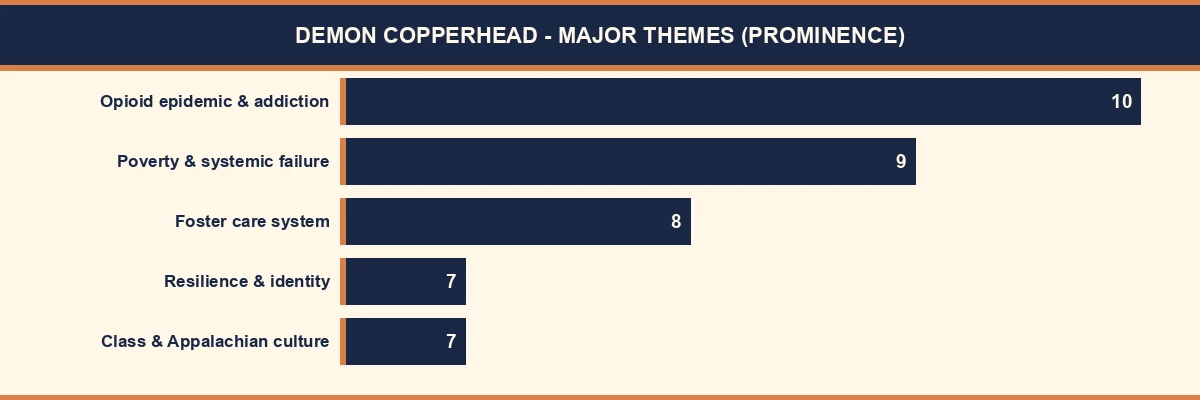
Kingsolver treats the opioid crisis not as a moral failing of addicted individuals but as the predictable outcome of corporate greed and institutional negligence. OxyContin’s introduction into communities like Lee County, Virginia is shown as a deliberate market decision — distributors knew the demand, doctors were incentivized to prescribe, and the communities had no political infrastructure to push back. Demon’s addiction begins with a legal prescription written by a doctor who treated a football injury. That detail is not incidental. This novel won the Pulitzer Prize for Fiction in 2023 in recognition of exactly this kind of socially urgent, rigorously crafted storytelling.
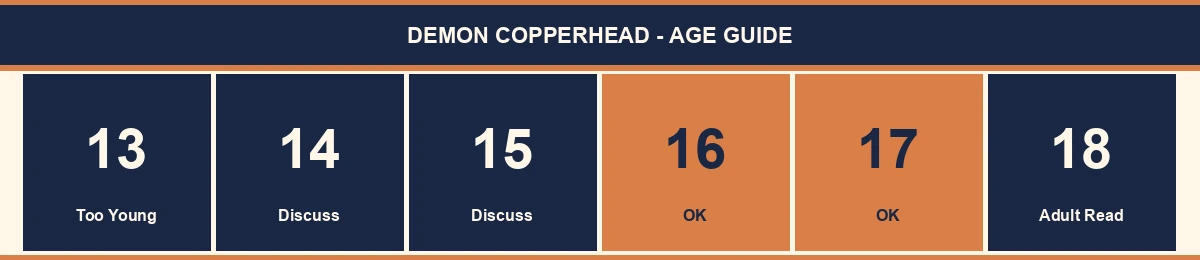
Content advisory: Demon Copperhead contains detailed depictions of opioid addiction, childhood neglect, foster care abuse, sexual content, and character death. It is written for adult readers. Most educators recommend it for ages 16 and up, with parental discussion for ages 14–15.
2. Foster Care and the Abandonment of Children
Demon’s time in the Virginia foster care system is one of the novel’s most damning stretches. The families who take in foster children are often doing so for the stipend rather than the children’s welfare. Case workers are overloaded and underinvested. The system fails Demon repeatedly and systematically. Kingsolver draws a direct line between childhood instability and adult vulnerability to addiction — not as an excuse, but as a cause.
3. Appalachian Identity and Class Invisibility
Rural Appalachia is rendered here not as a region of quaint poverty but as a place with a distinct culture, history, and dignity that the rest of America consistently ignores. Demon’s voice is full of awareness that people from outside see his home as a punchline or a policy problem rather than a place people actually love and belong to. This is the novel’s most quietly political thread, and it runs throughout.
4. The Dickensian Social Critique, Updated
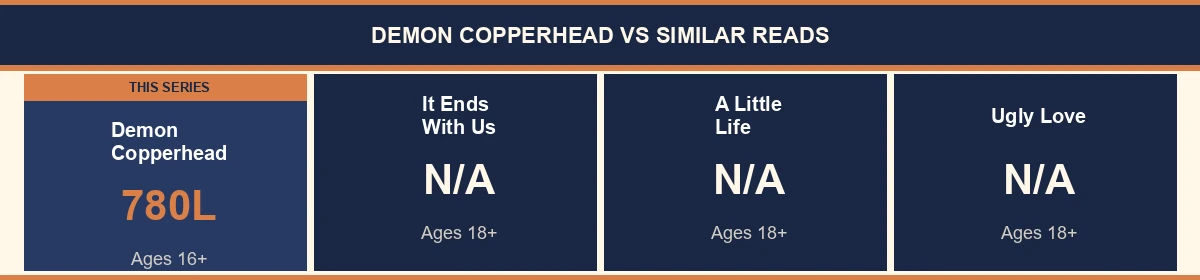
Kingsolver’s choice to transpose David Copperfield to contemporary Appalachia is not a parlor trick. Dickens wrote David Copperfield as a critique of the systems — workhouses, indentured labor, a legal establishment indifferent to the poor — that destroyed children in Victorian England. Kingsolver’s update argues those systems haven’t gone away; they’ve been restructured. For readers who enjoy novels that use emotional depth to interrogate systemic injustice, the way It Ends With Us by Colleen Hoover approaches domestic violence shares that same commitment to making structural problems personal and visceral.
5. Adolescent Resilience and the Role of Community
What saves Demon, in the end, is not a program or a policy but specific people — Mrs. Peggot, Hammer, a few others who show up consistently. Kingsolver is making a specific argument about what communities can provide that states and markets cannot. The resilience Demon demonstrates is not innate toughness; it’s the product of having been witnessed and valued by at least a few people at critical moments.
Is Demon Copperhead Worth Reading?
The short answer is yes — but with honest caveats about what you’re signing up for.
What Kingsolver gets absolutely right: The narrative voice is a genuine achievement. Sustaining first-person present-tense across 560 pages of difficult material without the voice becoming mannered or exhausting is hard, and Kingsolver mostly pulls it off. The Dickens parallel is executed with more structural fidelity than readers who haven’t read David Copperfield will realize — but the novel also works fine if you’ve never read Dickens. The research into the opioid epidemic is woven into the fabric of the story rather than delivered as documentary data drops. Demon’s relationship with Mrs. Peggot is one of the most genuinely warm central relationships in recent literary fiction.
Where the novel strains: The middle section — Demon’s peak addiction years — can feel repetitive. Addiction narratives have an inherent structural problem: the subject matter resists forward momentum, and readers can feel that stall. Some readers will also find the dialect density heavy going; Kingsolver commits fully to Appalachian vernacular, which is the right call for authenticity but creates occasional friction on the page.
Demon Copperhead holds a 4.29 average rating on Goodreads across 200,000+ ratings — a reflection of its broad appeal beyond the literary prize circuit.
Who should read Demon Copperhead:
- Literary fiction readers who want their investment of 560 pages to mean something
- Anyone interested in the opioid epidemic, Appalachian culture, or American social history
- Readers who loved Dickens and want to see his architecture rebuilt in a new context
- Pulitzer Prize completionists — this won the 2023 prize jointly with Trust by Hernan Diaz, and it is genuinely one of the stronger recent winners
- Readers who found Ugly Love emotionally intense but rewarding — Demon Copperhead operates at a similar pitch of emotional commitment, though in a very different genre register
Books Similar to Demon Copperhead
A Little Life by Hanya Yanagihara is the most obvious companion read. Like Demon Copperhead, it is an unflinching account of childhood trauma and adult survival, narrated with tremendous intimacy and length. The scale of suffering is similar, and so is the structural commitment to following a character through decades of consequence. A Little Life will gut you in comparable ways, though it stays in an urban rather than rural setting.
Educated by Tara Westover is non-fiction but tracks some of the same thematic ground: childhood in a marginalized American community, survival through creativity and stubbornness, the cost of leaving and the cost of staying. Readers drawn to Demon’s self-documentation instinct will recognize it in Westover.
Hillbilly Elegy by J.D. Vance offers a real-world account of an Appalachian upbringing with similar socioeconomic pressure points, though its politics diverge sharply from Kingsolver’s — reading both together makes for an instructive contrast.
Fool Me Once by Harlan Coben serves a different reader appetite — it’s a thriller rather than literary fiction — but for readers who want an emotionally intense page-turner after the dense emotional weight of Demon Copperhead, Fool Me Once delivers a fast, gripping change of register.
For readers who want emotionally intense character studies in a more accessible format, Ugly Love by Colleen Hoover offers a very different surface (contemporary romance) but the same core investment in characters carrying serious emotional damage.
Frequently Asked Questions
What is Demon Copperhead about?
Demon Copperhead is Barbara Kingsolver’s 2022 literary novel retelling Charles Dickens’s David Copperfield in opioid-era rural Virginia. It follows Damon Fields — “Demon Copperhead” — from birth through childhood in foster care, a football career, addiction to prescription opioids, and the long road toward recovery. It won the Pulitzer Prize for Fiction in 2023.
How does Demon Copperhead end?
(Spoiler) Demon survives his addiction, achieving a fragile but real recovery in his early twenties. He remains in Lee County, Virginia, and turns to art — drawing and documenting the stories of people around him. The ending implies that the novel itself is the document Demon has created, mirroring David Copperfield’s resolution as a writer. It is hopeful without being falsely redemptive.
Did Demon Copperhead win the Pulitzer Prize?
Yes. Demon Copperhead won the Pulitzer Prize for Fiction in 2023, jointly awarded alongside Trust by Hernan Diaz. It was one of the more acclaimed Pulitzer wins in recent years, with near-universal critical praise for Kingsolver’s narrative voice and research depth.
Is Demon Copperhead based on a true story?
It is not based on a single true story, but it is deeply researched. Kingsolver drew on extensive reporting about the opioid epidemic in Lee County, Virginia, and the broader Appalachian region. The characters are fictional; the conditions that produced them are documentary-accurate.
What is the connection between Demon Copperhead and David Copperfield?
Kingsolver deliberately structured Demon Copperhead as a modern American retelling of Dickens’s 1850 novel David Copperfield. Key plot beats, character archetypes, and Dickens’s thematic concern with systems that destroy children are transposed into the opioid-era American South. Demon’s trajectory mirrors David’s: motherless childhood, exploitation by adults, survival, and eventual self-authorship.
What age is Demon Copperhead for?
This is adult literary fiction. It contains graphic depictions of drug use and addiction, child abuse and neglect within the foster care system, sexual content, and death. It is not appropriate for younger readers. Most readers approach it from their mid-twenties onward; it is frequently taught in university literature and social policy courses.
What should I read next?
If you want to stay in literary fiction with emotional weight, A Little Life is the natural next step. If you’re curious what else in the literary space is generating serious attention right now, our roundup of most anticipated books of 2026 is a good place to start. And if you prefer getting your hands on advance copies before publication, our guide to advanced reader copy websites covers the best platforms for exactly that.
Please Write Your Comments