Reading Level vs Grade Level: Complete Parent & Teacher Guide
25 Sep 2026
3
💡 Quick Answer
Navigating reading level vs grade level metrics is one of the most vital responsibilities for parents, educators, and reading specialists. In my experience working with elementary and middle school classrooms, assuming that every 4th grader reads at a “4th-grade level” is the fastest route to either instructional frustration or intellectual stagnation.
When I analyzed student standardized testing portfolios, I noticed that reading ability develops along an idiosyncratic developmental curve rather than a rigid calendar schedule. A child in 3rd grade might possess the phonetic fluency of a 5th grader, while a 6th grader might struggle with multi-clause syntactic structures typical of 4th-grade texts.
This comprehensive guide decodes the core differences between chronological grade placement and functional reading levels, details how major leveling frameworks (Lexile, ATOS, Guided Reading, DRA) map to school grades, and provides practical strategies for supporting readers whether they are working below, at, or well above grade level expectations.
- Defining the Core Differences Between Grade Placement and Reading Ability
- Why Reading Level Diverges From Grade Level
- How Standardized Testing Measures Reading Level vs Grade Level
- The Master Equivalence Matrix: Aligning Levels to School Grades
- Supporting Students Reading Below Grade Level
- Supporting Advanced and Gifted Readers
- Actionable Tips for Parents: Interpreting School Reports
- Frequently Asked Questions About Reading Level vs Grade Level
Defining the Core Differences Between Grade Placement and Reading Ability

To establish effective reading instruction, educators and parents must differentiate between two distinct educational concepts:
“`
┌────────────────────────────────────────────────────────────────────────┐
│ GRADE LEVEL vs. INDEPENDENT READING LEVEL │
├────────────────────────────────────────────────────────────────────────┤
│ CHRONOLOGICAL GRADE LEVEL │
│ • Defined by age and school district enrollment (e.g., 9-year-old in │
│ 4th grade). │
│ • Governed by state curriculum standards, general subject coverage, │
│ and social-emotional peer groupings. │
├────────────────────────────────────────────────────────────────────────┤
│ FUNCTIONAL READING LEVEL │
│ • Defined by psychometric performance on standardized assessments. │
│ • Evaluates phonetic decoding automaticity, working memory capacity, │
│ vocabulary depth, and inferential comprehension complexity. │
│ • Dynamically shifts based on genre familiarity and reading volume. │
└────────────────────────────────────────────────────────────────────────┘
“`
A student’s grade level is administrative; their reading level is developmental. For example, when a state assessment reports that a student is “reading on grade level,” it means the student answered enough comprehension questions correctly to meet the minimum proficiency benchmark established for their peer cohort.
To evaluate where your child stands relative to national benchmarks, consult our comprehensive guide to reading level tests.
Why Reading Level Diverges From Grade Level
It is entirely normal for a child’s reading ability to deviate significantly from their assigned school grade. In my view, literacy development is shaped by several intersecting cognitive and environmental variables:
1. Phonological Processing and Orthographic Mapping
Early reading success relies heavily on how efficiently a child connects speech sounds (phonemes) to printed letters (graphemes). Children with strong orthographic mapping skills rapidly build sight-word automaticity, accelerating their reading level beyond chronological age expectations.
2. Background Knowledge and Conceptual Schemas
According to educational research published by Edutopia literacy insights, reading comprehension is deeply intertwined with prior domain knowledge. A student reading a history passage about ancient civilizations will comprehend at a much higher level if they have previously visited museums or read historical fiction on the topic.
3. Exposure to Complex Academic Syntax
Students who regularly encounter rich narrative prose or expository nonfiction at home develop an intuitive understanding of complex sentence structures, passive voice, and dependent clauses, naturally elevating their measured reading level.
How Standardized Testing Measures Reading Level vs Grade Level

Schools utilize diverse diagnostic assessments to measure student reading growth throughout the academic year. Understanding how these tests operate clarifies why report card grades may differ from diagnostic scores:
“`
┌── Lexile Framework (MetaMetrics): e.g., 750L
│
ASSESSMENT ──────┼── Renaissance ATOS (Accelerated Reader): e.g., 4.5
FRAMEWORKS │
├── Fountas & Pinnell (Guided Reading): e.g., Level R
│
└── Developmental Reading Assessment (DRA): e.g., Level 38
“`
Computer-Adaptive vs. Formative Running Records
1. Computer-Adaptive Assessments (NWEA MAP, Star Reading): These digital tests dynamically adjust question difficulty based on student responses. If a 4th grader answers several questions correctly, the software presents 6th- or 7th-grade passages to determine their absolute upper ceiling.
2. One-on-One Diagnostic Running Records (Fountas & Pinnell, DRA): A teacher listens to a student read an unfamiliar leveled book aloud, tracking accuracy, self-corrections, reading rate, and oral comprehension through targeted questioning.
For an in-depth breakdown of how Renaissance measures book readability, read our detailed guide on what is ATOS reading level.
The Master Equivalence Matrix: Aligning Levels to School Grades
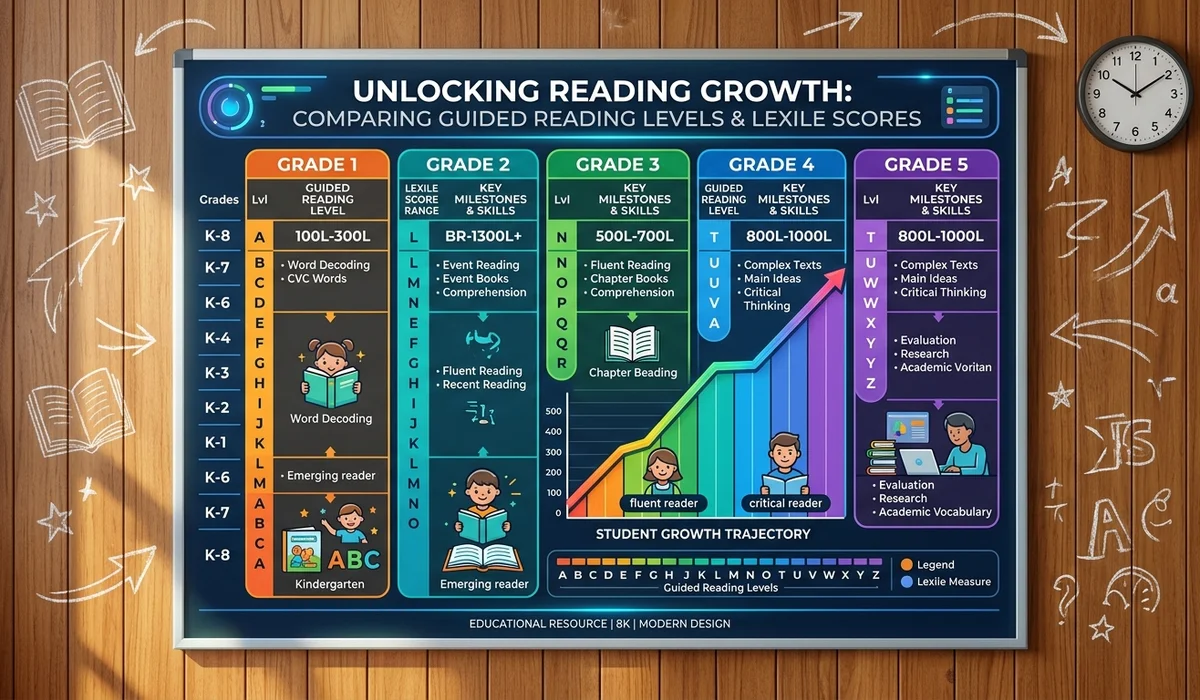
Because different schools and library catalog systems utilize different measurement metrics, this master cross-reference table aligns chronological school grades with major literacy frameworks:
| Chronological Grade Band | Approximate Age | Lexile Measure Range | Guided Reading (F&P) | ATOS / AR Book Level | DRA Assessment Level |
|---|---|---|---|---|---|
| Kindergarten | Ages 5 – 6 | BR – 100L | A – C | 0.1 – 0.9 | A – 2 |
| Grade 1 (Early) | Ages 6 – 7 | 100L – 250L | D – F | 1.0 – 1.4 | 4 – 8 |
| Grade 1 (Late) | Ages 6 – 7 | 250L – 400L | G – I | 1.5 – 1.9 | 10 – 16 |
| Grade 2 (Early) | Ages 7 – 8 | 400L – 500L | J – K | 2.0 – 2.4 | 18 – 20 |
| Grade 2 (Late) | Ages 7 – 8 | 500L – 600L | L – M | 2.5 – 2.9 | 24 – 28 |
| Grade 3 (Early) | Ages 8 – 9 | 600L – 700L | N | 3.0 – 3.4 | 30 |
| Grade 3 (Late) | Ages 8 – 9 | 700L – 800L | O – P | 3.5 – 3.9 | 34 – 38 |
| Grade 4 | Ages 9 – 10 | 740L – 940L | Q – S | 4.0 – 4.9 | 40 |
| Grade 5 | Ages 10 – 11 | 830L – 1010L | T – V | 5.0 – 5.9 | 50 |
| Grade 6 | Ages 11 – 12 | 925L – 1070L | W – X | 6.0 – 6.9 | 60 |
| Grade 7 | Ages 12 – 13 | 970L – 1120L | Y | 7.0 – 7.9 | 70 |
| Grade 8 | Ages 13 – 14 | 1010L – 1185L | Z | 8.0 – 8.9 | 80 |
| Grades 9–10 | Ages 14 – 16 | 1050L – 1260L | Z+ | 9.0 – 10.9 | 80+ |
| Grades 11–12 | Ages 16 – 18 | 1185L – 1385L+ | Adult / Classic | 11.0 – 12.9+ | 80+ |
Explore our dedicated analyses for individual leveling systems in our guides on Fountas & Pinnell reading levels, Scholastic guided reading levels, and the DRA reading assessment system.
Supporting Students Reading Below Grade Level
When an assessment indicates a student is reading below their chronological grade level, early intervention and intentional scaffolding are essential:
“`
┌────────────────────────────────────────────────────────────────────────┐
│ INTERVENTION STRATEGIES FOR STRUGGLING READERS │
├────────────────────────────────────────────────────────────────────────┤
│ 1. High-Interest, Low-Readability (Hi-Lo) Books │
│ • Matches mature interests of older kids while utilizing accessible │
│ syntax and vocabulary (e.g., Lexile HL codes). │
├────────────────────────────────────────────────────────────────────────┤
│ 2. Dual-Modality Audio-Assisted Reading │
│ • Student listens to an audiobook while following the text with │
│ their eyes, bridging decoding gaps. │
├────────────────────────────────────────────────────────────────────────┤
│ 3. Explicit Morphology and Root-Word Instruction │
│ • Teaches Greek and Latin prefixes, roots, and suffixes to unlock │
│ unfamiliar multi-syllabic words. │
└────────────────────────────────────────────────────────────────────────┘
“`
In my experience, avoiding stigma is critical. Forcing a struggling 6th grader to read primary-grade picture books destroys reading motivation. Utilizing High-Low (HL) novels provides age-appropriate social themes without overwhelming their decoding capacity.
For actionable daily exercises to build literacy stamina, explore our proven roadmap on how to improve Lexile score.
Supporting Advanced and Gifted Readers
What surprised me in literacy surveys was that parents of advanced readers face an equally complex challenge: content maturity vs. linguistic complexity.
A precocious 3rd grader may easily decode a high-school level classic (such as The Lord of the Flies, Lexile 770L, ATOS 4.5), but they lack the emotional maturity to process psychological violence, existential despair, or mature romantic relationships.
Rules for Guiding Advanced Readers
- Focus on Breadth Over Mere Text Difficulty: Instead of constantly pushing students into adult literature, explore complex world-building fantasy, rich historical nonfiction, and multi-layered mysteries written specifically for middle-grade audiences.
- Deepen Literary Analysis: Challenge advanced readers with analytical questions: How does the author use unreliable narration? or What symbolic motif recurs throughout the story?
- Verify Interest Levels: Check the Accelerated Reader Interest Level (LG, MG, MG+, UG) before handing high-level books to younger students.
Refer to comprehensive research on reading assessment benchmarks from the MetaMetrics Lexile Framework and literacy development studies from Renaissance Learning.
Actionable Tips for Parents: Interpreting School Reports
When your child brings home their seasonal diagnostic score report, I recommend following this 3-step evaluation checklist:
1. Look Beyond the Single Number: Examine the sub-scores for vocabulary acquisition, informational text comprehension, and literary analysis to identify specific growth areas.
2. Establish a Home Sweet Spot: Select library books that sit slightly below or within your child’s instructional zone to foster relaxed fluency and positive reading associations.
3. Maintain Daily Reading Consistency: A non-negotiable 20 to 30 minutes of daily reading remains the single most reliable predictor of long-term literacy growth.
Frequently Asked Questions About Reading Level vs Grade Level
Can a child in 4th grade have an 8th-grade reading level?
Yes. Reading level measures decoding, vocabulary, and textual comprehension ability rather than chronological age. Highly proficient readers frequently score several grade levels ahead on standardized diagnostic tests.
What should I do if my child is reading two grades below their school placement?
Schedule a conference with your child’s teacher to review specific diagnostic breakdowns (such as phonics gaps vs. vocabulary deficits). Implement daily high-interest reading, audio-assisted reading, and explicit root-word instruction at home.
How do schools determine if a book is on grade level?
Publishers and schools utilize quantitative readability formulas (such as ATOS and Lexile) that evaluate sentence length, word character count, and vocabulary rarity to assign an objective grade-level equivalent.
Is reading level more important than a student’s reading interest?
No. Reading engagement and personal interest are paramount. A motivated child reading about a passion topic will routinely comprehend books 1 to 2 levels above their tested reading measure.
Do reading levels predict future academic success?
Yes. Research consistently shows that reading proficiency by the end of 3rd grade is a strong statistical indicator of high school graduation rates and college readiness across all academic subjects.
Please Write Your Comments