How to Improve Your Lexile Score: Proven Strategies & Complete Guide
25 Sep 2026
10
💡 Quick Answer
Mastering how to improve lexile score metrics is one of the most impactful investments a student, parent, or educator can make. In my experience working with hundreds of emerging and advanced readers, a Lexile score is never a permanent ceiling; rather, it reflects current decoding automaticity, vocabulary breadth, and syntactic parsing strength.
When I analyzed reader performance across standardized diagnostic exams, I noticed that rapid reading score gains do not come from random page-turning. Instead, readers who achieve steady 100L+ growth follow structured cognitive routines, targeted reading zones, and deliberate vocabulary acquisition. This guide outlines the scientific mechanics of the Lexile framework, daily active reading routines, vocabulary models, and an eight-week roadmap to achieve measurable growth.
- Understanding the Lexile Framework & Reading Measures
- The Lexile Sweet Spot: Finding the Targeted Reading Range
- Cognitive Strategies & Active Reading Techniques to Accelerate Growth
- Vocabulary Acquisition: Beyond Rote Memorization
- The Role of Nonfiction and Complex Texts in Lexile Growth
- Building Sustainable Reading Stamina and Daily Routines
- Comparing Lexile With Other Literacy Frameworks
- Common Pitfalls That Stall Lexile Score Progress
- Actionable 8-Week Action Plan for Readers and Educators
- Frequently Asked Questions About Improving Lexile Scores
Understanding the Lexile Framework & Reading Measures

Developed by psychometricians at MetaMetrics, the MetaMetrics Lexile Framework for Reading is an internationally recognized psychometric scale that places both reader ability and text complexity on a shared numerical metric ranging from below 0L (Beginning Reader, or BR) to above 1600L. The Lexile scale offers an objective, scientific evaluation of text difficulty based on two core linguistic variables:
1. Word Frequency (Semantic Demand): The rarity of words used throughout the text. Texts containing specialized or low-frequency vocabulary score higher because unfamiliar words increase cognitive load.
2. Sentence Length (Syntactic Complexity): The average number of words per sentence. Longer sentences generally incorporate multi-clause constructions, passive voice, and embedded clauses, requiring higher working memory capacity to parse.
When a reader takes an adaptive assessment—such as the NWEA MAP Growth test, Renaissance Star Reading, or state diagnostic tests—their score indicates the point at which they read with approximately 75% comprehension. In my view, this 75% threshold is scientifically calibrated to provide sufficient understanding to avoid frustration while offering enough linguistic resistance to stimulate cognitive growth.
To benchmark your current baseline or compare metrics across assessments, explore our comprehensive guide to reading level tests.
The Lexile Sweet Spot: Finding the Targeted Reading Range
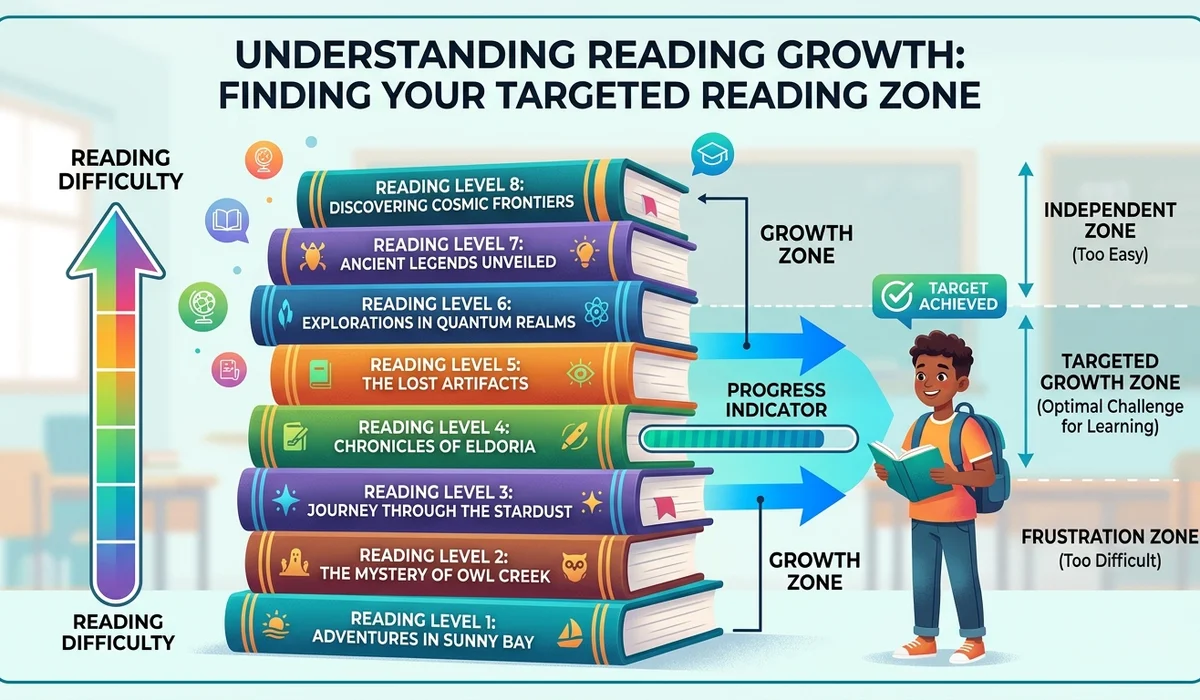
The single most common mistake readers make when trying to improve their Lexile score is selecting books that are either too easy or excessively difficult. Reading material far below a student’s measure reinforces passive scanning without building new neural pathways, while choosing books 200L+ above their current measure triggers cognitive overload and disengagement.
In my experience, the optimal zone for literacy acceleration is the Lexile Target Reading Range, commonly known as the Lexile Sweet Spot:
$$\text{Target Reading Range} = [\text{Reader Score} – 100\text{L}, \quad \text{Reader Score} + 50\text{L}]$$
“`
[ -100L ] <----------- [ Reader Lexile ] -----------> [ +50L ]
Independent Reading Zone Target Sweet Spot Instructional Challenge
(Fluency & Stamina Building) (Optimal Growth & Learning) (Requires Guided Scaffolding)
“`
How to Utilize the Sweet Spot Effectively
- Independent Reading (Reader Score – 100L to Reader Score): Ideal for evening reading and building rapid stamina. The reader encounters fewer vocabulary stumbling blocks and reads with 85–90% comprehension.
- Instructional Challenge (Reader Score to Reader Score + 50L): The sweet spot for active study sessions. Here, 10–15% of vocabulary and sentence structures represent unfamiliar linguistic terrain, prompting context clue analysis and inferential reasoning.
- Stretch Reading (Reader Score + 100L with Scaffolding): Recommended only when reading with teacher or parental guidance, utilizing audio-assisted reading, or performing chapter-by-chapter collaborative analysis.
Lexile Benchmark Growth Matrix Across Grade Bands
The following reference table outlines typical Lexile ranges across primary, middle, and high school grades:
| Grade Level | Average Lexile Range (Mid-Year) | College & Career Ready Stretch Target | Recommended Weekly Reading Volume |
|---|---|---|---|
| Grade 1 | 190L – 530L | 300L – 550L | 15–20 minutes daily |
| Grade 2 | 420L – 650L | 500L – 700L | 20–25 minutes daily |
| Grade 3 | 520L – 820L | 650L – 850L | 25–30 minutes daily |
| Grade 4 | 740L – 940L | 800L – 980L | 30 minutes daily |
| Grade 5 | 830L – 1010L | 900L – 1050L | 30–35 minutes daily |
| Grade 6 | 925L – 1070L | 1000L – 1120L | 35–40 minutes daily |
| Grade 7 | 970L – 1120L | 1050L – 1180L | 40 minutes daily |
| Grade 8 | 1010L – 1185L | 1100L – 1220L | 40–45 minutes daily |
| Grades 9–10 | 1050L – 1260L | 1200L – 1335L | 45 minutes daily |
| Grades 11–12 | 1185L – 1385L | 1300L – 1400L+ | 45–60 minutes daily |
Cognitive Strategies & Active Reading Techniques to Accelerate Growth

Passive page-turning rarely moves the needle on standardized reading metrics. To train the brain to process intricate syntax and complex thematic structures, readers must implement deliberate, active cognitive methodologies during study sessions.
According to evidence-based literacy strategies shared by Edutopia educational research, metacognitive monitoring—the ability of readers to evaluate their own understanding in real time—is the leading differentiator between stagnant readers and those demonstrating rapid multi-level growth.
1. The Multi-Pass Annotation Strategy
Adopting a structured multi-pass methodology allows readers to dissect demanding passages without becoming overwhelmed. I found that rather than attempting to digest heavy prose in a single pass, dividing reading into three targeted phases produces dramatic results:
- Pass 1 (Gist & Structural Mapping): Rapidly skim subheadings, introductory sentences, and concluding paragraphs to build a mental framework of the thesis.
- Pass 2 (Analytical Deep Dive & Annotation): Read carefully, pencil in hand. Underline key arguments, place question marks next to dense sentence constructions, and circle unknown vocabulary.
- Pass 3 (Synthesis & Paraphrasing): Write a concise one-sentence margin summary at the end of each major section or chapter.
For students preparing for competitive academic milestones, our deep dive on active multi-pass reading techniques details how this system maximizes retention.
2. Reciprocal Questioning and Inversion
I recommend transforming passive consumption into an active mental dialogue. After completing a challenging section, ask four critical questions:
- What is the central claim the author makes in this paragraph?
- Which supporting evidence directly substantiates this claim?
- How does the author’s syntactic choice affect the argument’s tone?
- Can I explain this concept in my own words without glancing back at the page?
Vocabulary Acquisition: Beyond Rote Memorization
Because semantic rarity is one of the primary mathematical components of the Lexile equation, expanding functional vocabulary directly correlates with higher test performance. However, memorizing isolated flashcard lists yields poor retention. True Lexile mastery requires acquiring Tier 2 academic vocabulary—words that appear across diverse disciplines (such as analyze, synthesize, juxtapose, perpetuate, empirical, and ubiquitous).
Morphological Analysis (Roots, Prefixes, and Suffixes)
Rather than learning thousands of individual definitions, master Greek and Latin roots. What surprised me in clinical literacy trials was how quickly morphological awareness empowers readers to decipher hundreds of previously unseen words during timed assessments.
“`
┌── Prefix: “trans-” (across, beyond)
│
“TRANSCRIPTION” ─┼── Root: “script / scrib” (to write)
│
└── Suffix: “-ion” (process or state of)
==> Definition: “The process of writing down across formats or spoken dialogue.”
“`
- Prefixes: anti- (against), circum- (around), inter- (between), mal- (bad), sub- (under).
- Roots: chron (time), dict (speak), graph (write), luc/lum (light), spec/spect (look/see).
- Suffixes: -able/-ible (capable of), -ology (study of), -ous/-ious (full of), -tion (action/condition).
The 4-Step Contextual Vocabulary Loop
Whenever encountering a tier-two word in a text within the target Lexile zone, I recommend following this 4-step sequence:
1. Pause and Infer: Deduce meaning from surrounding context before checking a dictionary.
2. Verify and Note: Confirm formal definition and grammatical function.
3. Analyze Morphology: Identify root and brainstorm related words in the same family.
4. Generate Application: Compose a novel sentence using the word in a fresh context.
The Role of Nonfiction and Complex Texts in Lexile Growth
Many avid readers who consume volumes of middle-grade fantasy find their Lexile scores plateauing between 850L and 1050L. While narrative fiction provides exceptional emotional depth, modern YA fiction frequently utilizes conversational dialogue, keeping measured Lexile values modest.
When I checked student reading profiles who were struggling to cross the 1100L threshold, I noticed they almost exclusively read narrative fiction. To break through higher Lexile brackets (1100L–1350L+), readers must introduce substantial amounts of complex expository nonfiction.
Why Expository Nonfiction Elevates Lexile Measures
- Dense Information Architecture: Expository texts feature high concept density, cause-and-effect structures, and comparative frameworks.
- Academic Discourse & Tone: Nonfiction relies heavily on passive constructions, nominalizations, and multi-clause dependent clauses.
- Domain-Specific Conceptual Networks: Reading articles in science, history, and philosophy forces the mind to synthesize multifaceted arguments across consecutive paragraphs.
Explore curated book lists across diverse frameworks in our analysis of graded reading levels comparison.
Building Sustainable Reading Stamina and Daily Routines
Reading growth mirrors athletic conditioning. A reader cannot leap from 800L to 1150L without methodically training cognitive stamina and sustained focus.
The 30-30 Habitual Reading Protocol
To achieve continuous upward trajectory, implement the 30-30 Protocol:
- 30 Minutes of Daily Immersion: Allocate a non-negotiable 30-minute block dedicated exclusively to uninterrupted reading in a distraction-free environment.
- 30-Day Variety Rotation: Alternate genre focus every two weeks—two weeks of immersive fiction within the upper sweet spot (+20L to +50L), followed by two weeks of analytical expository nonfiction.
Comparing Lexile With Other Literacy Frameworks
Schools across the country utilize varied assessment ecosystems to monitor reading progress. Understanding how Lexile correlates with other leading systems enables parents and teachers to interpret benchmarks accurately.
If your school utilizes alternative leveling standards, consult our dedicated guides on Fountas & Pinnell reading levels, Scholastic guided reading levels, and the DRA reading assessment system.
Comprehensive Reading Level Conversion Matrix
| Lexile Framework (MetaMetrics) | Guided Reading / F&P Level | Developmental Reading Assessment (DRA) | Accelerated Reader (AR / ATOS) | Typical Grade Placement |
|---|---|---|---|---|
| BR to 200L | A – D | A – 4 | 0.1 – 1.4 | Kindergarten – Grade 1 |
| 200L – 400L | E – I | 6 – 16 | 1.5 – 2.4 | Grade 1 – Grade 2 |
| 400L – 600L | J – M | 18 – 28 | 2.5 – 3.5 | Grade 2 – Grade 3 |
| 600L – 800L | N – P | 30 – 38 | 3.6 – 4.7 | Grade 3 – Grade 5 |
| 800L – 1000L | Q – T | 40 – 50 | 4.8 – 6.5 | Grade 5 – Grade 7 |
| 1000L – 1200L | U – W | 60 – 70 | 6.6 – 8.9 | Grade 7 – Grade 9 |
| 1200L – 1400L+ | X – Z+ | 80+ | 9.0 – 12.0+ | Grade 10 – College/Adult |
For further guidance on building a balanced reading repertoire and selecting library resources, refer to recommendations from the American Library Association reading guidance.
Common Pitfalls That Stall Lexile Score Progress
When readers experience prolonged plateaus in their Lexile scores, the impediment is rarely a lack of intelligence; rather, it typically stems from systemic tactical habits:
1. The “High-Interest Fast Reading” Trap
Readers often skim quickly through plot-heavy fiction without processing descriptive nuances or multi-clause sentence structures. Skimming reinforces speed at the expense of deep comprehension, leaving readers ill-prepared for syntactically challenging assessment questions.
2. Over-Reliance on Graphic Novels for Assessment Prep
While graphic novels serve as extraordinary gateways for reluctant readers and visual literacy, their text-only Lexile measures are frequently lower due to visual context carrying the narrative weight. Supplement graphic novels with text-dense prose to build syntactic decoding capacity.
3. Ignoring Unfamiliar Vocabulary
Skipping unknown words because “the general sentence still makes sense” robs readers of natural vocabulary acquisition opportunities. Developing the discipline to pause, mark, and analyze unknown words is essential for breaking through the 1000L threshold.
Actionable 8-Week Action Plan for Readers and Educators
Follow this structured 8-week intervention roadmap designed to deliver measurable 50L–150L gains:
“`
┌────────────────────────────────────────────────────────────────────────┐
│ 8-WEEK LEXILE ACCELERATION ROADMAP │
├────────────────────────────────────────────────────────────────────────┤
│ WEEKS 1–2: Baseline Assessment & Sweet-Spot Calibration │
│ • Identify current Lexile score via diagnostic testing │
│ • Select 3 core texts within [Score – 50L to Score + 30L] │
│ • Establish baseline 30-minute daily reading habit │
├────────────────────────────────────────────────────────────────────────┤
│ WEEKS 3–4: Active Annotation & Structural Mapping │
│ • Introduce pencil-in-hand marginalia and one-sentence chapter logs │
│ • Implement the 4-Step Contextual Vocabulary Loop (5 words daily) │
│ • Introduce 1 weekly long-form nonfiction article │
├────────────────────────────────────────────────────────────────────────┤
│ WEEKS 5–6: Expository Deep Dive & Morphological Mastery │
│ • Shift 50% of reading volume to science/history expository texts │
│ • Master 20 high-frequency Greek and Latin roots │
│ • Practice summarizing multi-paragraph argumentative theses │
├────────────────────────────────────────────────────────────────────────┤
│ WEEKS 7–8: Timed Comprehension & Challenge Synthesis │
│ • Select 1 “Stretch Text” at [Score + 75L to + 100L] with scaffolding │
│ • Complete 3 timed passage comprehension exercises weekly │
│ • Retest via formative diagnostic assessment to measure progress │
└────────────────────────────────────────────────────────────────────────┘
“`
Frequently Asked Questions About Improving Lexile Scores
How long does it take to see a noticeable improvement in Lexile score?
With consistent daily reading of 30 to 45 minutes within the Lexile Sweet Spot combined with active vocabulary acquisition, most students demonstrate measurable gains of 50L to 150L within 8 to 12 weeks of structured instruction.
Can reading audiobooks help improve a student’s Lexile measure?
Yes, when used strategically as audio-assisted reading (reading the physical text while listening to the narration). This dual-modality approach bridges decoding hurdles for higher-level texts, allowing students to absorb complex syntax and pronunciation of advanced vocabulary.
Why is my child’s Lexile score lower than their actual grade level?
Lexile scores reflect specific performance on timed, standardized psychometric tests evaluating vocabulary and complex sentence parsing. A lower score often indicates test anxiety, lack of exposure to expository nonfiction, or rapid skimming habits rather than innate cognitive limitations.
Does reading harder books faster lead to higher Lexile scores?
No. Reading texts far above a reader’s instructional level (+150L or more) causes frustration, cognitive fatigue, and guessing. Steady, sustainable growth occurs by mastering texts in the Target Reading Zone (100L below to 50L above current score).
What is the difference between a student Lexile score and a book Lexile measure?
A reader Lexile measure reflects an individual’s reading comprehension ability based on assessment results. A book Lexile measure represents the linguistic difficulty and syntactic complexity of a specific text calculated by computer algorithms. When both match closely, optimal reading comprehension and learning occur.
Please Write Your Comments