Harry Potter Books in Order — Complete Series Reading Guide (All Books + Companions)
29 May 2026
464
The Harry Potter series has sold over 600 million copies in 85 languages — but the reading order is simpler than the fandom makes it sound. Seven books, published in sequence, read in sequence. The debate is not about order; it is about when a child is ready for each book, and how sharply the series darkens between book three and book four.
The 7 Main Harry Potter Books in Publication (Reading) Order
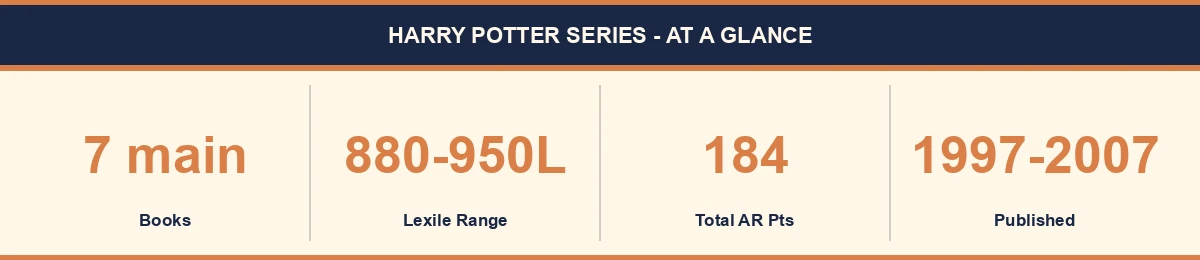
The Harry Potter series by J.K. Rowling has 7 main books. Read them in publication order — starting with Harry Potter and the Philosopher’s Stone (1997) through Harry Potter and the Deathly Hallows (2007). Companion books and Cursed Child can follow after book seven. All 7 books are appropriate for ages 8–17, with reading levels, page counts, and themes rising meaningfully from book to book.
The complete reading order is the publication order — and unlike some long fantasy series, there is no debate here. J.K. Rowling built the plot so that each book picks up where the last left off, with foreshadowing planted in book one that doesn’t pay off until book six. Starting anywhere but Philosopher’s Stone (or its American edition, Sorcerer’s Stone) means missing the setup that makes the later payoffs land. The series was published by Bloomsbury (UK) and Scholastic (US) between 1997 and 2007.
| # | Title | Year | Lexile | AR Level | AR Points | Pages (US) | Age |
|---|---|---|---|---|---|---|---|
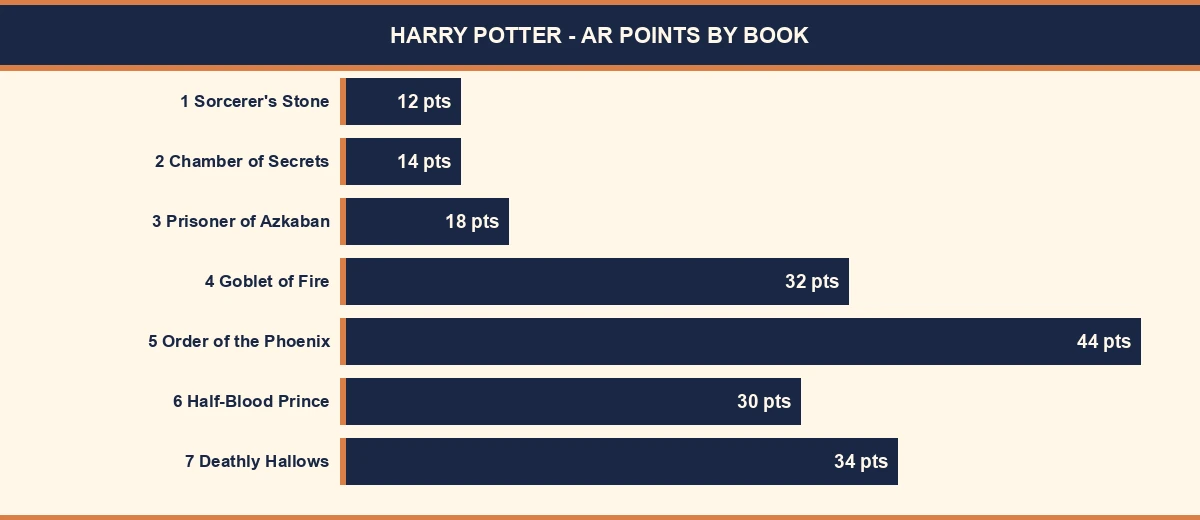
| 1 | Harry Potter and the Sorcerer’s Stone | 1997 | 880L | 5.5 | 12 | 309 | 8–10 |
| 2 | Harry Potter and the Chamber of Secrets | 1998 | 940L | 6.7 | 14 | 341 | 8–11 |
| 3 | Harry Potter and the Prisoner of Azkaban | 1999 | 880L | 6.7 | 18 | 435 | 9–11 |
| 4 | Harry Potter and the Goblet of Fire | 2000 | 880L | 6.8 | 32 | 734 | 10–12 |
| 5 | Harry Potter and the Order of the Phoenix | 2003 | 950L | 7.2 | 44 | 870 | 11–13 |
| 6 | Harry Potter and the Half-Blood Prince | 2005 | 920L | 7.2 | 30 | 652 | 12–13 |
| 7 | Harry Potter and the Deathly Hallows | 2007 | 880L | 7.2 | 34 | 759 | 12–14 |
Series at a glance: 7 books | 1997–2007 | J.K. Rowling | Bloomsbury (UK) / Scholastic (US) | Lexile range: 880L–950L | AR level: 5.5–7.2 | Total AR points: 184 | Total pages (US editions): ~4,100
1. Harry Potter and the Philosopher’s Stone / Sorcerer’s Stone (1997)
Eleven-year-old Harry discovers he’s a wizard and enters Hogwarts School of Witchcraft and Wizardry for the first time. The tone is warm and wonder-filled — a boarding-school adventure with a mystery at its center. This is the entry point for every reader, full stop. Lexile 880L | AR Level 5.5 | AR Points 12 | Recommended Age 8–10.
2. Harry Potter and the Chamber of Secrets (1998)
A hidden chamber beneath Hogwarts has been opened, students are being petrified, and Harry keeps hearing a disembodied voice in the walls. Slightly darker in atmosphere than book one but structurally similar — still a contained Hogwarts mystery. Lexile 940L | AR Level 6.7 | AR Points 14 | Recommended Age 8–11.
3. Harry Potter and the Prisoner of Azkaban (1999)
A dangerous prisoner has escaped from the wizarding prison Azkaban and is believed to be hunting Harry. Rowling introduces time travel, moral ambiguity, and her best-constructed mystery plot in the series. Many readers — and many critics — consider this the finest book of the seven. Lexile 880L | AR Level 6.7 | AR Points 18 | Recommended Age 9–11.
4. Harry Potter and the Goblet of Fire (2000)
Harry is mysteriously entered into a dangerous magical tournament against older students from rival wizarding schools. This is the tonal pivot of the series — the book that opens with a murder and ends with one, and from which the story never returns to its early lightness. At 734 pages, it’s also the point where the series demands serious reading stamina. Lexile 880L | AR Level 6.8 | AR Points 32 | Recommended Age 10–12.
5. Harry Potter and the Order of the Phoenix (2003)
Voldemort has returned and the Ministry of Magic refuses to believe it, leaving Harry increasingly isolated. At 870 pages, this is the longest book in the series and the most emotionally demanding — Harry’s anger throughout is sometimes hard to read, but the story arc earns it. The AR point value of 44 makes this the single most valuable book in any school’s accelerated reading catalog. Lexile 950L | AR Level 7.2 | AR Points 44 | Recommended Age 11–13.
6. Harry Potter and the Half-Blood Prince (2005)
Voldemort’s past is revealed through a series of memories, as Harry and Dumbledore prepare for the final confrontation. The book functions as setup for book seven but contains some of the series’ best individual chapters — and one of its most shocking endings. Lexile 920L | AR Level 7.2 | AR Points 30 | Recommended Age 12–13.
7. Harry Potter and the Deathly Hallows (2007)
Harry, Ron, and Hermione go on the run, hunting for objects that will allow Voldemort to be destroyed. The series finale spends most of its running time away from Hogwarts — a deliberate structural choice that emphasizes how much the earlier books had relied on that setting as a safe harbor. Lexile 880L | AR Level 7.2 | AR Points 34 | Recommended Age 12–14.
For a full per-book breakdown of reading systems — including Fountas & Pinnell and grade-level equivalents — see our Harry Potter reading level by book guide. Total AR points across all seven books: 184 points.
Should You Read Harry Potter in Order?
Yes — and the reason is structural, not just conventional. Rowling embedded foreshadowing in book one that resolves in book six. Details that read as background color in the early books (a name in passing, an unexplained behavior, an odd item in a shop window) are later revealed to be load-bearing. Reading out of order doesn’t break the plot, but it does rob you of the setup that makes the later reveals feel earned.
Can you start at Book 3 or 4? Technically, yes — both books have enough context that an out-of-order reader can follow the plot. Practically, no. Characters who die in books four through seven carry far more weight if you’ve watched them grow since book one. Readers who jump in at Goblet of Fire often feel the emotional gut-punches land differently — not because they can’t process what happened, but because they haven’t spent enough time with the people it happened to.
What about re-reading as an adult? The series is built for it. Rowling left enough ambiguity in early installments that adult re-readers spot things that are functionally invisible on a first pass. Snape’s behavior in book one reads completely differently once you’ve finished book seven. The first three books in particular reward adult attention — what feels like charm for younger readers is also precision, and that precision only becomes visible in retrospect.
The one situation where order doesn’t matter: if your child is a strong but reluctant reader who bounced off book one and you think Prisoner of Azkaban might hook them. That’s a reasonable exception. But treat it as a bridge, not a starting point — go back to book one once they’re invested. For younger readers who need an easier on-ramp first, the Diary of a Wimpy Kid reading level guide can help find the right challenge level before tackling Rowling.
Harry Potter Companion Books and Spin-Offs
| Title | Type | Author | When to Read | Year |
|---|---|---|---|---|
| Fantastic Beasts and Where to Find Them | Companion / In-universe textbook | Newt Scamander (J.K. Rowling) | After Book 1 (anytime) | 2001 |
| Quidditch Through the Ages | Companion / In-universe textbook | Kennilworthy Whisp (J.K. Rowling) | After Book 1 (anytime) | 2001 |
| The Tales of Beedle the Bard | Companion / Story collection | J.K. Rowling | After Book 7 | 2008 |
| Harry Potter and the Cursed Child | Stage play script (8th story) | J.K. Rowling, Jack Thorne, John Tiffany | After Book 7 | 2016 |
| Hogwarts: An Incomplete and Unreliable Guide | Short story collection | J.K. Rowling | After Book 7 (optional) | 2016 |
| Short Stories from Hogwarts of Power, Politics and Pesky Poltergeists | Short story collection | J.K. Rowling | After Book 7 (optional) | 2016 |
| Short Stories from Hogwarts of Heroism, Hardship and Dangerous Hobbies | Short story collection | J.K. Rowling | After Book 7 (optional) | 2016 |
Fantastic Beasts and Where to Find Them (2001) — Originally published as a real in-universe textbook, this slim companion describes magical creatures from the wizarding world. Written under the pen name Newt Scamander, it reads as if it’s an actual school textbook Harry and Ron have scribbled in. Fine to read after book one — it adds texture without spoiling anything. Note: the film tie-in novelizations (2016–2022) of the Fantastic Beasts film franchise are separate products with different content.
Quidditch Through the Ages (2001) — A mock-history of the wizarding sport, also published as an in-universe document. Short, fun, and completely standalone. Both this and Fantastic Beasts were published for charity; proceeds went to Comic Relief.
The Tales of Beedle the Bard (2008) — A collection of wizarding fairy tales referenced directly in Deathly Hallows — one story is plot-critical in book seven. Read it after you’ve finished the main series; the references land much harder when you know what happened.
Harry Potter and the Cursed Child (2016) — The published script of the stage play, subtitled “the eighth story.” Set 19 years after the end of Deathly Hallows, it follows Harry’s son Albus at Hogwarts. Read only after finishing book seven — the script format is different from the novels, and fan reception has been divided. It’s canonical but not universally loved; approach it as a supplementary story rather than an eighth novel. No standard AR or Lexile data is widely cited for the play script format.
The Pottermore short story collections (2016) — Three e-book collections released via Pottermore (now Wizarding World), gathering previously published online writings by Rowling. Optional reading for fans who want additional backstory on characters and Hogwarts history. No essential plot content.
What Age Is Each Harry Potter Book For?
| # | Book | Recommended Age | Content Notes |
|---|---|---|---|
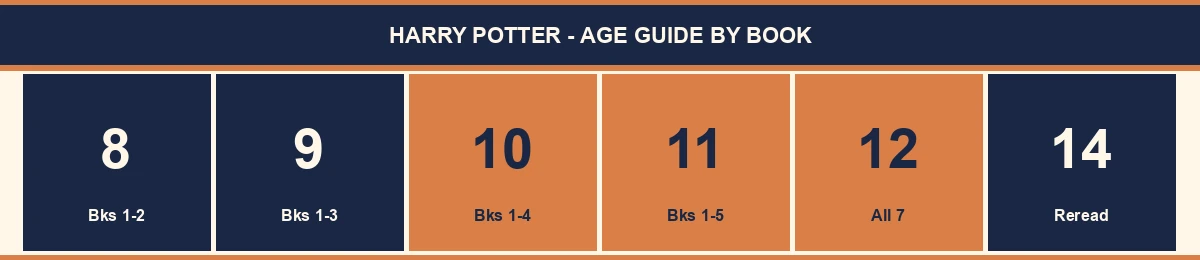
| 1 | Sorcerer’s Stone | 8–10 | Mild danger, no death of main characters, gentle horror (Voldemort’s face on Quirrell) |
| 2 | Chamber of Secrets | 8–11 | Petrification of students, giant spider sequence, Tom Riddle as villain |
| 3 | Prisoner of Azkaban | 9–11 | Dementors (despair/depression metaphor), themes of wrongful imprisonment |
| 4 | Goblet of Fire | 10–12 | Murder in first chapter, tournament danger, death of a Hogwarts student, Voldemort’s return |
| 5 | Order of the Phoenix | 11–13 | Sustained institutional gaslighting, significant character death, prolonged emotional distress |
| 6 | Half-Blood Prince | 12–13 | Death of major character, trauma, dark magic, teenage romance |
| 7 | Deathly Hallows | 12–14 | Multiple deaths of significant characters, war, torture, sacrifice |
The book 3→4 shift: Goblet of Fire opens with a murder and ends with a Hogwarts student’s death. The Lexile score (880L) does not reflect this content jump — books 3 and 4 have identical Lexile levels but very different emotional weight. Many families read books 1–3 aloud together, then reassess before book 4.
The series grows with the reader — Sorcerer’s Stone reads at a Grade 4 level and is thematically appropriate for most eight-year-olds. Deathly Hallows sits at Grade 7–8 on most reading scales and involves sustained themes of loss and death. The reading level shift is real but gradual; the content shift is steeper and faster.
The most important break point is between books three and four. Goblet of Fire opens with a murder, and a sympathetic teenage character dies at the climax. Many parents read books one through three aloud with younger children and then reassess — that’s a reasonable strategy. The Lexile numbers don’t flag this shift (both books three and four are 880L), which is why the content table above matters more than the reading level data for younger readers.
If your child reads ahead of grade level and wants to start early, books one through three are generally safe for ages seven and up. Books four through seven are better suited to ages ten and older, not because of vocabulary, but because the emotional weight requires some life experience to process fully.
For a broader view of where Harry Potter sits alongside other popular series, our Lexile level guide by grade maps the full K–12 reading landscape.
Harry Potter vs Similar Series: What to Read Next
| Series | Books | Age Range | Lexile Range | If You Liked HP Because… |
|---|---|---|---|---|
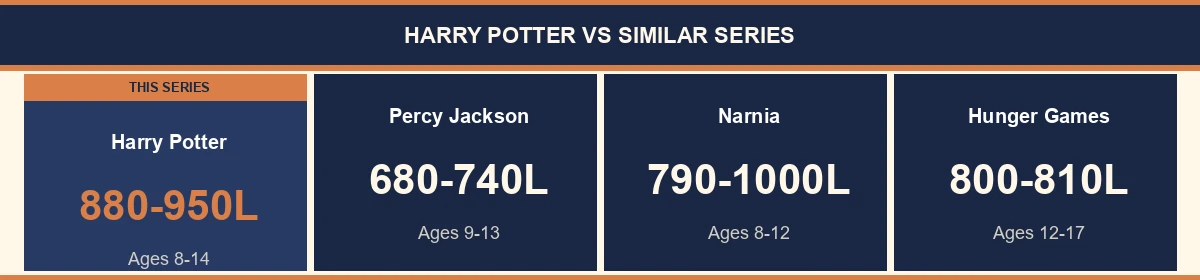
| Percy Jackson & the Olympians | 5 (main) + 2 sequels | 9–13 | 680L–740L | Fast-moving mythology, friendship trio, humor |
| The Chronicles of Narnia | 7 | 8–12 | 790L–1000L | British fantasy, moral depth, immersive world |
| The Hunger Games | 3 | 12–17 | 800L–810L | High stakes, dark turns, one protagonist carrying the story |
| Wings of Fire | 15+ (ongoing) | 8–12 | 740L–840L | Dragon-scale world-building, ensemble cast, series length |
| His Dark Materials | 3 | 12–16 | 930L–1000L | Complex themes, Oxbridge atmosphere, mature emotional depth |
Finished the series? Start here: Percy Jackson is the most common next step for HP fans who finished young (ages 9–11). His Dark Materials suits readers who finished older and want something with more philosophical weight. Both are available in most school libraries.
Percy Jackson reading level — Percy Jackson is the most natural next step for HP fans who finished the series younger and want something with similar energy at a slightly easier Lexile (680L–740L). The humor is different from Rowling’s but the friendship dynamics rhyme.
The Chronicles of Narnia reading level — C.S. Lewis predates Rowling and goes broader in world-scope. Narnia’s Lexile range (790L–1000L) means it skews both easier and harder than Harry Potter depending on the book. Good for readers who loved the British boarding-school texture of the early HP books.
Wings of Fire series — Tui T. Sutherland’s dragon series is the longest on this list (15+ books and still growing) and has become the dominant series for 8–12 readers who want something to disappear into the same way HP readers disappeared into Rowling’s world. The Lexile is a grade below Harry Potter — appropriate for slightly younger readers or as a bridge to HP.
The Hunger Games reading level — For HP readers who responded most to the later, darker books. The Hunger Games shares little with early Rowling but has the same tonal arc: it starts manageable and ends brutal. Age 12+ is the right floor.
Frequently Asked Questions
What order should I read the Harry Potter books in?
Read them in publication order: Sorcerer’s Stone (1997) → Chamber of Secrets (1998) → Prisoner of Azkaban (1999) → Goblet of Fire (2000) → Order of the Phoenix (2003) → Half-Blood Prince (2005) → Deathly Hallows (2007). Publication order is reading order — there are no prequels or interleaved companion books that need to be woven in before book seven.
How many Harry Potter books are there?
Seven main books, published between 1997 and 2007. Beyond those seven, J.K. Rowling has released several companion books (Fantastic Beasts and Where to Find Them, Quidditch Through the Ages, The Tales of Beedle the Bard), a stage play script (Harry Potter and the Cursed Child, sometimes called the “eighth story”), and three short Pottermore e-book collections. Total AR points across the main seven: 184.
What is the first Harry Potter book?
Harry Potter and the Philosopher’s Stone (Bloomsbury, UK, 1997) — published in the US as Harry Potter and the Sorcerer’s Stone (Scholastic, 1998). The content is identical except for the title change and a small number of vocabulary substitutions for American readers. Most reading-level databases list both editions under the same Lexile (880L) and AR data (AR 5.5, 12 points).
What reading level is Harry Potter?
The seven-book series spans Lexile 880L to 950L (some databases list Chamber of Secrets at 820L — verify before citing), or AR levels 5.5 to 7.2 — roughly grades 4 through 8. For a full per-book breakdown across Lexile, AR, Fountas & Pinnell, and grade level, see our Harry Potter reading level by book guide. If you’re new to reading systems, our guide to reading level measurement systems explains what each score means.
What age are Harry Potter books appropriate for?
Books 1–3: ages 8–11. Books 4–5: ages 10–13. Books 6–7: ages 12 and up. The reading levels themselves are appropriate for younger readers, but the content — particularly from Goblet of Fire onward — involves death, war, and sustained emotional darkness that works better with some maturity. Many families read books one through three together and then reassess.
Should I read Fantastic Beasts before or after the main series?
The original Fantastic Beasts and Where to Find Them companion book (2001) can be read anytime after Sorcerer’s Stone — it’s an in-universe textbook with no spoilers. The Fantastic Beasts film tie-in novelizations (separate books adapting the 2016–2022 films) are best read after the main series if you want full context, but aren’t required reading at all. The Tales of Beedle the Bard should wait until after Deathly Hallows, since one of its stories is directly plot-relevant.
Is there an 8th Harry Potter book?
Harry Potter and the Cursed Child (2016) is officially described as “the eighth story” by J.K. Rowling. It is a stage play script, not a novel, written by Jack Thorne based on a story by Rowling, Thorne, and director John Tiffany. Set 19 years after Deathly Hallows, it follows Harry’s son Albus Potter. Read it only after completing book seven.
Please Write Your Comments