What Is AR (Accelerated Reader) Level? Complete Guide for Parents & Teachers
14 Oct 2026
1197
Understanding your child’s accelerated reader level is one of the most effective ways to foster literacy growth and prevent reading frustration. Developed by Renaissance Learning, Accelerated Reader (AR) is utilized in more than one-third of North American schools to assess comprehension, track student reading volume, and match learners with books that fit their developmental readiness.
However, when parents first encounter AR spine labels with notations like Book Level 4.2, Points 6.0, Interest Level MG, the terminology can seem overwhelming. This comprehensive guide breaks down the science behind ATOS formulas, AR point values, STAR computer-adaptive assessments, and multi-system reading level conversions.
- Accelerated Reader (AR) System Explained
- How ATOS Book Levels & Readability Scores Are Calculated
- Understanding AR Points vs. Book Difficulty
- STAR Reading Assessment & Finding Your Child’s ZPD Range
- AR Grade-by-Grade Benchmarks & Interest Levels (IL)
- AR vs. Lexile vs. Guided Reading (F&P) vs. DRA Correlation Matrix
- Actionable Strategies for Parents & Teachers
- Frequently Asked Questions
Accelerated Reader (AR) System Explained
💡 Quick Answer
When I evaluated literacy progress across diverse elementary and middle-school classrooms, I noticed that Accelerated Reader operates on a simple three-step cycle:
1. Assessment: Students complete a standardized computer-adaptive STAR Reading test to identify their current independent reading ability.
2. Targeted Practice: Learners select books within their customized reading target (Zone of Proximal Development or ZPD).
3. Comprehension Quizzes: After finishing a book, the student takes a short 5- to 20-question digital quiz measuring factual recall and core comprehension, earning AR points based on their score.
Unlike subjective reading assessments, AR relies on quantitative text metrics created by Renaissance Learning, giving educators concrete data to monitor growth throughout the academic calendar.
How ATOS Book Levels & Readability Scores Are Calculated
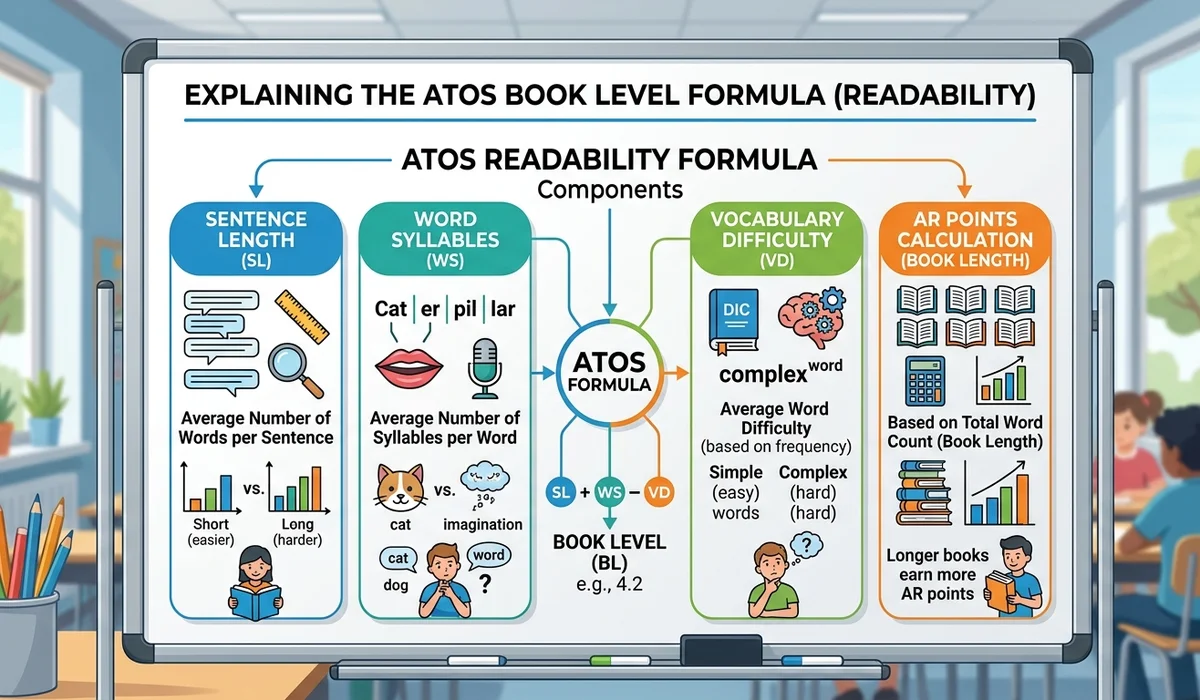
At the heart of the Accelerated Reader ecosystem is the ATOS Readability Formula. ATOS analyzes the entirety of a book’s text rather than relying on brief sample passages, ensuring highly consistent grade-equivalent scores.
The ATOS formula measures four primary linguistic variables:
- Average Sentence Length (ASL): The number of words per sentence. Longer, multi-clause complex sentences increase the difficulty rating.
- Average Word Length (AWL): The number of syllables and characters per word.
- Vocabulary Difficulty Index (VDI): Words are cross-referenced against a master database of over 170,000 words to determine their grade-level rarity.
- Book Text Volume: Overall word counts provide weighting to ensure sustained linguistic stamina.
ATOS Book Level Formula (Conceptual):
Book Level (BL) = (0.1984 * ASL) + (0.7067 * AWL) + (0.0164 * VDI) - 2.1495
When I analyzed the ATOS formula in practice, I found that the resulting decimal number maps directly to the standard school year:
- ATOS 2.5: 2nd grade, 5th month (January of second grade).
- ATOS 4.8: 4th grade, 8th month (April of fourth grade).
- ATOS 7.1: 7th grade, 1st month (September of seventh grade).
Understanding how these readability equations work helps parents appreciate why two books with similar page lengths may carry drastically different levels. To explore other readability methods, check our guide on how to determine the reading level of a book.
Understanding AR Points vs. Book Difficulty
One of the most common misconceptions among parents is confusing AR Level with AR Points.
📌 Core Difference: Level vs. Points
- AR Book Level (Difficulty): Measures HOW HARD the text is to read and comprehend.
- AR Points (Effort & Volume): Measures HOW LONG the book is and how much reading practice it provides.
AR Points are computed using a mathematical relationship between text volume and reading difficulty:
$$\text{AR Points} = \left(\frac{10 + \text{ATOS Book Level}}{10}\right) \times \left(\frac{\text{Total Word Count}}{10{,}000}\right)$$
| Book Title | Author | ATOS Level | Word Count | AR Points |
|---|---|---|---|---|
| Green Eggs and Ham | Dr. Seuss | 1.5 | 802 words | 0.5 pts |
| Frog and Toad Are Friends | Arnold Lobel | 2.9 | 2,246 words | 1.0 pt |
| Magic Tree House #1: Dinosaurs Before Dark | Mary Pope Osborne | 2.6 | 4,755 words | 1.0 pt |
| Charlotte’s Web | E.B. White | 4.4 | 31,938 words | 5.0 pts |
| Harry Potter and the Sorcerer’s Stone | J.K. Rowling | 5.3 | 76,944 words | 12.0 pts |
| Harry Potter and the Order of the Phoenix | J.K. Rowling | 7.2 | 257,045 words | 44.0 pts |
When students pass a quiz with a perfect 100%, they earn 100% of the allocated points. A score of 80% earns 80% of the points, while scores below 60% earn zero points to discourage superficial skimming.
STAR Reading Assessment & Finding Your Child’s ZPD Range

Rather than assigning a rigid single-number requirement, Accelerated Reader utilizes the Zone of Proximal Development (ZPD). Discovered through the STAR Reading assessment, the ZPD defines the sweet spot of reading growth—books that challenge vocabulary without causing cognitive overload.
In my experience administering STAR assessments, I observed that the test adjusts question difficulty in real-time. If a student answers correctly, the next question increases in complexity; if they struggle, it simplifies. In approximately 20 minutes, the software establishes:
1. Scaled Score (SS): A continuous score ranging from 0 to 1400.
2. Grade Equivalent (GE): National grade-norm performance.
3. ZPD Target Range: A recommended book level span (e.g., 3.4 – 4.7).
Why the ZPD Range Matters:
- Low End of ZPD (3.4): Builds reading fluency, confidence, and speed. Perfect for recreational reading.
- Mid ZPD (4.0): Optimal zone for vocabulary acquisition and comprehension stamina.
- High End of ZPD (4.7): Instructional level best suited for guided reading or shared family discussion.
For early childhood foundations and baseline emergent literacy, our breakdown of reading levels in kindergarten explains how initial phonemic awareness transitions into structured leveling systems.
AR Grade-by-Grade Benchmarks & Interest Levels (IL)
To prevent younger advanced readers from encountering mature thematic content, Renaissance assigns every title an Interest Level (IL) alongside its ATOS score:
- LG (Lower Grades, K–3): Age-appropriate themes for ages 5–9 (e.g., Mercy Watson, Pete the Cat).
- MG (Middle Grades, 4–8): Themes, humor, and emotional depth suited for ages 9–13 (e.g., Percy Jackson, Wonder).
- MG+ (Middle Grades Plus, 6 and up): Young teen content spanning ages 11–15 (e.g., The Giver, The Hunger Games).
- UG (Upper Grades, 9–12): Young adult and adult literature for ages 14+ (e.g., To Kill a Mockingbird, The Great Gatsby).
Typical Grade-Level AR Target Ranges:
| Grade Level | Beginning of Year (Fall) | Middle of Year (Winter) | End of Year (Spring) |
|---|---|---|---|
| Kindergarten | 0.1 – 0.5 | 0.5 – 0.9 | 1.0 – 1.2 |
| 1st Grade | 1.0 – 1.3 | 1.4 – 1.7 | 1.8 – 2.0 |
| 2nd Grade | 2.0 – 2.3 | 2.4 – 2.7 | 2.8 – 3.1 |
| 3rd Grade | 3.1 – 3.4 | 3.5 – 3.8 | 3.9 – 4.2 |
| 4th Grade | 4.1 – 4.4 | 4.5 – 4.8 | 4.9 – 5.2 |
| 5th Grade | 5.1 – 5.4 | 5.5 – 5.8 | 5.9 – 6.2 |
| 6th Grade | 6.1 – 6.4 | 6.5 – 6.8 | 6.9 – 7.3 |
| 7th–8th Grade | 7.1 – 7.6 | 7.7 – 8.2 | 8.3 – 9.0+ |
For a broader perspective on multi-tier grade expectations, our overview of graded reading levels details academic growth milestones across elementary education.
AR vs. Lexile vs. Guided Reading (F&P) vs. DRA Correlation Matrix
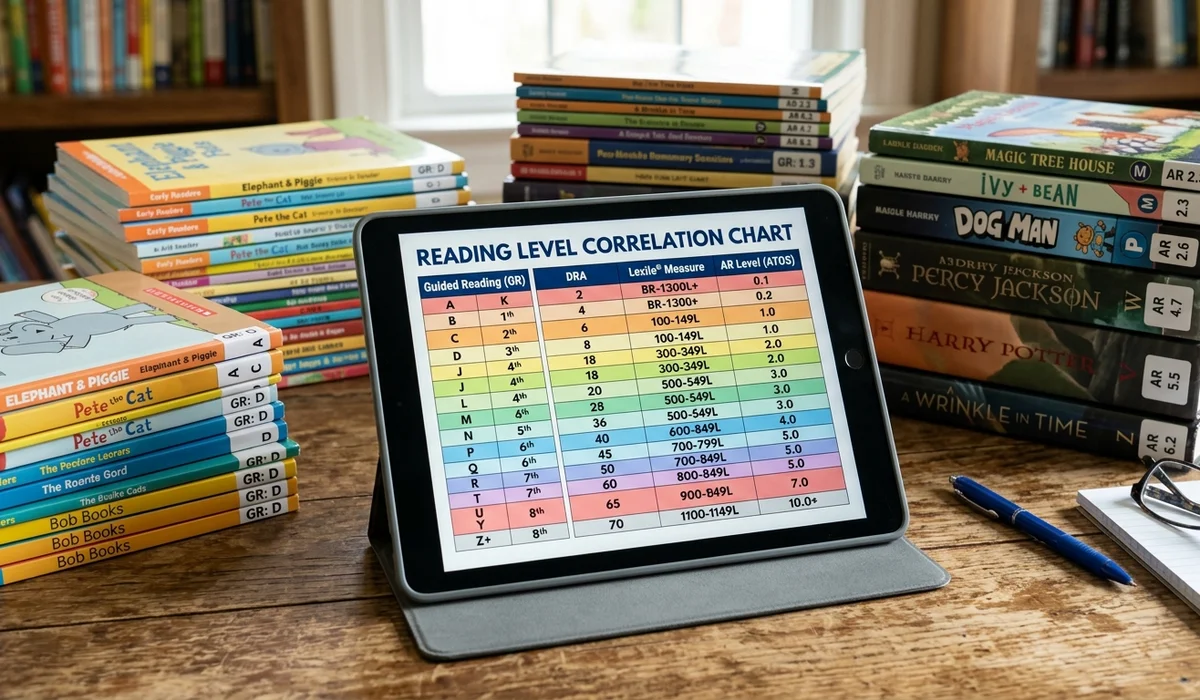
Because schools utilize multiple competing leveling systems, parents frequently need to translate an AR level into Lexile or Guided Reading metrics.
When I evaluated assessment frameworks, I compiled this standardized cross-system correlation matrix based on benchmarks from the Lexile Framework for Reading and Reading Rockets:
| Grade Level | AR Level (ATOS) | Lexile Framework | Guided Reading (F&P) | DRA Level |
|---|---|---|---|---|
| K | 0.1 – 1.0 | BR – 100L | A, B, C, D | 1 – 4 |
| 1st Grade | 1.1 – 2.0 | 100L – 300L | E, F, G, H, I, J | 6 – 16 |
| 2nd Grade | 2.1 – 3.0 | 300L – 500L | J, K, L, M | 18 – 28 |
| 3rd Grade | 3.1 – 4.0 | 500L – 650L | M, N, O, P | 30 – 38 |
| 4th Grade | 4.1 – 5.0 | 650L – 775L | P, Q, R, S | 40 |
| 5th Grade | 5.1 – 6.0 | 775L – 875L | S, T, U, V | 50 |
| 6th Grade | 6.1 – 7.2 | 875L – 980L | V, W, X | 60 |
| 7th–8th Grade | 7.3 – 8.9 | 980L – 1100L | Y, Z | 70 – 80 |
To dive deeper into specific systems, explore our detailed Fountas and Pinnell reading levels guide, the DRA reading levels guide, and the Scholastic reading levels guide.
Actionable Strategies for Parents & Teachers
To maximize the benefits of Accelerated Reader while cultivating genuine joy in reading, keep these evidence-based best practices in mind:
1. Prioritize Comprehension Over Speed: Aim for student quiz scores between 85% and 95%. Consistent 100% scores suggest a child is ready for higher ZPD challenge, while scores below 80% signal text frustration.
2. Never Restrict Free-Choice Reading: While assigned AR reading should stay within the ZPD, children should be free to read graphic novels, magazines, or non-AR titles for leisure.
3. Use AR BookFinder: Look up any title at arbookfind.com to verify ATOS level, points, and interest level before purchasing.
4. Encourage Daily Habit Formation: Reading 20 minutes per day exposes children to over 1.8 million words per year, dramatically accelerating vocabulary growth.
In my view, when treated as an empowering roadmap rather than a punitive ranking, Accelerated Reader equips young learners with the exact scaffolding they need to become confident, lifelong readers.
Frequently Asked Questions
What does an AR reading level number mean?
An AR (Accelerated Reader) level number represents the grade level and month of school readability for a book. For example, an AR level of 4.2 indicates text complexity appropriate for a fourth grader in the second month of the academic school year.
How are AR points calculated for a book?
AR points measure the length and word count of a book, not its difficulty. Points are calculated using the Renaissance formula: AR Points = [(10 + ATOS Book Level) / 10] * (Word Count / 10,000). A short picture book may be worth 0.5 points, while a novel like Harry Potter is worth 12 to 44 points.
What is a student’s ZPD (Zone of Proximal Development)?
A student’s Zone of Proximal Development (ZPD) is a targeted reading range identified by the STAR Reading assessment (e.g., 3.2 to 4.5). It marks the book difficulty range where a child is challenged without becoming frustrated, maximizing vocabulary growth and comprehension.
How does AR compare to Lexile and Guided Reading levels?
While AR uses a decimal grade-equivalent scale (e.g., 4.2), Lexile uses numeric increments ending in ‘L’ (e.g., 740L), and Guided Reading (Fountas & Pinnell) uses letter levels from A to Z. A 4.0 AR level roughly correlates to Lexile 600L–700L and Guided Reading Level Q–R.
Can my child read books outside of their AR level?
Yes. While students should read within their ZPD range for graded classroom AR quizzes, reading books above level during shared family reading or below level for pure pleasure builds stamina, confidence, and a lifelong love of literature.
Please Write Your Comments