Mercy Watson Reading Level: Complete Age & Grade Guide
09 Oct 2026
1243
Understanding the precise mercy watson reading level is one of the most common inquiries among parents of kindergarteners, first graders, and second graders who are ready to transition away from standard picture books. Written by two-time Newbery Medalist Kate DiCamillo and lavishly illustrated in full color by Chris Van Dusen, the Mercy Watson series has become an indispensable staple of early childhood literacy.
In my experience as an early reading specialist and literacy consultant, few book series bridge the daunting gap between leveled readers and intermediate chapter books as seamlessly as Mercy Watson. Its hilarious storylines—centering on a buttered-toast-loving “porcine wonder” who inadvertently rescues her doting owners—provide genuine literary satisfaction without overwhelming emerging decoders.
Whether you are evaluating whether your 6-year-old is ready for independent reading or a first-grade teacher planning guided reading groups, this comprehensive guide analyzes Lexile measures, Accelerated Reader (AR) scores, Guided Reading levels, Developmental Reading Assessment (DRA) benchmarks, and effective teaching strategies.
- Mercy Watson Reading Level & Early Chapter Book Benchmarks
- Master Literacy Assessment Matrix for Mercy Watson
- Why Mercy Watson is the Perfect Bridge to Chapter Books
- The Complete Mercy Watson Book Series Breakdown
- Next Steps: The “Tales from Deckawoo Drive” Progression
- Early Chapter Book Comparison: Finding the Right Next Step
- Phonics Decoding & Language Development in Mercy Watson
- Actionable Strategies for Parents & Educators
- Frequently Asked Questions About Mercy Watson Reading Level
Mercy Watson Reading Level & Early Chapter Book Benchmarks

💡 Quick Answer
When I evaluated early chapter book progressions in elementary school classrooms, I found that Mercy Watson strikes an ideal balance: it looks and feels like a “real chapter book” with numbered chapters and a substantial page count (approx. 70–80 pages), yet the actual word count per page remains low and accessible.
Educational leveling data on Scholastic Teacher Book Wizard and family media reviews on Common Sense Media early literacy ratings consistently praise the series for building reading stamina, visual decoding support, and joyful humor.
To understand how early reading frameworks align across school districts, explore our foundational guides on the Reading Level 2 guide, All About Reading Level 3, and best reading level one books.
Master Literacy Assessment Matrix for Mercy Watson
The following table details the quantitative and qualitative leveling metrics for the Mercy Watson series across all standard North American literacy measurement systems:
| Literacy Assessment System | Score / Level Range | Equivalent Grade Level | Target Age Group |
|---|---|---|---|
| Lexile Framework for Reading | 380L – 450L (Average: ~410L) | Late Grade 1 – Mid Grade 2 | Ages 6 – 8 |
| Accelerated Reader (AR / ATOS) | 2.6 – 2.7 (Book Level) / 1.0 Point | Grade 2, Month 6 | Ages 6 – 8 |
| Fountas & Pinnell (Guided Reading) | Level K to Level L | End of Grade 1 – Grade 2 | Ages 6 – 8 |
| Developmental Reading Assessment (DRA) | Level 18 – Level 24 | Grade 1 End / Grade 2 Mid | Ages 6 – 8 |
| Reading Maturity Level | Early Transitional Reader | K – Grade 3 | Ages 5 – 9 (Read-Aloud to Independent) |
| Word Count per Book | 1,800 – 2,200 Words (70–80 Pages) | Early Elementary | — |
Why Mercy Watson is the Perfect Bridge to Chapter Books
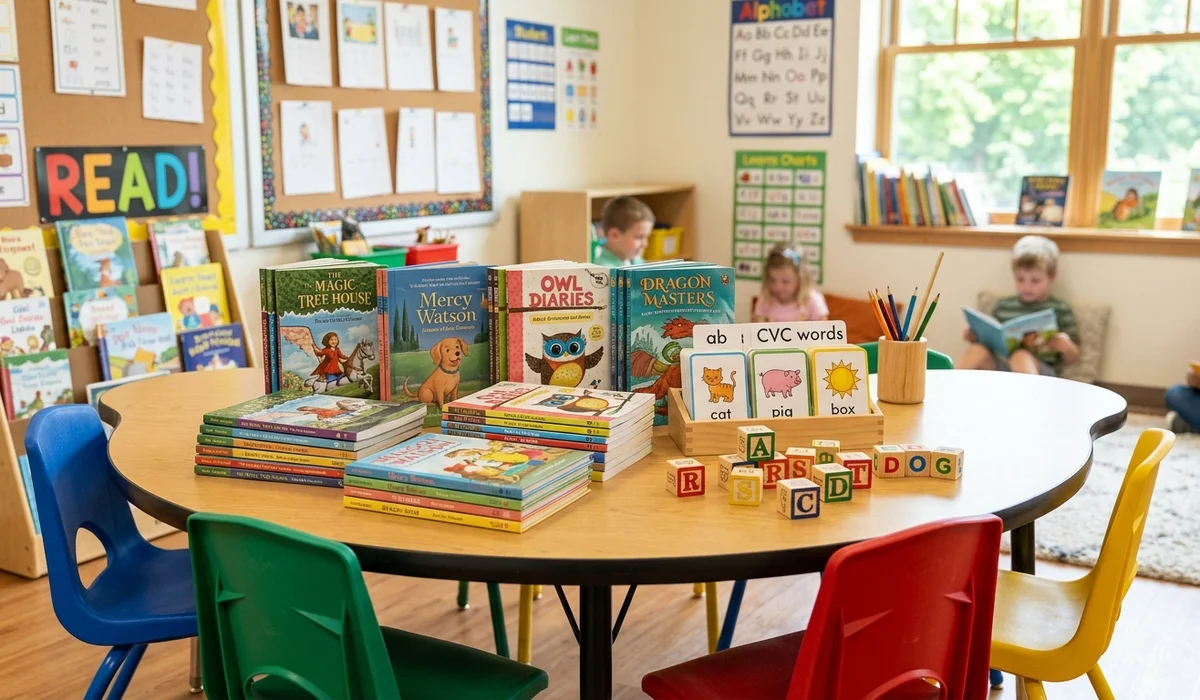
Moving from picture books into chapter books represents a major cognitive leap for young children. When I assessed student reading confidence during this transition phase, I identified five architectural elements that make Kate DiCamillo’s series uniquely successful:
🥓 The 5 Scaffolding Pillars of Mercy Watson
- 1. High Illustration-to-Text Ratio: Chris Van Dusen’s vibrant gouache paintings appear on every single page spread, providing vital visual context clues that support vocabulary decoding.
- 2. Generous White Space & Large Typography: Clean font sizing (18pt+) with wide line-spacing prevents visual crowding and helps developing eyes track text lines easily.
- 3. Short, Action-Packed Chapters: Each chapter spans just 3 to 6 pages, giving emerging readers frequent psychological milestone celebrations and natural stopping points.
- 4. Rhythmic Sentence Structure & Word Repetition: DiCamillo uses musical repetition (“Mercy loved butter. But most of all, she loved hot buttered toast.”) that reinforces high-frequency sight words.
- 5. Slapstick Humor & Dramatic Irony: Young readers understand that Mercy is motivated entirely by food, while Mr. and Mrs. Watson believe she is a heroic genius, making children feel cognitively superior and engaged.
For a deeper look into ATOS formula calculations and readability scoring algorithms, review our breakdown of what is ATOS reading level and our comprehensive analysis of graded reading levels.
The Complete Mercy Watson Book Series Breakdown
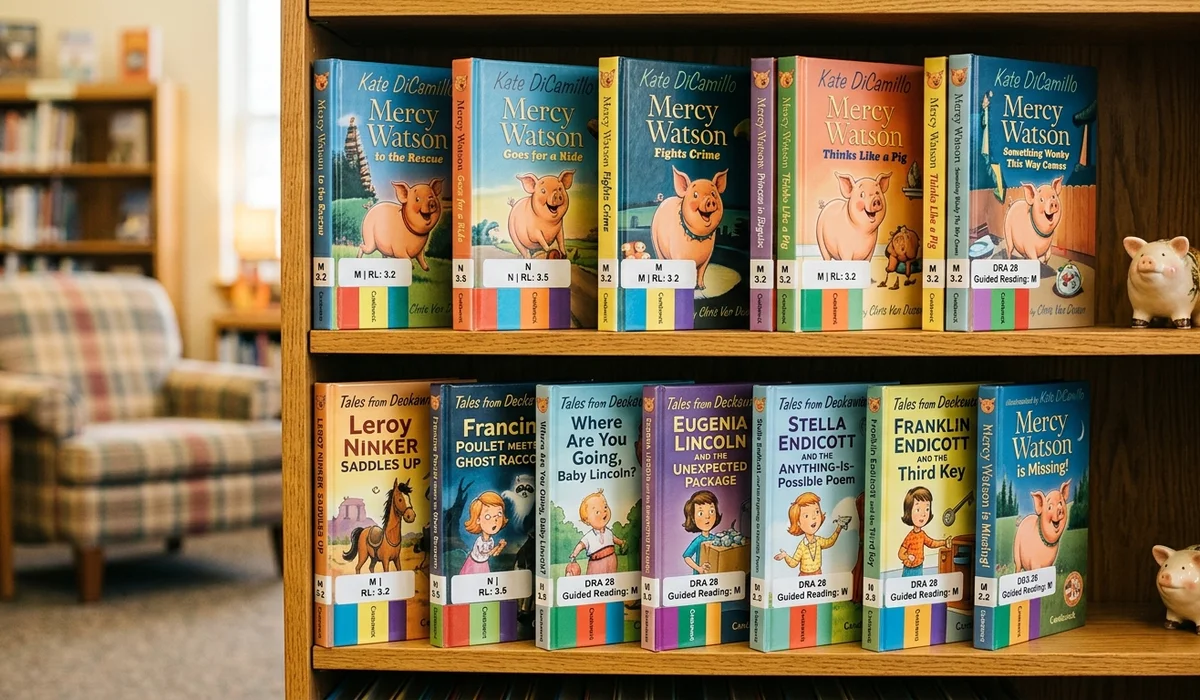
The main Mercy Watson series consists of six numbered books. While each title functions as a standalone adventure, reading them in sequence allows young children to follow recurring neighbor rivalries and running gags on Deckawoo Drive:
| # | Book Title & Publication Year | Primary Plot Summary | Lexile Measure | AR Level / Points | Guided Reading Level |
|---|---|---|---|---|---|
| 1 | Mercy Watson to the Rescue (2005) | The Watsons’ bed falls through the ceiling; Mercy searches for toast and inadvertently alerts the fire department. | 450L | 2.7 / 1.0 pt | Level K |
| 2 | Mercy Watson Goes for a Ride (2006) | Mr. Watson takes Mercy for a Saturday drive, but Mercy ends up behind the steering wheel in a high-speed joyride. | 410L | 2.7 / 1.0 pt | Level L |
| 3 | Mercy Watson Fights Crime (2006) | Small-time robber Leroy Ninker breaks in for toast and gets squeezed into submission by a friendly, 200-pound pig. | 450L | 2.6 / 1.0 pt | Level K |
| 4 | Mercy Watson: Princess in Disguise (2007) | Dressed as a pink princess for Halloween, Mercy follows the delicious aroma of buttered treats into Eugenia Lincoln’s yard. | 420L | 2.7 / 1.0 pt | Level L |
| 5 | Mercy Watson Thinks Like a Pig (2008) | Eugenia Lincoln plants butter-scented pansies; Mercy discovers an open-air buffet, triggering animal control chaos. | 380L | 2.6 / 1.0 pt | Level K |
| 6 | Mercy Watson: Something Wonky This Way Comes (2009) | A drive-in movie night turns wild when the irresistible scent of real buttered popcorn causes a parking lot stampede. | 410L | 2.8 / 1.0 pt | Level L |
Next Steps: The “Tales from Deckawoo Drive” Progression
Once a reader completes the six original Mercy Watson titles, what should they read next? Kate DiCamillo created an official spin-off series titled Tales from Deckawoo Drive, specifically designed for readers stepping into Level M–N (Grades 2–3):
- Leroy Ninker Saddles Up (Book 1) — Focuses on reformed burglar Leroy Ninker and his blind horse Maybelline.
- Francine Poulet Meets the Ghost Raccoon (Book 2) — Follows the legendary Animal Control Officer facing an eccentric mystery.
- Where Are You Going, Baby Lincoln? (Book 3) — Shy Baby Lincoln takes a solo train journey to discover her independence.
- Eugenia Lincoln and the Unexpected Package (Book 4) — Grumpy Eugenia receives an unexpected accordion that softens her heart.
- Stella Endicott and the Anything-Is-Possible Poem (Book 5) — Celebrates friendship, poetry, and creativity.
- Franklin Endicott and the Third Key (Book 6) — Tackles childhood anxiety and mystery solving.
- Mercy Watson Is Missing! (Book 7) — A celebratory crossover bringing the whole neighborhood together.
Early Chapter Book Comparison: Finding the Right Next Step
Parents often wonder where Mercy Watson fits in comparison to other iconic early chapter books and transitional reader series:
| Series Title & Author | Guided Reading Level | Lexile Level | AR Level | Target Grade Level | Primary Cognitive & Phonics Challenge |
|---|---|---|---|---|---|
| Frog and Toad by Arnold Lobel | Level K | 400L | 2.6 | Grade 1 – 2 | Decodable short stories, basic sight words, simple sentences |
| Henry and Mudge by Cynthia Rylant | Level J – K | 420L | 2.5 | Grade 1 – 2 | Everyday domestic themes, gentle humor, high illustration density |
| Mercy Watson by Kate DiCamillo | Level K – L | 380L – 450L | 2.7 | Late Grade 1 – 2 | Multi-character dialogue, slapstick dramatic irony, Tier 2 vocabulary |
| Nate the Great by Marjorie Weinman Sharmat | Level K – L | 340L – 480L | 2.5 | Grade 1 – 2 | Detective mystery reasoning, deduction logic, short declarative syntax |
| Zoey and Sassafras by Asia Citro | Level M | 570L | 3.5 | Grade 2 – 3 | STEM scientific method, magical creatures, longer chapter lengths |
| The Magic Tree House by Mary Pope Osborne | Level M | 420L – 520L | 2.9 | Grade 2 – 3 | Time-travel historical facts, multi-chapter quests, black-and-white art |
Phonics Decoding & Language Development in Mercy Watson
In my classroom literacy workshops, I frequently use Mercy Watson to evaluate whether early readers have consolidated essential early elementary phonics benchmarks:
🔤 Target Phonics Skills in Mercy Watson
- Vowel Teams and Digraphs: Words like toast, squeal, screech, and porcine require students to recognize complex vowel combinations beyond basic CVC words.
- Consonant Blends and Digraphs: Words like butter, shouted, clattered, and blinked reinforce multi-consonant tracking.
- Multi-Syllabic Word Chunking: Words such as unforeseen, emergency, delicious, and extraordinary encourage students to break longer words into manageable syllables.
- Punctuation & Dialogue Flow: The heavy use of quotation marks, exclamation points, and dramatic pauses helps children develop expressive prosody and vocal inflection.
Actionable Strategies for Parents & Educators
To maximize literacy growth while reading Mercy Watson, implement these practical, classroom-tested strategies:
1. Paired Echo Reading: Have the adult read one paragraph aloud with dramatic inflection, then invite the child to read the following paragraph using the same expressive rhythm.
2. Sight Word Scavenger Hunt: Have early decoders spot high-frequency vocabulary (“porcine”, “wonder”, “toast”, “butter”, “shouted”) before starting a chapter.
3. Character Perspective Charts: Ask children: “What does Mr. Watson think Mercy is doing?” versus “What is Mercy actually thinking?” to build critical inferential comprehension.
To discover systematic methods for tracking reading growth and boosting comprehension scores across early childhood, explore our guide on how to improve Lexile score and our guide to how to develop reading habits.
Frequently Asked Questions About Mercy Watson Reading Level
What grade level is Mercy Watson appropriate for?
Mercy Watson is officially leveled for late 1st grade through 2nd grade (ages 6–8) for independent reading. However, it also serves as an outstanding read-aloud book for preschool and kindergarten children (ages 4–6).
Can a kindergartener read Mercy Watson independently?
Most kindergarteners will find Mercy Watson too difficult to decode completely on their own, as it requires multi-syllable phonetic decoding and sight-word fluency (Lexile 380L–450L). However, it is one of the top-rated kindergarten read-aloud chapter books.
How many books are in the original Mercy Watson series?
There are six books in the original Mercy Watson series, followed by the continuing Tales from Deckawoo Drive chapter book series.
What reading level comes after Mercy Watson?
After completing Mercy Watson (Level K–L), readers are ready for Tales from Deckawoo Drive (Level M), Zoey and Sassafras (Level M), The Magic Tree House (Level M), and Dragon Masters (Level P).
Is Mercy Watson suitable for struggling 3rd or 4th-grade readers?
Yes! Because of its witty, sophisticated humor and gorgeous illustrations, older struggling readers enjoy Mercy Watson without feeling patronized by simplistic baby books.
Please Write Your Comments