Junie B. Jones Reading Level and Age Range — Complete Guide for Parents & Teachers
21 Jun 2026
1914
With over 50 million copies sold and a place on every first-grade classroom shelf, Junie B. Jones is one of the most-read chapter book series in America — yet most parents have never looked up her actual reading level. The series spans a Lexile range of 290L to 570L, a spread wide enough to take a child from early first grade through the end of third grade, all within the same beloved character’s voice.
What Is the Junie B. Jones Reading Level?
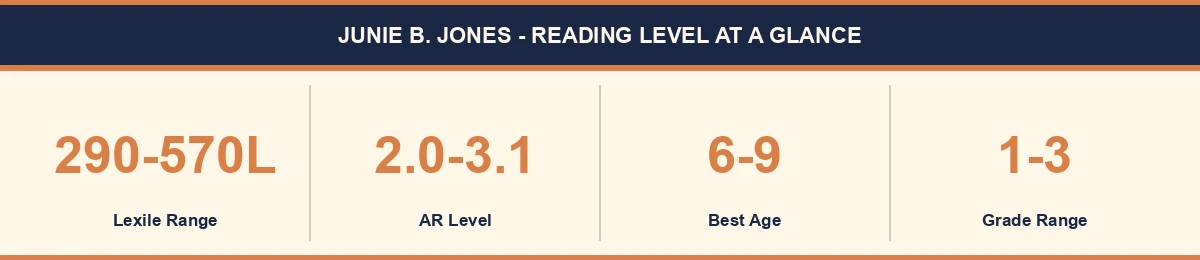
The Junie B. Jones series by Barbara Park carries a Lexile range of 290L–570L and an Accelerated Reader (AR) level of 2.0–3.1, placing it at a grade 1–3 reading level. Guided Reading Level (Fountas & Pinnell) runs from J to M. The series is best suited for independent readers aged 6–9, though younger children (ages 4–6) enjoy it as a read-aloud. Data sourced from Scholastic Book Wizard and the MetaMetrics Lexile Framework.
The Junie B. Jones series by Barbara Park has a Lexile range of 290L–570L, an AR level of 2.0–3.1, and a Guided Reading Level of J–M (Fountas & Pinnell). This places the series squarely in the grades 1–3 range, making it ideal for independent readers aged 6–9.
| Measure | Score |
|---|---|
| Lexile Range | 290L–570L |
| AR Level | 2.0–3.1 |
| Guided Reading Level (F&P) | J–M |
| DRA (Developmental Reading Assessment) | 18–28 |
| Grade Equivalent | Grades 1–3 |
| Recommended Age | 6–9 (independent); 4–6 (read-aloud) |
Those numbers need a little unpacking before they’re useful for a parent or teacher. A Lexile score measures text complexity on a scale of roughly 0L to 1600L, where a typical first grader reads between 190L and 530L and a typical second grader reads between 420L and 650L. The spread within Junie B. Jones — 290L at the low end, 570L at the upper end — reflects the fact that the earliest books in the 34-book series (published by Random House beginning in 1992) are shorter and use simpler sentence structures, while the later entries grow in length and vocabulary complexity.
The AR level of 2.0–3.1 follows the same pattern. Renaissance Learning’s AR system ties scores to grade-level equivalents, so a 2.4 AR level means “difficulty typical of mid-second grade.” Most individual titles in the series cluster between 2.4 and 2.8, which is why the series feels consistent to children even as complexity creeps upward. For a full breakdown of how Lexile and AR levels work, see our comparison guide, which explains why the same book can carry different scores on different systems.
Data sourced from Scholastic Book Wizard and the MetaMetrics Lexile Framework.
Junie B. Jones Reading Level by Book
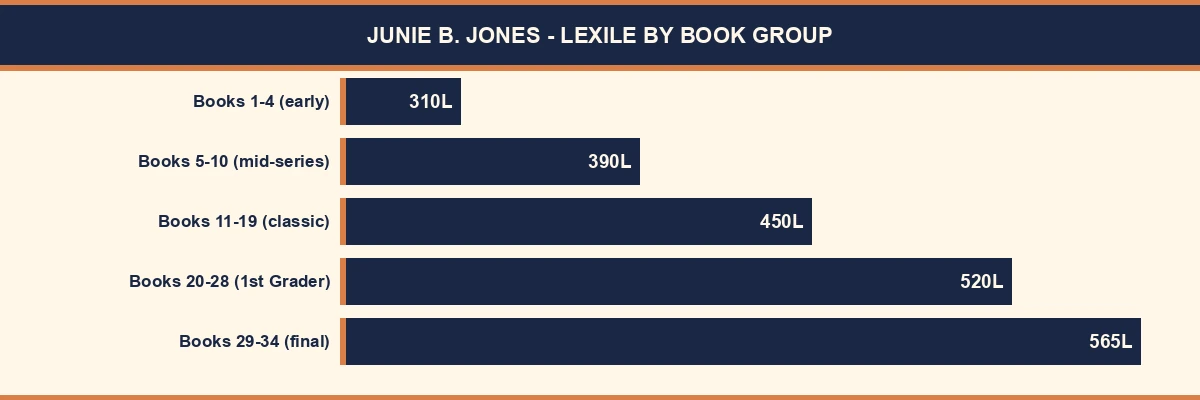
The table below covers ten representative titles from the 34-book series. Lexile scores and AR data are drawn from Scholastic Book Wizard and Renaissance Learning’s AR BookFinder. Difficulty climbs gradually but never dramatically — Barbara Park wrote the series specifically to keep reluctant readers from being scared off by sudden jumps in complexity.
| Title | Lexile | AR Level | AR Points | F&P GRL | Grade | Age |
|---|---|---|---|---|---|---|
| #1: Junie B. Jones and the Stupid Smelly Bus | 290L | 2.6 | 1.0 | J | 1–2 | 6–7 |
| #2: Junie B. Jones and a Little Monkey Business | 300L | 2.6 | 1.0 | J | 1–2 | 6–7 |
| #3: Junie B. Jones and Her Big Fat Mouth | 310L | 2.7 | 1.0 | J–K | 1–2 | 6–7 |
| #5: Junie B. Jones and the Yucky Blucky Fruitcake | 390L | 2.7 | 1.0 | K | 2 | 7–8 |
| #7: Junie B. Jones Loves Handsome Warren | 400L | 2.8 | 1.0 | K | 2 | 7–8 |
| #10: Junie B. Jones Is a Party Animal | 420L | 2.8 | 1.0 | K–L | 2 | 7–8 |
| #15: Junie B. Jones Has a Monster Under Her Bed | 450L | 3.0 | 1.0 | L | 2–3 | 7–9 |
| #20: Junie B., First Grader (at Last!) | 510L | 3.0 | 2.0 | L–M | 2–3 | 7–9 |
| #27: Junie B., First Grader: Toothless Wonder | 530L | 3.1 | 2.0 | M | 3 | 8–9 |
| #34: Junie B., First Grader: Aloha-ha-ha! | 570L | 3.1 | 2.0 | M | 3 | 8–9 |
Series at a glance: The 34 Junie B. Jones books span Lexile 290L–570L and AR levels 2.0–3.1. AR point values run from 1.0 point (early books) to 2.0 points (later “First Grader” books). Total series AR points if read end-to-end: approximately 47 points.
The progression is deliberate. Books #1–#4 sit below 330L and carry one AR point each — short, punchy chapters that a new first-grade reader can finish in a single sitting. By the time the series shifts to “First Grader” branding at book #20, Lexile scores have climbed above 500L and AR point values double to 2.0, signalling longer books with more sustained narrative. Teachers who use AR in classrooms often find that children who test into a 2.5–2.8 ATOS level will be engaged but not frustrated by the bulk of the series.
To see how these scores compare across the full elementary range, our books by Lexile level by grade chart places every Junie B. Jones title in context alongside hundreds of popular titles.
Is Junie B. Jones Appropriate for Your Child?
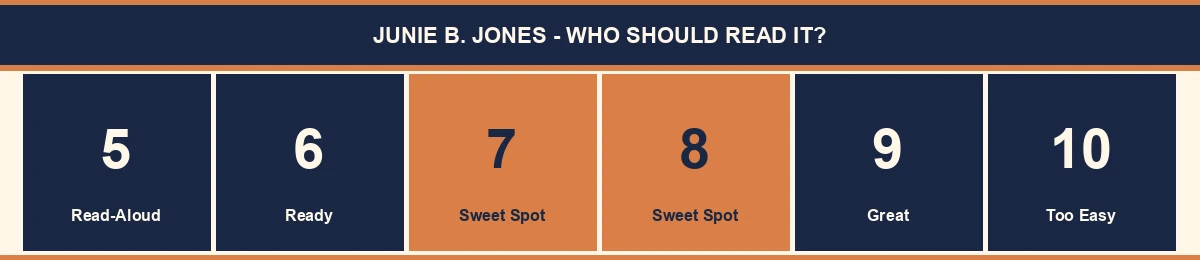
Kindergarten and early Grade 1 (ages 5–6): These books are too long for most kindergarteners to read independently, but they make excellent read-alouds. Junie B.’s voice — opinionated, chaotic, genuinely funny — holds young children’s attention even when they cannot yet decode the words themselves. Parents reading aloud can pause to explain vocabulary like “reproach” or “humongous” that Park drops in deliberately, since one of her quiet goals was building vocabulary through context.
Grade 1–2 (ages 6–8): the sweet spot. A child reading at a Lexile of 300L–500L, which the Developmental Reading Assessment (DRA) places at levels 18–28 (based on standard Lexile-to-DRA correlation tables), will find these books engaging and confidence-building. The chapters are short (typically 8–12 pages), the font is large, and Denise Brunkus’s illustrations appear frequently enough to support comprehension. For most first and second graders, Junie B. Jones works as a gateway to chapter books — the format looks grown-up, but the reading demand is very manageable. Books like the Dog Man reading level series pair well with Junie B. Jones for early Grade 2 readers who enjoy humor-driven stories.
Grade 3 and above (ages 8–9+): Most children who read above a 600L Lexile will find the series too easy for independent reading practice, though they may still enjoy it for pleasure. Classroom use at Grade 3 typically means using the books for shared reading, reader’s theater, or writing-voice studies, since Junie B.’s first-person narration is a strong mentor text for teaching authentic character voice.
Grammar note for parents and teachers: Junie B. deliberately uses incorrect grammar (“runned,” “holded,” “gots”) as a character trait. Research from reading specialists finds this does not harm children’s grammar development when they are simultaneously hearing and reading correct models — but it is worth discussing if a child begins mimicking the errors in writing.
Content considerations. The books deal with everyday school situations — a frightening school bus, a classroom talent show, losing a tooth, jealousy over a baby sibling. There is no violence, romance, or mature language. Junie B. herself uses grammatically incorrect English (“runned,” “holded”) as a character trait, which some parents and teachers flag as a concern. From a classroom perspective, this is worth addressing explicitly: frame her speech as intentional character writing, not a model for the child’s own grammar, and use it as a discussion point about how authors create character voice.
The books also work well for read-aloud in K–2 classrooms because each title can be completed in two to four sessions, and the episodic, chapter-based structure lends itself to prediction and retelling activities.
How Does Junie B. Jones Compare to Similar Books?
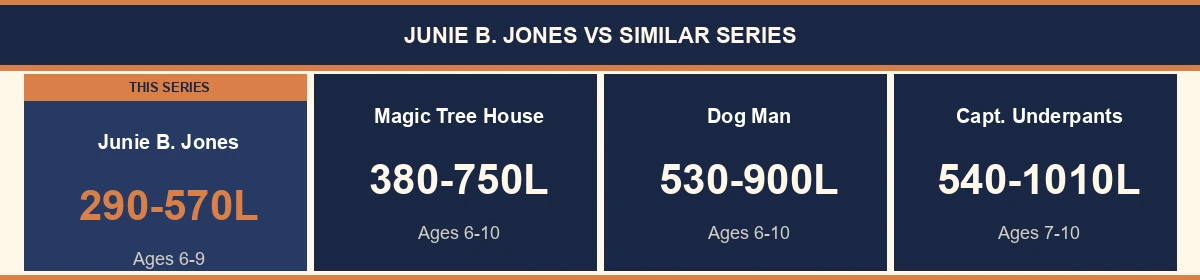
Parents who ask “is this right for my child?” often find it easier to reason from books they already know. The table below places Junie B. Jones alongside four comparable early-chapter-book and middle-grade series. Slightly further along the same reading curve, our Geronimo Stilton reading level and age range guide covers a similarly illustrated, humor-forward series for grades 2-4.
| Book/Series | Lexile | AR Level | Grade | Age |
|---|---|---|---|---|
| Junie B. Jones (full series) | 290L–570L | 2.0–3.1 | 1–3 | 6–9 |
| Magic Tree House (series) | 380L–750L | 2.6–3.5 | 1–4 | 6–10 |
| Captain Underpants (series) | 540L–1010L | 2.9–5.3 | 2–5 | 7–11 |
| Dog Man (series) | 530L–900L | 2.3–3.5 | 1–4 | 6–10 |
| Diary of a Wimpy Kid (series) | 950L–1060L | 5.2–5.8 | 4–7 | 9–13 |
The comparison makes the positioning clear. Junie B. Jones starts lower and stays lower than most of these series. A child who has worked through the early Junie B. books and is ready to level up faces two natural paths depending on what they enjoyed most:
- If they loved the humor and the short chapters: the Magic Tree House reading level offers a step up in complexity while keeping the same fast-paced, chapter-per-sitting feel.
- If they loved the silly, irreverent tone: the Dog Man reading level sits in a similar range but uses a hybrid graphic-novel format that appeals to visual learners.
- If they are mature readers who finished the series quickly: the Diary of a Wimpy Kid reading level jumps to 950L–1060L Lexile, which is a significant step — confirm the child’s actual reading level before making that leap.
The comparison also shows why Junie B. Jones is often the right book for a child who has been reluctant to attempt chapter books. At 290L–390L, the earliest titles sit well within what a late-kindergarten or early-first-grade reader can decode with confidence, making them one of the lowest-stakes entry points into chapter-book reading available in a popular, culturally visible series.
Tips to Support Reading Junie B. Jones
Before reading. Look at the cover and read the title together. Junie B. Jones titles are deliberately absurd (“Junie B. Jones and the Stupid Smelly Bus,” “Junie B. Jones Has a Monster Under Her Bed”), and asking a child to predict what the problem in the story might be — based purely on the title — activates prior knowledge and sets up genuine curiosity.
For children new to chapter books, preview the chapter titles before starting. Junie B. Jones chapter titles are short and often funny in themselves; reading them as a list takes 60 seconds and helps a hesitant reader feel like they already know the shape of the story.
Quick tip for reluctant readers: Read the chapter titles aloud before starting. Junie B. Jones chapter titles are deliberately funny (“The Meanie Jim’s Birthday” / “That Dog from the Pound”). Previewing them in 60 seconds primes a reluctant reader’s curiosity before committing to the chapter.
During reading. Junie B.’s narration is dense with her particular logic — she explains her reasoning in long, spiraling sentences that are funny precisely because they reveal how a five- or six-year-old actually processes the world. Slow down at those passages. Ask the child what they think Junie B. should do, or whether her reasoning makes sense. This turns a solo reading session into a conversation about inference and character motivation without sounding like a comprehension quiz.
Pay attention to words Junie B. gets wrong. Park often has Junie B. mishear adult vocabulary and invent her own version (“the school nurse has a actual stereo-scope”). These moments are natural stopping points for vocabulary discussion.
After reading. Each book ends with a problem resolved, usually through Junie B. deciding to accept something she initially resisted — a new baby sibling, losing a tooth, performing on stage. Ask: “Did she change? What changed her mind?” These are accessible literary analysis questions even for a six-year-old, and they build habits of mind that matter for reading comprehension at every level.
If your child has devoured the 34-book series and is hunting for what comes next, check our guide to the Captain Underpants reading level — it sits in the 540L–1010L range, so the early Captain Underpants books are a natural next step before the series overtakes a developing reader’s current ability.
Frequently Asked Questions About Junie B. Jones Reading Level
What is the Junie B. Jones Lexile level?
The Junie B. Jones series spans a Lexile range of 290L to 570L across its 34 books, according to the MetaMetrics Lexile Framework and Scholastic Book Wizard. The earliest titles in the series sit at approximately 290L–310L, while the later “First Grader” books reach 530L–570L as the series grows in length and complexity.
What grade level is Junie B. Jones?
Junie B. Jones is generally considered a grades 1–3 series. The grade equivalent across the series is 1.0–3.2 based on AR ATOS scores. Most titles are calibrated for first- and second-grade independent reading, with the later books working well for strong first graders and early third graders who want an easy, fun read.
What age is Junie B. Jones for?
The Junie B. Jones age range for independent reading is approximately 6–9 years old, corresponding to grades 1–3. Children as young as 4–5 enjoy the series as a read-aloud, since Junie B.’s humor lands even when an adult is doing the reading. By age 9–10, most readers will find the books too easy for reading practice, though they remain popular pleasure reads.
Is Junie B. Jones appropriate for kindergarteners?
Yes, with an adult reading aloud. As an independent read, the books are above most kindergarteners’ decoding ability — the earliest titles start at 290L, which aligns with mid-first-grade reading. But the content, humor, and story situations are absolutely appropriate for kindergarteners, and the books are widely used as kindergarten and Grade 1 read-alouds in classrooms and at home.
What AR level is Junie B. Jones?
The Junie B. Jones AR level ranges from 2.0 to 3.1 across the series, according to Renaissance Learning’s AR BookFinder. Most individual titles sit between 2.6 and 2.9 ATOS. Each book carries 1.0 AR point through most of the series, with the longer “First Grader” books (starting around book #20) earning 2.0 AR points.
What comes after Junie B. Jones for young readers?
The two most common next steps are Magic Tree House (380L–750L, AR 2.6–3.5) for readers who want adventure and a bit more complexity, and the early Captain Underpants books (540L–700L range) for readers who want to stay in humor but step up slightly in length. Both keep the same accessible chapter-book format while adding vocabulary and narrative complexity. If a child has tested above a 600L Lexile, the early Dog Man books (530L+) and Ricky Ricotta’s Mighty Robot series by Dav Pilkey are also strong options before moving to longer middle-grade fiction. Readers ready for a bigger challenge often love Diary of a Wimpy Kid, which reads at around 950L.
Please Write Your Comments