Maze Runner Reading Level: Is Your Teen Ready for the Maze?
14 May 2026
408
Every parent I’ve talked to who has a seventh-grader either already knows The Maze Runner or is about to find out their kid finished it without asking first. James Dashner’s debut YA series — published by Delacorte Press, a Random House imprint — lands in a very specific reading zone: the text is accessible enough for strong middle-schoolers, but the content is emphatically not the same conversation as Percy Jackson.
The series follows Thomas, a teenager who wakes up in a place called the Glade with no memories except his name. Around the Glade runs a massive, ever-changing maze populated by Grievers — bioengineered creatures that kill. Thomas and the Gladers — including Newt, Minho, and Teresa — have to solve the maze and survive the organization behind it, WICKED, before the whole situation collapses around them.
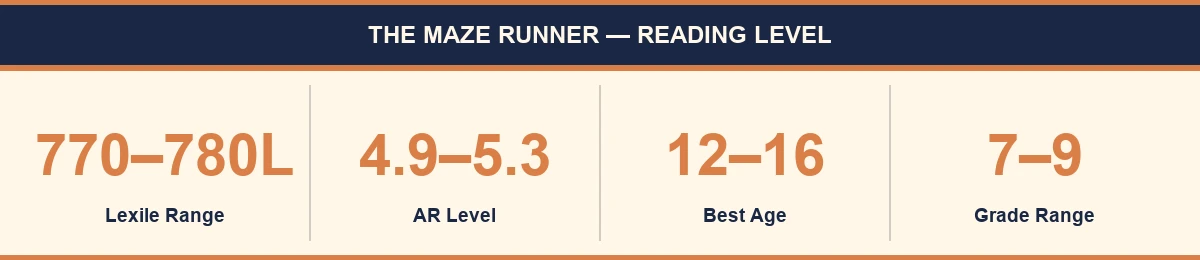
The short answer on reading level: Lexile 770–780L, AR 5.0–5.3, ages 12–16. The longer answer — especially on content — is below.
Quick Answer: What Reading Level Is The Maze Runner?
Quick answer
Here is the full systems overview for the series:
| Reading System | The Maze Runner (Book 1) | Series Range |
|---|---|---|
| Lexile | 770L | 770L – 780L |
| AR (ATOS) Book Level | 5.3 | 4.9 – 5.3 |
| AR Points | 14 | 14 – 19 |
| Fountas & Pinnell | W–X | W – Z |
| DRA Level | 70+ | 70+ |
| Recommended Age | 12–16 | 12–16 |
| Grade Level | 7th–8th grade reading | 7th–9th grade |
The Lexile of 770L places the text in the 5th–6th grade reading ability range by strict vocabulary and sentence measure. The content maturity — which no reading-level formula captures — puts the appropriate age for independent reading squarely at 12 and above.
Lexile Level and Reading Systems Overview
Lexile scores are produced by MetaMetrics’ Lexile database, which measures vocabulary demand and sentence complexity. A Lexile of 770L means the text sits at roughly the 6th-grade reading level on the text-difficulty scale — solidly mid-range for young adult fiction.
The full 770–780L band across all five Maze Runner titles is notably narrow. Most long-running series drift higher as authors gain confidence or narratives grow more complex. The Maze Runner series holds consistent; Dashner’s prose style in all five books is punchy and dialogue-forward, which keeps sentence complexity relatively low even when the plot is at its most intense.
For context, here is where the Maze Runner series sits in the broader YA and upper middle-grade landscape:
| Title | Lexile | AR Level | Typical Age |
|---|---|---|---|
| Percy Jackson (Book 1) | 680L | 4.7 | 8–12 |
| The Maze Runner (Book 1) | 770L | 5.3 | 12–16 |
| The Hunger Games (Book 1) | 800L | 5.3 | 12–16 |
| Divergent (Book 1) | 700L | 4.8 | 14+ |
| The Fault in Our Stars | 850L | 5.5 | 14+ |
The Maze Runner falls between Percy Jackson and The Hunger Games in raw Lexile — closer to Hunger Games, with similar content weight. Our full Lexile vs AR guide explains how to cross-reference these numbers when a school or library asks for a specific system.
Per-Book Reading Level: The Maze Runner Series
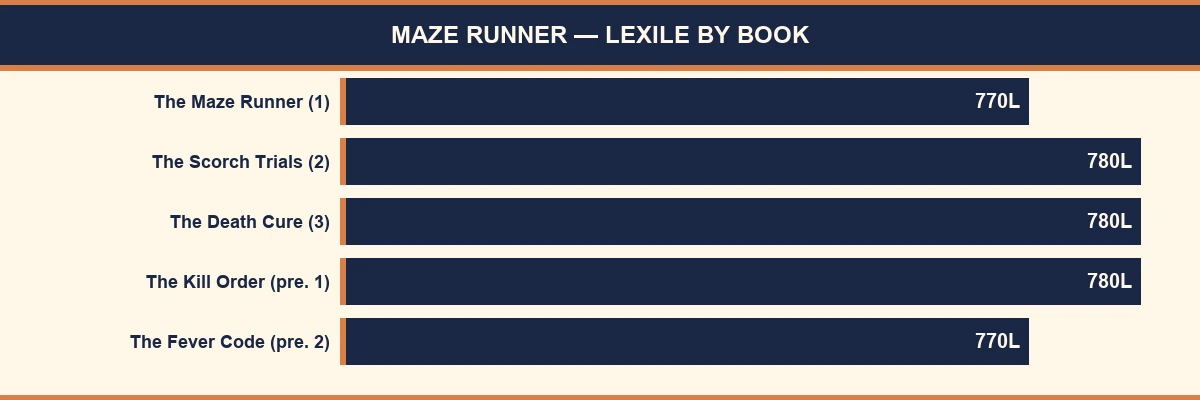
The series spans three main novels and two prequels, all published by Delacorte Press under Random House. Renaissance Learning’s AR system assigns each book a level and a point value; both are used widely by schools for reading programs.
| Book | Lexile | AR Level | AR Points | Pages | Publisher |
|---|---|---|---|---|---|
| The Maze Runner (Book 1) | 770L | 5.3 | 14 | 374 | Delacorte Press |
| The Scorch Trials (Book 2) | 780L | 5.0 | 18 | 360 | Delacorte Press |
| The Death Cure (Book 3) | 780L | 5.1 | 19 | 325 | Delacorte Press |
| The Kill Order (Prequel 1) | 780L | 5.0 | 14 | 327 | Delacorte Press |
| The Fever Code (Prequel 2) | 770L | 4.9 | 14 | 352 | Delacorte Press |
A few things worth noting here. Book 1 has the highest AR level (5.3) but the fewest points (14) — meaning it’s the most vocabulary-dense per page but the shortest in total reading load. The Death Cure carries the most AR points (19) for a shorter page count, which reflects Renaissance Learning’s algorithm weighting reading comprehension complexity, not just length. The Fever Code drops to Lexile 770L with AR 4.9 — the prequel reads slightly more accessibly than the main trilogy, which makes sense as a reading-order decision if a parent wants a gentler entry point.
AR Level and Accelerated Reader Points
Renaissance Learning’s Accelerated Reader system gives each title both an ATOS grade-level equivalent and a point value for comprehension quizzes. For the Maze Runner series:
- AR book levels: 4.9–5.3 (equivalent to late 4th through early 6th grade reading ability by the ATOS formula)
- Points per book: 14–19 (these are above average for YA; the main trilogy accumulates 51 AR points)
- Typical AR goal for 7th grade: 25–30 points per semester — meaning one or two Maze Runner books per term covers most school AR requirements
The AR level of 5.0–5.3 can be misleading on its own. The ATOS formula primarily captures vocabulary and sentence length. A 5.3 AR level reads as “5th–early 6th grade vocabulary,” but the comprehension questions for The Maze Runner test plot analysis, character motivation, and thematic inference — skills that are firmly middle-school and up.
For comparison, Warriors by Erin Hunter runs AR 4.5–5.3 — nearly identical to Maze Runner’s range — but Warriors is positioned for ages 8–12. That overlap shows exactly why AR level alone is insufficient guidance: the reading mechanics may be similar, but the content of Warriors (animal clans, loyalty, fantasy combat) and The Maze Runner (psychological manipulation, human death, dystopian conspiracy) are aimed at entirely different ages.
Recommended Age Range and Grade Level
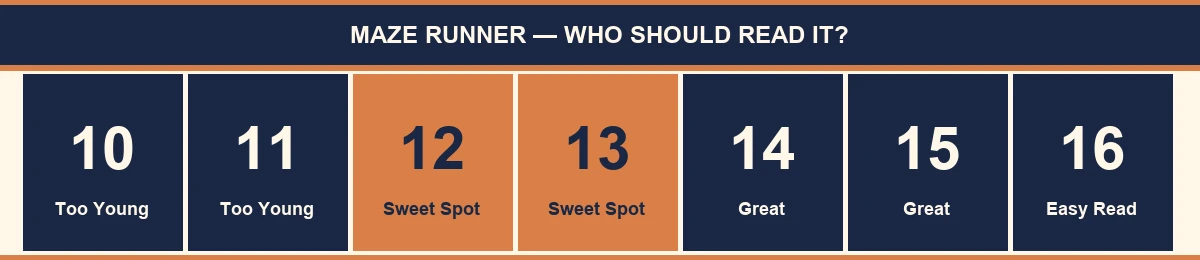
The publisher-stated age range for The Maze Runner is 12 and up, with most reading guides settling on 12–16 as the practical bracket. The grade sweet spot is 7th through 9th grade — years when readers can both handle the text and engage with the themes.
I have a specific read on where the real age line is, and it’s not the Lexile. A 10-year-old who reads at 7th-grade level can decode every page of The Maze Runner. The question is whether they’re ready for named characters they’ve grown attached to dying without narrative recovery, for institutional betrayal as a central plot engine, and for the sustained psychological cruelty that WICKED inflicts on Thomas and the other Gladers. Those are content variables, not vocabulary variables.
Here’s the practical age guide:
| Age | Grade | Reading Verdict | Content Verdict |
|---|---|---|---|
| 10–11 | 5th–6th | Text accessible for strong readers | Content heavy — parental preview recommended |
| 12–13 | 7th–8th | Sweet spot — text and content align | Ready for full series independently |
| 14–15 | 9th–10th | Easy read, all themes land | Ideal age for full emotional impact |
| 16+ | 10th–12th | Reads fast; lore satisfying | Full series; prequels add depth |
The series runs harder than Harry Potter books 1–4 in content intensity, and roughly comparable to books 5–7. The Hunger Games, which sits in the same content tier, is probably the most direct comparator for parent guidance.
Content Warnings: Violence, Death, and Intensity
The Maze Runner carries significant content that parents and educators should know about before handing it to younger readers:
- Named character deaths: Characters the reader invests in over 300+ pages die on-page, some unexpectedly. This is not foreshadowed softly. Newt’s arc across Books 2 and 3 is the most emotionally difficult sequence in the series.
- Creature violence: Grievers — WICKED’s bioengineered maze-runners — sting and kill. The violence is described with enough detail to register as horror-adjacent.
- Psychological manipulation: WICKED’s treatment of the Gladers is presented as deliberate, institutional cruelty framed as necessary experimentation. This theme of adults systematically lying to and using children is pervasive across all five books.
- Themes of betrayal and loss: Teresa’s actions in The Scorch Trials and the overall WICKED reveal are genuinely disturbing to readers who have built trust in those characters.
- No explicit sexual content: The series contains romantic tension but no sexual content. This is not a barrier for most school reading programs.
Scholastic’s teacher guide for The Maze Runner includes discussion questions on trust, identity, and survival ethics — useful for classroom contexts or book clubs where parents want structured conversation around the darker themes.
The content sits in the same tier as The Hunger Games — which is a useful benchmark most parents already have a feel for. If a child handled Katniss’s story without distress, they will likely handle Thomas’s story the same way. Goosebumps is a useful lower-intensity contrast: Goosebumps (Lexile 530–730L, ages 8–12) uses horror-adjacent content with almost no permanent consequences, which is the inverse of how The Maze Runner operates.
Maze Runner vs Hunger Games vs Divergent: Dystopian YA Compared
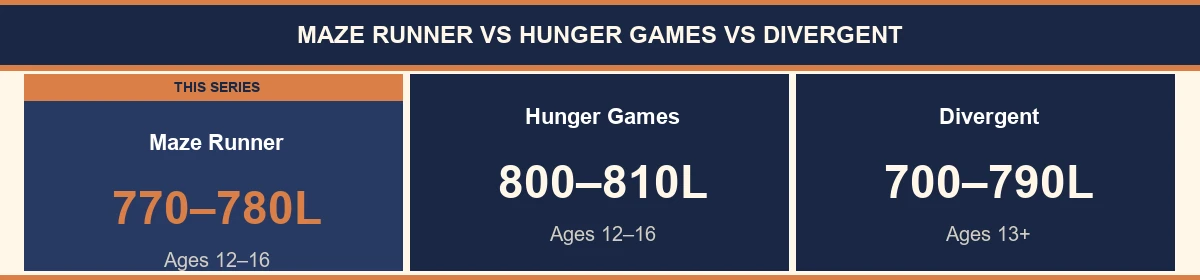
These three series dominate the dystopian YA shelf and get searched together constantly. Here is how they compare across every reading-level system: The Divergent Lexile and content warnings covers the full trilogy in detail — worth cross-checking if you are deciding between the two series on content grounds.
| Series | Lexile | AR Level | AR Points | Age Range | Content Intensity |
|---|---|---|---|---|---|
| The Maze Runner (Dashner) | 770–780L | 4.9–5.3 | 14–19/book | 12–16 | High — violence, death, psych. harm |
| The Hunger Games (Collins) | 800–810L | 5.3 | 15–22/book | 12–16 | Very high — war, arena killing, trauma |
| Divergent (Roth) | 700–800L | 4.8–5.5 | 16–22/book | 14+ | High — violence, identity collapse, loss |
The Hunger Games runs slightly harder in Lexile (800–810L vs 770–780L for Maze Runner) and slightly more intense in content — the explicit arena-killing premise has no equivalent in Dashner’s series. Divergent has a wider Lexile range and skews slightly older in its intended audience, particularly in books 2 and 3.
For reading progression purposes: a reader who finishes The Maze Runner trilogy at 12–13 is well-prepared for The Hunger Games trilogy as a next step. Both feature similar thematic ground — institutional betrayal, collective survival, the cost of hope — at comparable reading levels. Going the other direction (Hunger Games first, then Maze Runner) works equally well.
Divergent sits slightly below Maze Runner in average Lexile but above it in recommended age — Veronica Roth’s series escalates in violence and moral complexity through Insurgent and Allegiant in ways that make most librarians recommend it for ages 14+.
Frequently Asked Questions
What Lexile level is The Maze Runner?
The Maze Runner (Book 1) is Lexile 770L, per MetaMetrics. The full series ranges from 770L to 780L — an unusually narrow band that reflects Dashner’s consistent prose style across all five books. The Scorch Trials, The Death Cure, and The Kill Order each score 780L; The Fever Code matches Book 1 at 770L.
What is the AR level of The Maze Runner?
Book 1 is AR 5.3 (ATOS), equivalent to early 6th grade reading ability. The full series ranges from AR 4.9 to 5.3. Point values range from 14 to 19 per book, with the full trilogy totaling 51 AR points. Schools running Accelerated Reader programs should check the Renaissance Learning database for current values, as occasional revisions occur.
Is The Maze Runner appropriate for a 12-year-old?
Generally yes — 12 is the publisher’s stated minimum and the practical lower bound for most readers. A 12-year-old in 7th grade is the intended sweet-spot reader. The caveat is content: named characters die, psychological manipulation is a central theme, and the violence involves creatures specifically designed to harm humans. Most 12-year-olds in 7th grade handle it without issue; some 11-year-olds are ready, some 13-year-olds are not. Know your specific reader.
How does The Maze Runner compare to The Hunger Games in reading level?
The Hunger Games (Book 1) is Lexile 800L, about 30 points harder than The Maze Runner at 770L. Both carry AR 5.3 for Book 1. In practical terms, the reading-level difference is minor — a reader who can handle one can handle the other. The more meaningful difference is content: Hunger Games escalates into explicit war violence and political atrocity; Maze Runner’s intensity is more creature-horror and conspiracy-thriller. Both series are appropriate for ages 12–16.
What is the Scorch Trials reading level?
The Scorch Trials (Book 2) is Lexile 780L, AR 5.0, 18 AR points, published by Delacorte Press. It runs 360 pages — slightly shorter than Book 1’s 374 pages — but carries more AR points, reflecting increased narrative complexity. Content escalates from Book 1: Thomas and the Gladers face the Scorch environment and WICKED’s escalating trials, with higher emotional stakes and more character loss.
What is the Death Cure reading level?
The Death Cure (Book 3) is Lexile 780L, AR 5.1, 19 AR points — the most AR points in the main trilogy. It runs 325 pages. The highest point value for the shortest book reflects content complexity; the climax of the series involves the most sustained violence and the most significant named character deaths. Content-wise it is the most intense book in the trilogy and is not appropriate for younger readers who might have started the series early.
What grade level is The Maze Runner?
By Lexile and AR alone, The Maze Runner reads at approximately 5th–6th grade reading ability. The content appropriate grade is 7th–9th grade. Most schools using Accelerated Reader assign it to middle-school programs. The gap between “readable by” and “appropriate for” is wide here — a 5th grader can decode the text; a 7th grader is the target reader.
Please Write Your Comments