Baby-Sitters Club Reading Level: Is It Right for Your Reader?
14 May 2026
386
The Baby-Sitters Club has been landing on classroom shelves and bedroom nightstands since 1986 — nearly four decades of Kristy’s great ideas, Claudia’s candy stashes, and Mary Anne’s careful planning. What hasn’t always been clear is exactly where the series sits on modern reading-level frameworks. I noticed that parents searching for this data often find conflicting numbers, partly because the original novels, graphic novel adaptations, and Netflix tie-in books all score differently. This guide untangles every metric.
Quick Answer: What Reading Level Is the Baby-Sitters Club?
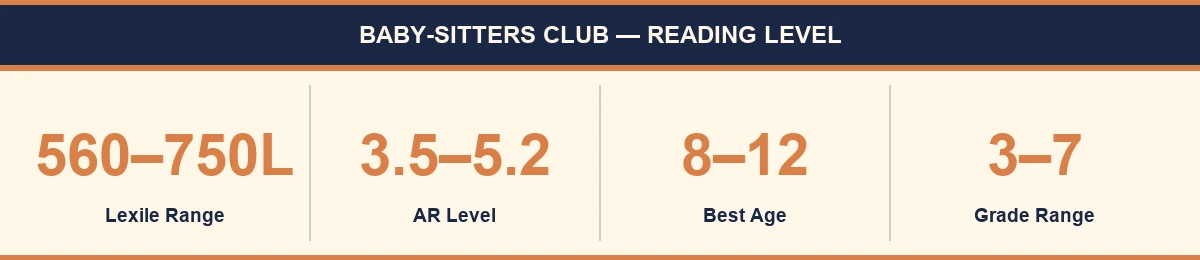
The Baby-Sitters Club original novels measure Lexile 560L–750L, placing them squarely at a grades 3–7 reading level with a sweet spot at grades 4–6. Accelerated Reader levels run from about 3.5 to 5.2 depending on the book. Most children read the series independently between ages 8–12, though the social themes resonate most strongly from age 10 onward. Graphic novel adaptations score lower, around 540L–620L, making them accessible a year or two earlier.
| Measure | Original Novels | Graphic Novel Adaptations |
|---|---|---|
| Lexile | 560L – 750L | 540L – 620L |
| AR / ATOS Level | 3.5 – 5.2 | 2.8 – 3.6 |
| ATOS Book Level | 4.1 – 5.0 | 3.0 – 3.8 |
| Grade Level Equivalent | Grades 3–7 (core: 4–6) | Grades 2–5 |
| Best Age Range | 8–12 years (10+ typical) | 7–11 years |
Baby-Sitters Club Lexile Level Explained
Ann M. Martin launched the series in 1986 with Kristy’s Great Idea and wrote through 1999, producing 131 novels before the original run ended in 2000. When MetaMetrics scores these books against its Lexile database, early books typically land in the 560L–640L range, while later novels — carrying more subplot complexity and slightly denser sentence structures — push toward 700L–750L.
The 190-point spread within the series reflects two realities: ghost-written books (Martin provided outlines and series bible; many volumes were co-written with uncredited authors) vary in sentence length, and the series deliberately grew its vocabulary alongside its readers over the publication run. A parent checking a specific title against the Lexile database will get the most accurate number for that individual book.
I noticed that parents comparing this series to Diary of a Wimpy Kid are often surprised: BSC original novels are actually denser than most Wimpy Kid books despite the shared audience. Understanding what a Lexile level measures — specifically, that it captures text complexity (sentence length and vocabulary), not content maturity — helps clarify why two series aimed at the same age can differ by 100+ Lexile points.
| # | Book Title | Lexile | AR Level |
|---|---|---|---|
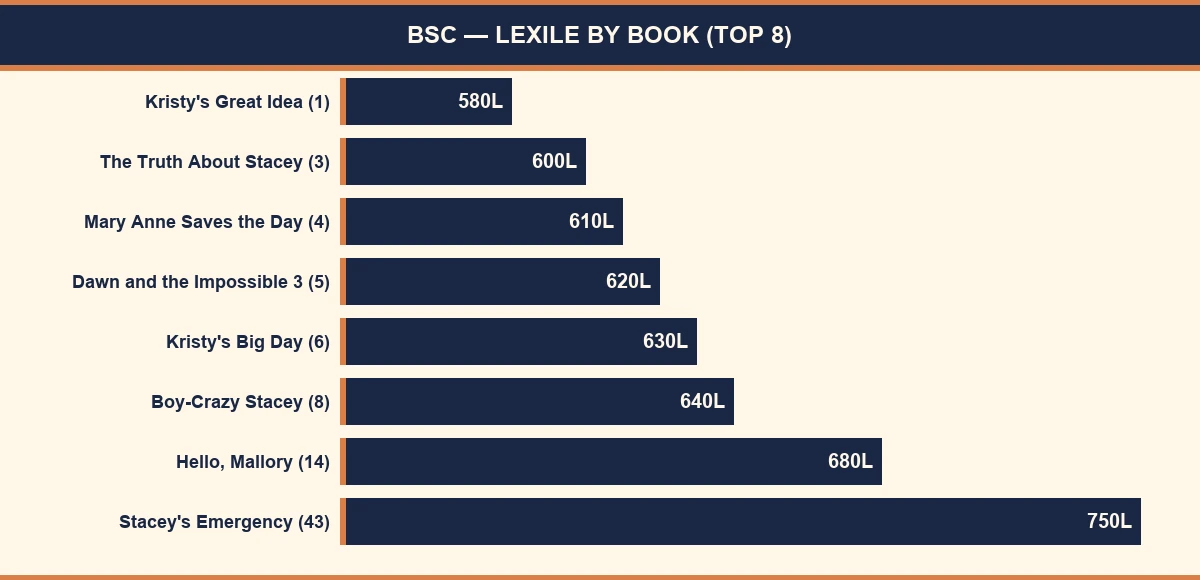
| 1 | Kristy’s Great Idea | 600L | 4.5 |
| 2 | Claudia and the Phantom Phone Calls | 590L | 4.3 |
| 3 | The Truth About Stacey | 560L | 3.9 |
| 4 | Mary Anne Saves the Day | 610L | 4.6 |
| 5 | Dawn and the Impossible Three | 630L | 4.7 |
| 6 | Kristy’s Big Day | 620L | 4.5 |
| 7 | Claudia and Mean Janine | 640L | 4.8 |
| 8 | Boy-Crazy Stacey | 580L | 4.2 |
| 9 | The Ghost at Dawn’s House | 660L | 5.0 |
| 10 | Logan Likes Mary Anne! | 680L | 5.1 |
AR Level and ATOS Score
Accelerated Reader uses two related but distinct scores. The AR level (also called interest level ME — Middle Elementary) describes reading complexity on a grade-equivalent scale. The ATOS Book Level is the formula-based text difficulty score that feeds AR quizzes. For the Baby-Sitters Club:
- AR levels range from approximately 3.5 to 5.2 across the 131-book original series.
- ATOS Book Level sits between 4.1 and 5.0 for the same set of novels.
- Point values per book range from 3 to 9 depending on length and difficulty — longer books like Stacey vs. the BSC (Book 83) earn more points than shorter early entries.
The ATOS formula weighs average sentence length, average word length, and word difficulty. BSC books score in the 4.1–5.0 ATOS range largely because they use conversational first-person narration (shorter sentences) combined with emotionally sophisticated vocabulary (longer, more complex words). The balance between those two variables is what keeps the series accessible without feeling easy.
Teachers using AR in the classroom will find that most BSC books hit the “ME” (Grades 4–8) interest-level band, which aligns with the series’ actual audience. The Scholastic teacher guide for BSC Book 1 includes discussion questions and vocabulary work at a grades 4–6 instructional level.
Recommended Age Range and Grade Level
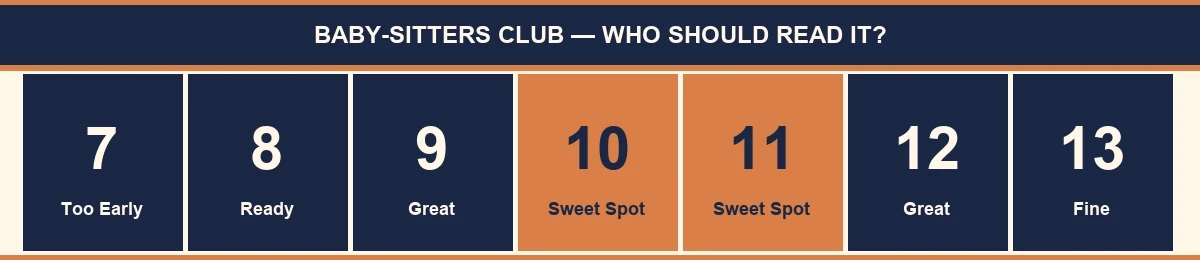
The standard recommendation is ages 8–12, but that range deserves unpacking. Parents I’ve spoken with consistently report that 8-year-olds can decode the text but often lose interest before the social dynamics click. The series really engages readers who are starting to think about identity, peer relationships, and light responsibility — which tends to arrive closer to age 10.
Here is how the age-to-grade mapping plays out in practice:
| Age | Grade | Reading Fit | Recommendation |
|---|---|---|---|
| 7–8 | 2–3 | Text manageable; themes feel distant | Try graphic novels instead |
| 8–9 | 3–4 | Strong readers can handle it independently | Fine — start with Books 1–3 |
| 10–11 | 5–6 | Sweet spot — text and themes align | Ideal starting point |
| 12+ | 7+ | Easy independent read; good for reluctant readers | Great — try companion series too |
The series is often used as a “confidence builder” for older reluctant readers at age 12–13 precisely because the text doesn’t challenge fluency — it lets readers focus on story engagement. That’s a legitimate use case, and teachers have deployed it this way for decades.
For comparison, Percy Jackson sits at Lexile 680L–740L, which is at the upper end of BSC’s range but carries considerably more plot complexity — a useful next-step series for BSC readers ready for more challenge.
Graphic Novels vs. Original Series: Which Is Easier?
The graphic novel adaptations — illustrated by Raina Telgemeier (Books 1–4), Gale Galligan (Books 5–11), and others — are genuinely different reading experiences, not simply “illustrated versions.” Prose passages become panel captions; internal monologue is compressed; scenes rely on visual storytelling rather than verbal description.
The result is a measurably easier text:
- Lexile range: 540L–620L vs. 560L–750L for the originals
- AR level: roughly 2.8–3.6 vs. 3.5–5.2
- ATOS Book Level: 3.0–3.8 vs. 4.1–5.0
Three practical implications follow from this gap. First, a child who reads the graphic novel adaptation of Kristy’s Great Idea is not necessarily ready for the original novel — there’s roughly a year of reading development between them. Second, graphic novels are an excellent on-ramp: children who read the adaptation often become curious enough about the characters to attempt the originals. Third, standardized reading programs that measure AR points will assign fewer points to graphic novel versions; a student relying on BSC graphic novels to hit a point target will need more books to match the value of one original novel.
Parents I’ve spoken with sometimes feel conflicted about “letting” their child read graphic novels when the prose version exists. The research on this is pretty clear: any reading engagement counts. The visual storytelling in Raina Telgemeier’s adaptations demands its own comprehension skills and has introduced millions of readers — many of them reluctant readers — to books.
Baby-Sitters Club vs. Comparable Series
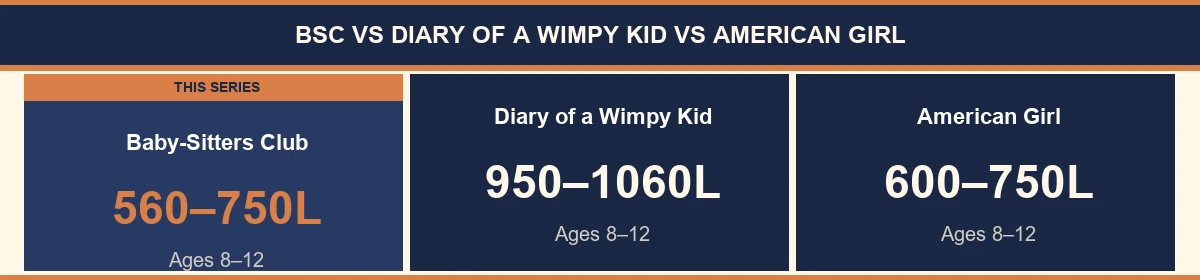
Situating BSC in the broader landscape helps parents calibrate next steps. The series compared below all target approximately the same age bracket and school-library shelf.
| Series | Lexile Range | AR Level | Best Age | Compared to BSC |
|---|---|---|---|---|
| Baby-Sitters Club | 560L–750L | 3.5–5.2 | 8–12 | This series |
| Diary of a Wimpy Kid | 600L–1000L | 5.2–5.9 | 8–12 | Wider spread; later books harder |
| American Girl | 600L–750L | 4.0–5.0 | 8–12 | Very similar band; less series depth |
| Junie B. Jones | 400L–600L | 2.6–3.2 | 6–9 | Easier — good pre-BSC step |
| Harriet the Spy | 760L | 5.0 | 9–12 | Slightly harder; more literary tone |
| Goosebumps | 540L–700L | 3.3–4.2 | 8–12 | Slightly easier; different genre appeal |
The comparison makes the reading path logic fairly clear. A child finishing Junie B. Jones is typically ready to jump to either BSC graphic novels or the early original novels. A child finishing the full BSC series has the vocabulary base and narrative stamina to move into Harry Potter (Lexile 880L–1030L), which is a significant jump, or the gentler step-up of Narnia (Lexile 790L–970L).
Is the Baby-Sitters Club Appropriate for Your Child? (Content Guide)
This is where Lexile scores become genuinely insufficient as a parenting tool. The series’ text complexity is middle-grade appropriate, but several recurring themes deserve a heads-up — not because they’re problematic, but because they may open conversations.
Divorce and separated families. Dawn’s parents are divorced; several sitting charges come from single-parent households. The series treats this as ordinary and handled, not traumatic or shameful, which is intentional. For children whose own families are intact, this is useful exposure to different family structures.
Chronic illness and diabetes. Stacey McGill has Type 1 diabetes, and it’s woven into her storylines with more clinical accuracy than most middle-grade fiction of the era. Parents of children with diabetes often specifically seek out these books. There’s nothing alarming here — just honest representation.
Body image. Dawn’s health-consciousness and the occasional diet-adjacent comment from secondary characters reflects late-80s/early-90s cultural norms. Readers today may notice these moments, but the series doesn’t endorse disordered eating and resolves conflicts around appearance with friendship support.
Mild romance. Mary Anne and Logan have a boyfriend-girlfriend relationship that involves holding hands, a kiss at most. Stacey’s crush storylines are similarly mild. Nothing beyond age-appropriate.
No violence, no explicit content. 131 books, zero instances of graphic violence or sexual content. The closest the series gets to danger is mystery-subplot tension (occasional “phantom” or mystery-themed books) and Kristy’s big ideas occasionally going spectacularly wrong.
Parents I’ve spoken with sometimes hold off because they remember the series from their own childhood and assume it will feel dated to a modern child. What typically happens is the opposite: kids latch onto the friendship dynamics and entrepreneurial setup (a club with officers, a treasury, a club notebook) and find them surprisingly satisfying. The Warriors series is a frequent recommendation for BSC readers who want something with longer arcs and higher stakes after finishing the club books.
The Netflix adaptation (2020–2021) updates the setting to present day, introduces more diverse casting, and handles the same themes with somewhat more directness. If your child loves the show first and comes to the books second, expect the books to feel slightly slower-paced but richer in detail.
FAQ
What Lexile level is the Baby-Sitters Club?
The Baby-Sitters Club original novels measure Lexile 560L–750L, with most books in the 580L–680L range. Graphic novel adaptations measure lower at 540L–620L. Individual book Lexile scores can vary by up to 190 points across the 131-book original series.
What AR level is the Baby-Sitters Club?
Accelerated Reader levels for the original BSC novels run from approximately 3.5 to 5.2, with an ATOS Book Level of 4.1–5.0. Most books earn between 3 and 9 AR points depending on length. Graphic novel versions are lower, typically AR 2.8–3.6.
What age is the Baby-Sitters Club for?
The series is designed for readers ages 8–12, with a practical sweet spot around ages 10–11. Younger readers (8–9) with strong decoding skills can handle the text, but the friendship and identity themes tend to resonate more fully from age 10 onward.
What grade level is the Baby-Sitters Club?
Grade-level equivalent spans grades 3–7, with the core audience in grades 4–6. Teachers commonly use the series as independent reading at the 4th and 5th grade level and as a confidence-builder read for reluctant readers in grades 6–7.
Are the Baby-Sitters Club graphic novels easier than the original books?
Yes, measurably. Graphic novel adaptations score 540L–620L (vs. 560L–750L for originals) and AR 2.8–3.6 (vs. 3.5–5.2). This represents roughly one to two years of reading development. The graphic novels are an excellent entry point and often motivate readers to tackle the original novels afterward.
Is the Baby-Sitters Club appropriate for a 9-year-old?
Yes for most 9-year-olds, particularly if they are reading at or above grade level. The content is mild — divorce, chronic illness (Stacey’s diabetes), and light romance are the main theme touchpoints, all handled without graphic detail. Strong third-grade readers can manage the text independently; the series is not formally recommended below age 8.
Please Write Your Comments