Divergent Reading Level and Age Range: Complete Guide by Book
14 May 2026
354
If you’re trying to figure out whether Divergent is the right fit for your teen — or tracking down the exact Lexile for a school assignment — the headline number is Lexile 700L for Book 1, climbing to 790L by Allegiant. The publisher, Katherine Tegen Books (a HarperCollins imprint), lists the series for ages 14 and up, though most school librarians I’ve spoken with place the real sweet spot at 13–15 for grade-level readers.
That range shifts depending on the book, the reader’s maturity, and how you feel about a series finale that kills its main character. Veronica Roth didn’t write Allegiant to comfort anyone, and parents who hand it to a young teen without warning tend to hear about it. This guide covers every reading-level metric — Lexile, AR, Fountas and Pinnell, DRA — across the full trilogy and the Four companion volume, then walks through the content questions that matter as much as the number.
Quick Answer: What Reading Level Is Divergent?
Quick Answer
Divergent (Book 1) is Lexile 700L, AR level 4.8, and recommended for ages 13–18. The full trilogy ranges from Lexile 700L to 790L as the series progresses, with AR levels between 4.8 and 5.1. The grade sweet spot is 8th–10th grade, though mature 7th-graders handle it fine. Fountas and Pinnell places the series at W–Z; DRA is 70+.
The reading-level numbers alone put Divergent at a 4th-to-5th grade text difficulty — but the content and themes are firmly teenage. That gap between text complexity and emotional complexity is the key thing to understand before handing any book in this trilogy to a younger reader.
| Reading System | Book 1 (Divergent) | Full Trilogy Range |
|---|---|---|
| Lexile | 700L | 700L – 790L |
| AR (ATOS) Level | 4.8 | 4.8 – 5.1 |
| AR Points | 16 pts | 16 – 21 pts |
| Fountas & Pinnell | W–X | W – Z |
| DRA | 70+ | 70+ |
| Recommended Age | 13–18 | 13–18 |
| Grade Sweet Spot | 8th | 8th – 10th |
Lexile Level and Reading Systems Overview
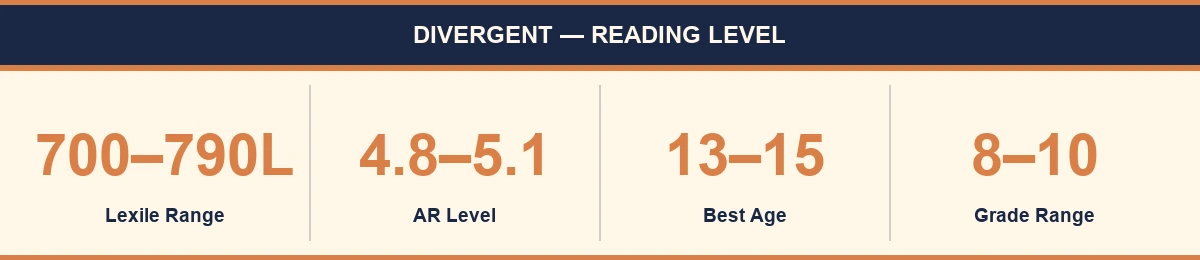
Lexile measures come from MetaMetrics’ Lexile database, the same database U.S. schools pull from when they assign independent reading. A 700L Lexile is roughly equivalent to a 4th-to-5th grade text difficulty — meaning most 8th-graders will find the prose easy to decode. That’s by design: Roth writes in short, punchy chapters with fast pacing and first-person present tense, all of which lower the Lexile score relative to the story’s emotional weight.
The Fountas and Pinnell (F&P) level for the trilogy is W–Z, which corresponds to upper-middle-school to high school. DRA (Developmental Reading Assessment) comes in at 70+. Neither of these systems captures content maturity — they measure text features like sentence length, vocabulary, and print layout.
For parents who are more familiar with Accelerated Reader: the series sits well inside the 4.5–5.5 AR level range that most school libraries assign to 7th–9th grade independent reading. If your teen’s school uses AR, they’ll find Divergent listed under the middle-school-to-high-school tier, which aligns with what the content actually demands.
A practical note on using the Lexile: the “reading range” model — where a reader at, say, 850L can comfortably access books at 600L–1050L — means almost any middle or high school reader can decode Divergent text. The question is never about decoding. It’s always about whether the content is appropriate for that specific reader at that specific age.
If you want a deeper look at how Lexile, AR, and F&P compare as systems, our Lexile vs AR guide explains how schools use each one and when they disagree.
Per-Book Reading Level: The Divergent Trilogy
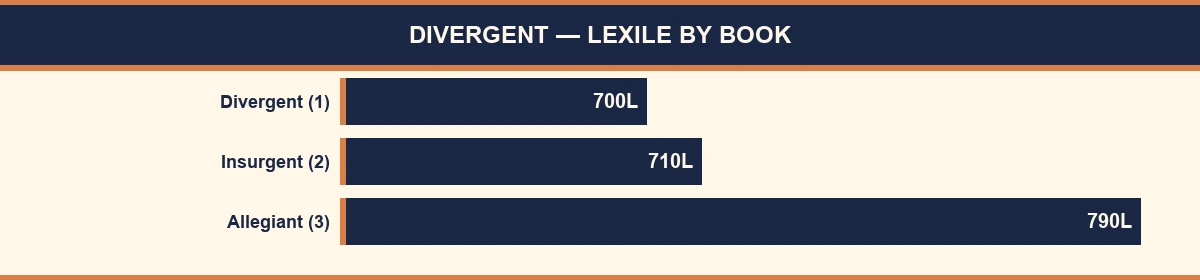
The trilogy shows a consistent upward trend — each book is slightly harder than the one before, with Allegiant making the biggest jump.
| Book | Lexile | AR Level | AR Points | Pages |
|---|---|---|---|---|
| Divergent (Book 1) | 700L | 4.8 | 16 | 487 |
| Insurgent (Book 2) | 710L | 5.0 | 19 | 525 |
| Allegiant (Book 3) | 790L | 5.1 | 21 | 526 |
| Four (companion) | 710L | 4.9 | 9 | 285 |
Allegiant‘s 80-point Lexile jump from Divergent is notable. The shift tracks with Roth’s choice to split the narration between Tris Prior and Four/Tobias Eaton, adding more complex sentence structures and a heavier philosophical register as the story moves outside the faction system into the Bureau of Genetic Welfare. The prose becomes denser and the pacing slower — closer to adult dystopian fiction than the breakneck opening book.
Four (subtitled A Divergent Collection) gives Tobias Eaton’s perspective on events leading up to and overlapping with Book 1. At AR 4.9 and 9 points, it’s shorter and somewhat lighter than the main trilogy, though it covers Tobias’s abusive home life in Abnegation with more directness than Book 1 does.
One thing I noticed when re-reading Divergent for this guide: the Lexile score undersells how much background knowledge the story assumes. Readers who haven’t encountered dystopian fiction before — the whole genre convention of a collapsed society with enforced social sorting — will work harder cognitively even if the sentence-level reading is easy. That gap matters more for younger readers than the Lexile number suggests. Series like Warriors and Harry Potter build world-reading skills that transfer well to Divergent’s faction system.
AR Level and Accelerated Reader Points
Renaissance Learning’s Accelerated Reader program uses ATOS (Advantage-TASA Open Standard) to calculate book level. For the Divergent trilogy, the AR levels cluster between 4.8 and 5.1 — roughly mid-to-late fifth-grade text complexity, even though the recommended reading age starts at 13.
| Book | AR Level | AR Points | Quiz Available |
|---|---|---|---|
| Divergent | 4.8 | 16 | Yes |
| Insurgent | 5.0 | 19 | Yes |
| Allegiant | 5.1 | 21 | Yes |
| Four | 4.9 | 9 | Yes |
The point totals reward readers who complete all three main books: the trilogy is worth 56 AR points combined, which puts it ahead of most single-volume YA novels and comparable to a Harry Potter mid-series entry. For schools running AR reading challenges, the trilogy is a strong points opportunity for an engaged 8th or 9th grader.
One practical note for parents: some school AR programs cap independent reading points per semester. A student who reads all three Divergent books in a few weeks will hit that cap quickly. Worth checking with the school library before the reading sprint begins.
Recommended Age Range and Grade Level
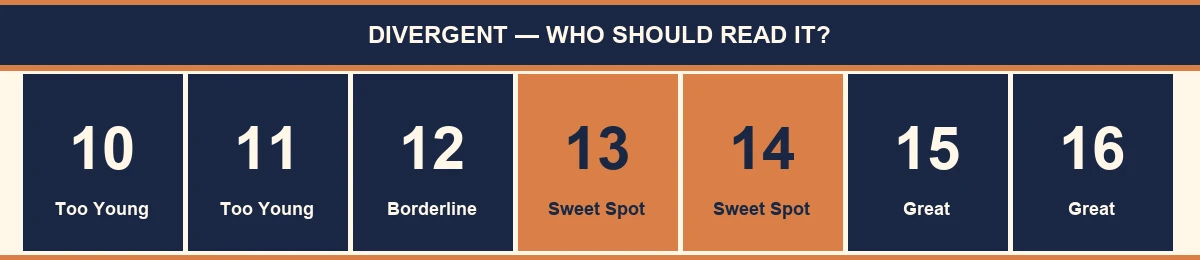
The publisher recommendation is 14+. School librarians and the common librarian consensus (tracked by ALA and Goodreads shelf data) tends to place it at 12–18, with the realistic sweet spot at 13–15. My own read on this: 8th grade is the ideal entry point for a reader coming in cold, regardless of their Lexile score.
Here’s why that grade marker matters more than age: 8th graders have typically encountered enough dystopian fiction — whether through class reading, The Giver, or the Hunger Games wave — that the genre conventions aren’t alien. They can read Tris’s choice to leave Abnegation for Dauntless as a genuine coming-of-age story rather than just plot mechanics. The faction system (Dauntless, Abnegation, Erudite, Amity, Candor) works best when a reader can engage with it as social allegory.
For advanced 6th or 7th graders who have been told they “read at a high school level”: the text is accessible, but Allegiant’s ending is genuinely difficult emotionally. I’d suggest those readers start with Book 1 and Book 2 and pause before Book 3 for a conversation about what Veronica Roth was trying to do with Tris’s arc.
Content Warnings: Violence, Death, and Mature Themes
This is the section that matters most for parents of younger readers. The Divergent series contains significant content that goes beyond what most middle-grade dystopian fiction includes.
Violence: The Dauntless initiation sequences in Book 1 involve hand-to-hand combat, knife throwing at human targets, and a simulation that requires Tris to confront lethal scenarios. Book 2 (Insurgent) escalates to faction warfare with named character deaths. Book 3 (Allegiant) contains the most sustained violence of the trilogy, culminating in a sacrifice sequence that kills the main protagonist.
Death of major characters: Allegiant’s ending is the most discussed content concern in the series. Tris Prior, the narrator for two-and-a-half books, dies. This is not a spoiler that fades — it’s the reason many parents who read ahead come back with questions. The death is not gratuitous, but it is final and clearly intended by Roth as a thematic statement. For some younger teens, this lands as powerful literature; for others, it lands as a traumatic shock they weren’t ready for.
Romance: Tris and Four have a relationship that includes kissing and age-appropriate physical intimacy, consistent with YA standards. Nothing explicitly sexual.
Themes: Government control, loss of identity, genetic manipulation (Allegiant), family trauma (Four’s backstory with his abusive father Marcus), and the ethics of self-sacrifice. These are substantive themes that make for good discussion — they’re also themes that benefit from a trusted adult available to talk through them.
For contrast: series like Goosebumps are categorized as horror but carry a fraction of this content weight. The Divergent series is a different beast — the content warnings are real and worth taking seriously.
Quick content checklist for parents:
| Content Area | Present? | Intensity |
|---|---|---|
| Violence / combat | Yes | Moderate–High |
| Death of main character | Yes (Allegiant) | High |
| Romance / kissing | Yes | Low–Moderate |
| Explicit sexual content | No | None |
| Government / political themes | Yes | Moderate |
| Family trauma | Yes (Book 4) | Moderate |
| Language / profanity | Minimal | Low |
Divergent vs Hunger Games vs Similar YA Dystopian Series
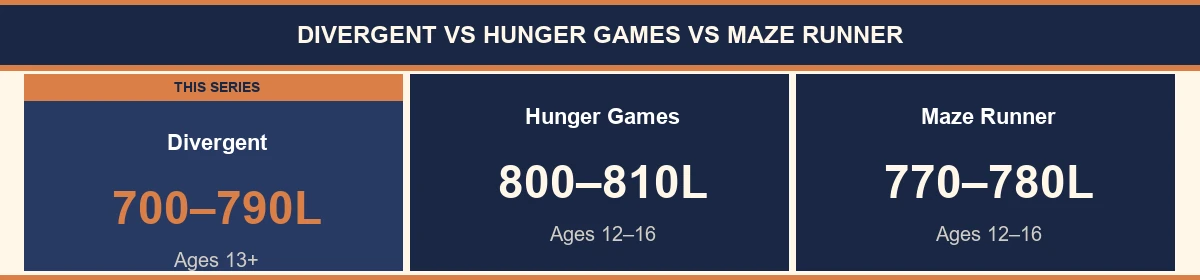
The comparison that comes up most often is Hunger Games — and it’s a fair one. Both series are first-person dystopian YA with female protagonists, faction-like social sorting, and significant violence. The Lexile scores are closer than most people expect. Parents comparing dystopian YA options often include Maze Runner Lexile and AR level by book in the shortlist — it runs 770L across five books, slightly easier than Hunger Games but equally intense in content.
The Hunger Games (Book 1) is Lexile 810L — about 110 points above Divergent‘s 700L, but in the same general band. Collins writes in a more compressed, journalistic style than Roth, which drives the Lexile slightly higher. Both series are AR 5.x and recommended for ages 12–18.
For Percy Jackson readers making the jump to dystopian YA: expect a significant content shift. Percy Jackson runs 680L–740L with action-adventure content appropriate for ages 9–14; Divergent starts at a similar Lexile but the violence, thematic darkness, and character deaths are in a different category. The numbers look similar; the reading experience is not.
| Series | Lexile Range | AR Level | Age Range | Content Intensity |
|---|---|---|---|---|
| Divergent (Roth) | 700–790L | 4.8–5.1 | 13–18 | High |
| Hunger Games (Collins) | 810L | 5.3 | 12–17 | High |
| Maze Runner (Dashner) | 770L | 5.3 | 13–17 | High |
| Percy Jackson (Riordan) | 680–740L | 4.6–4.7 | 9–14 | Low–Moderate |
The takeaway: Divergent, Hunger Games, and Maze Runner are all peers in terms of reading level and content weight. If your teen handled one of those series without issue, they’re ready for the others. The meaningful differences are in the specific content — Allegiant’s ending is harder than anything in Hunger Games Book 1; Maze Runner’s horror elements are different from Divergent’s faction-war violence.
Scholastic’s educator materials (available at Scholastic) list Divergent as appropriate for Grades 9 and up, which aligns with the 8th–10th grade sweet spot.
Frequently Asked Questions
What is the reading level of Divergent?
Divergent (Book 1) has a Lexile of 700L, an AR level of 4.8, and 16 AR points. The full trilogy ranges from Lexile 700L (Book 1) to 790L (Allegiant), with AR levels between 4.8 and 5.1. Fountas and Pinnell places the series at W–Z; DRA is 70+.
What age is Divergent for?
Publisher Katherine Tegen Books recommends Divergent for ages 14 and up. School librarians and ALA resources commonly list the series for ages 12–18, with 13–15 being the sweet spot for first-time readers. The primary concern for younger readers is Allegiant’s ending, which kills the main character.
Is Divergent appropriate for a 12-year-old?
A mature 12-year-old can handle Books 1 and 2 without issue — the violence is comparable to Hunger Games, which many 6th graders read. Book 3 (Allegiant) is where parents should pause: the death of the protagonist is abrupt and final, and some 12-year-olds find it genuinely upsetting. Reading ahead and having a conversation before they reach Allegiant is the practical approach.
What is the Lexile level of Allegiant?
Allegiant (Book 3) is Lexile 790L — the highest in the trilogy. That’s an 80-point jump from Divergent‘s 700L, driven by the dual-narrator structure and denser prose as the story moves beyond the faction system into the Bureau of Genetic Welfare setting.
What is the AR level of the Divergent series?
The AR (ATOS) levels are: Divergent 4.8 (16 pts), Insurgent 5.0 (19 pts), Allegiant 5.1 (21 pts), Four 4.9 (9 pts). Combined, the three main books are worth 56 AR points.
How does Divergent compare to Hunger Games reading level?
The Hunger Games is Lexile 810L vs Divergent‘s 700L — about 110 points higher, but both sit in the same general middle-school-to-high-school reading band. Both are AR 5.x. Content intensity is comparable: significant violence, character deaths, and dystopian themes. If a reader handled one, they’re ready for the other.
Please Write Your Comments