A Series of Unfortunate Events Reading Level: Harder Than You Think
14 May 2026
546
The Baudelaire orphans — Violet, Klaus, and Sunny — have been dodging Count Olaf and accumulating vocabulary words since 1999. Twenty-seven years later, the series Lemony Snicket built (real name: Daniel Handler, published by HarperCollins) remains one of the most discussed reading-level questions parents bring to school librarians. It shows up alongside Warriors and Percy Jackson in the same breath from parents trying to figure out what their kid should tackle next. The reason the question persists: the books look like middle-grade fiction but read like something considerably harder.
What struck me when I first looked up the Lexile data was how dramatically ASOUE outpaces the middle-grade average. Most MG fiction runs 600–900L. Book 1 of this series opens at approximately 1010L — higher than most 5th-grade classroom reads, and matching the Lexile of books commonly assigned in 7th grade. Book 13 (The End) climbs to around 1300L.
Here’s everything you need to know, including a book-by-book breakdown, age guide, and how the series compares to other popular series your kid is probably also asking about.
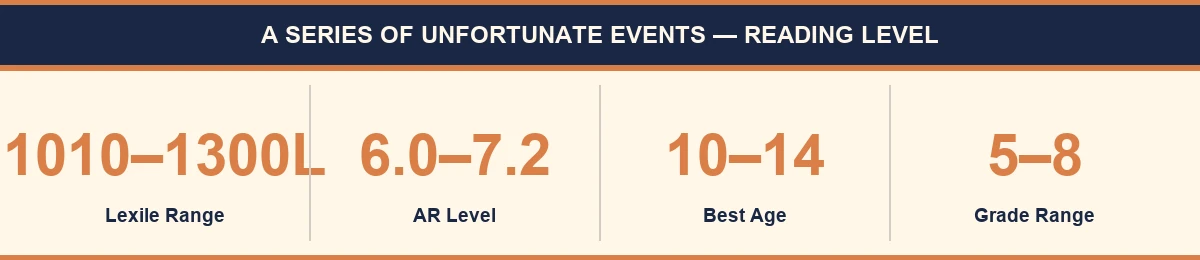
Quick Answer: What Reading Level Is A Series of Unfortunate Events?
Quick answer
Here’s the complete systems overview:
| Reading System | Range Across All 13 Books |
|---|---|
| Lexile | ~1010L (Books 1–12) — ~1300L (Book 13) |
| AR (ATOS) Book Level | 6.0 – 7.2 |
| AR Points | 6 – 10 per book |
| Fountas & Pinnell (F&P) | V – Y |
| DRA Level | ~60 – 70 |
| Recommended Age | 10 – 14 |
| Grade Level Sweet Spot | 5th – 8th grade |
Lexile Level — Higher Than You’d Expect
Most parents searching this topic expect something in the 700L–800L range — the typical zone for popular middle-grade series. The actual numbers from MetaMetrics’ Lexile database land considerably higher: Books 1–12 sit at approximately 1010L, and The End (Book 13) reaches approximately 1300L.
For context: 1010L is the Lexile of many 7th-grade reading assignments. The 1300L mark is typically reserved for high school or advanced middle school texts. Lemony Snicket’s prose style — dense vocabulary, lengthy multi-clause sentences, and a narrator who routinely stops to define words for the reader — drives those numbers up in ways that don’t apply to most fiction in the same bookstore section.
The ATOS (AR) formula, which weighs average word length, average sentence length, and book length, similarly scores these books at 6th–7th grade difficulty. That’s roughly two full grade levels above comparable series like Diary of a Wimpy Kid (AR 5.2) or Magic Tree House (AR 3.4–4.0).
What this means practically: a 4th-grader who devours books may be able to decode the text, but the vocabulary load — Handler deliberately uses words like “malfeasance,” “ersatz,” and “penultimate” in context — is designed for older readers. The narrator’s meta-commentary also requires a sophistication about how fiction works that most readers develop around 5th grade.
Per-Book Reading Level Breakdown (Books 1–13)
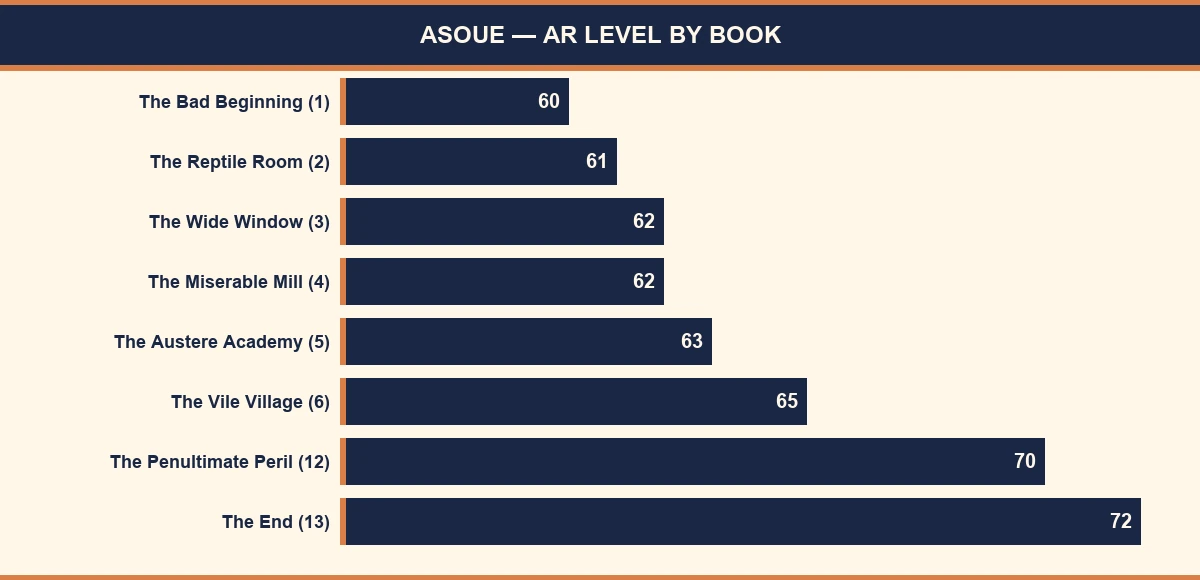
All AR data from Renaissance Learning. Lexile measures are approximate; MetaMetrics rounds to the nearest 10L for published titles.
| # | Title | Lexile (approx.) | AR Level | AR Points | F&P |
|---|---|---|---|---|---|
| 1 | The Bad Beginning | ~1010L | 6.0 | 6 | V |
| 2 | The Reptile Room | ~1010L | 6.1 | 6 | V |
| 3 | The Wide Window | ~1010L | 6.2 | 6 | V |
| 4 | The Miserable Mill | ~1010L | 6.3 | 7 | V |
| 5 | The Austere Academy | ~1010L | 6.4 | 7 | W |
| 6 | The Ersatz Elevator | ~1010L | 6.4 | 8 | W |
| 7 | The Vile Village | ~1010L | 6.5 | 8 | W |
| 8 | The Hostile Hospital | ~1010L | 6.5 | 8 | X |
| 9 | The Carnivorous Carnival | ~1010L | 6.6 | 9 | X |
| 10 | The Slippery Slope | ~1010L | 6.7 | 9 | X |
| 11 | The Grim Grotto | ~1010L | 6.7 | 9 | X |
| 12 | The Penultimate Peril | ~1010L | 6.8 | 10 | Y |
| 13 | The End | ~1300L | 7.2 | 10 | Y |
A few things worth pointing out. The Lexile is essentially flat across Books 1–12 — Handler’s sentence complexity and vocabulary density are remarkably consistent throughout the series. What rises is the AR level, which reflects increasing book length, thematic density, and narrative complexity as the series progresses. The End is a genuine outlier: the Lexile jump to 1300L reflects a structural shift in the narrative, which becomes more philosophical and less plot-driven in its final chapters.
AR points also rise: Book 1 earns 6 points, Books 12 and 13 earn 10. A student reading the full series would accumulate approximately 103 AR points — a significant total for a single series.
AR Level and Accelerated Reader Points
Renaissance Learning’s Accelerated Reader system rates ASOUE books at AR 6.0–7.2, placing them firmly in the 6th–7th grade reading-ability band. The ATOS formula (Advantage-TASA Open Standard) derives these levels from average word length, sentence length, and word difficulty — all three of which run high in Lemony Snicket’s prose.
For schools that use AR point goals:
- Books 1–4: 6–7 points each — good early-series targets
- Books 5–8: 7–8 points each — mid-series, slightly longer
- Books 9–12: 9–10 points each — longest, most complex
- Book 13: 10 points — highest AR level in the series (7.2)
If a student is working toward a quarterly AR goal of 25–30 points, reading Books 1–3 gets them to 18 points. The full 13-book series covers a student’s entire reading log for most of a school year. Parents I’ve spoken with often find this is the series that finally gets their middle schooler to stop asking “does this count for my goal?” and start reading for its own sake.
For comparison with our Lexile vs AR guide, these AR scores place ASOUE in the same range as Hatchet (AR 5.7), Holes (AR 4.6), and early Harry Potter books — though the Lexile measure tells a different story at the high end.
Recommended Age Range and Grade Level
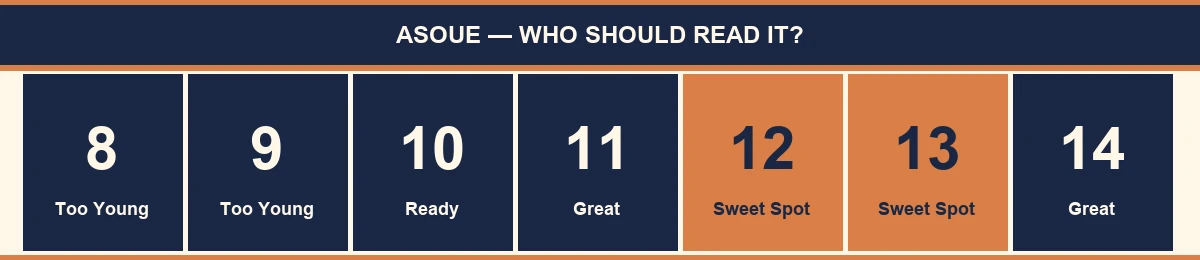
The publisher and most school librarians recommend A Series of Unfortunate Events for ages 10–14, with the reading-level sweet spot at 5th through 8th grade. Scholastic’s guide to The Bad Beginning aligns with this recommendation.
Here’s how it breaks down by age and grade:
| Age | Grade | Reading Fit | Notes |
|---|---|---|---|
| 8–9 | Grade 3–4 | Possible with support | Decoding is the challenge; themes fine for mature readers |
| 10–11 | Grade 5–6 | Sweet spot | Reading level and thematic complexity align perfectly |
| 12–13 | Grade 7–8 | Excellent | Later books especially rewarding; vocabulary enriching |
| 14+ | Grade 9+ | Easy read | Still entertaining; great for reluctant teen readers |
A 10–11-year-old who reads confidently at or above grade level is the ideal reader. The books are long enough to reward sustained attention (200–340 pages each), the vocabulary is challenging enough to build skills, and the dark humor lands best for readers who are old enough to appreciate irony but young enough to still find the Baudelaires’ predicaments genuinely tense.
For comparison, Narnia runs at Lexile 790L–1000L — measurably easier than ASOUE in most books, though The Last Battle approaches similar complexity.
What about age 8? An 8-year-old can enjoy the story with adult read-aloud support, but independent reading is a stretch for most. The Lexile alone (1010L vs. an average 8-year-old independent reading level of roughly 600–750L) suggests this. The content itself — parental death in chapter one, relentless adult failure, a villain with genuine menace — is also calibrated for older middle-grade readers.
Content and Darkness Guide: Is It Too Scary?
The series has a reputation for being “dark,” which is accurate but requires unpacking. Here’s what the content actually contains:
- Death: The Baudelaire parents die before Book 1 begins. Additional character deaths occur throughout, including sympathetic adults.
- Peril: Count Olaf poses genuine physical threat across all 13 books. The tone never lets readers fully relax.
- Adult incompetence: A central theme is that most adults are either malicious, oblivious, or both. This is played for dark comedy but can feel bleak to younger readers.
- Violence: Present but not graphic. The series is not gory.
- Romance/sexuality: Minimal. Count Olaf’s plot in Book 1 involves a forced marriage scheme, which is explained in age-appropriate terms.
- Language: Clean throughout.
The Hunger Games is often cited alongside ASOUE as a benchmark for “dark middle-grade/YA content.” ASOUE is considerably less violent — there’s no physical combat or gore — but the sustained hopelessness and adult failure can hit sensitive readers harder than overt action-adventure danger. Parents who are unsure should read Book 1 (The Bad Beginning, 162 pages) before deciding; it’s a reliable preview of the series’ tone.
The Netflix adaptation (2017–2019, starring Neil Patrick Harris as Count Olaf) is rated TV-PG and tracks the books closely. Parents who want to preview the tone before handing over the books often find the show useful for that purpose.
How ASOUE Compares to Harry Potter, Goosebumps, and Narnia
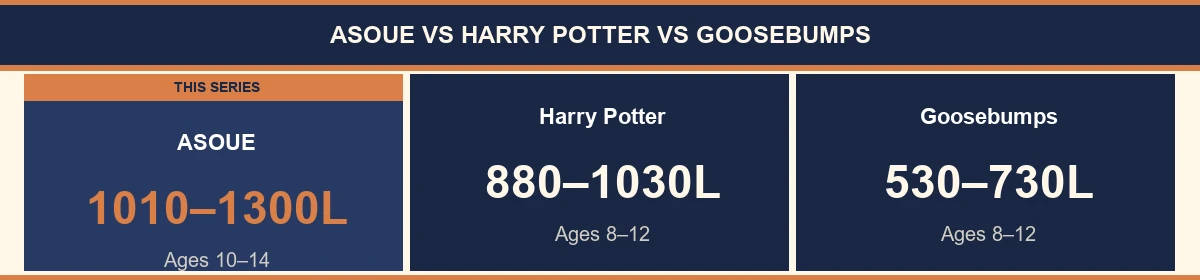
This is the comparison that drives most of the search traffic around this topic. Here’s the complete picture:
| Series | Publisher | Lexile Range | AR Range | Age Range | Key Difference |
|---|---|---|---|---|---|
| A Series of Unfortunate Events | HarperCollins | ~1010L – 1300L | 6.0 – 7.2 | 10–14 | Unusually high Lexile for MG; starts where HP ends |
| Harry Potter | Scholastic | ~880L – 1030L | 5.5 – 7.2 | 9–12 (Books 1–4), 12+ (Books 5–7) | Grows with reader; Books 1–3 much easier than ASOUE |
| Goosebumps | Scholastic | 530L – 710L | 3.5 – 5.3 | 8–12 | Much easier reading; horror without the vocabulary load |
| Narnia | HarperCollins | 790L – 1000L | 5.4 – 6.8 | 8–12 | Classic prose difficulty; most books easier than ASOUE |
The Harry Potter comparison is the most instructive. The Sorcerer’s Stone is Lexile 880L — approximately 130 Lexile points below The Bad Beginning. ASOUE Book 1 is harder than HP Books 1–4. Only Order of the Phoenix through Deathly Hallows (HP Books 5–7, Lexile 950L–1030L) approach comparable difficulty, and they still fall below The End (1300L).
Goosebumps runs at roughly half the Lexile level of ASOUE. They share a horror-adjacent tone and middle-grade age range, but a student reading Goosebumps independently at grade level is not automatically ready for ASOUE without a reading-level bridge.
What this table doesn’t capture: ASOUE’s high Lexile is partly a function of Handler’s intentional vocabulary difficulty. The narrator defines hard words in context, turning dense prose into an active reading lesson. A child who “shouldn’t” be able to read 1010L often can, because the text teaches itself. That’s a genuine design feature of the series, and it’s why librarians sometimes recommend it for advanced 4th-graders despite the Lexile gap.
Frequently Asked Questions
What is the Lexile level of A Series of Unfortunate Events?
Most books in the series (Books 1–12) have a Lexile level of approximately 1010L. Book 13, The End, is approximately 1300L. These are significantly higher than the typical middle-grade Lexile range of 600–900L, placing ASOUE in the same difficulty band as many 7th-grade classroom texts.
What AR level is A Series of Unfortunate Events?
The ATOS (AR) level ranges from 6.0 (The Bad Beginning, Book 1) to 7.2 (The End, Book 13). This puts the series at approximately 6th–7th grade reading ability by Renaissance Learning’s Accelerated Reader system. AR points range from 6 per book (early titles) to 10 per book (Books 12 and 13).
What is the series of unfortunate events reading level by book?
Book levels rise gradually: Books 1–4 are AR 6.0–6.3, Books 5–8 are AR 6.4–6.5, Books 9–12 are AR 6.6–6.8, and Book 13 (The End) jumps to AR 7.2. The Lexile is consistent at ~1010L for Books 1–12, then rises to ~1300L for Book 13.
Is A Series of Unfortunate Events appropriate for an 8-year-old?
Most 8-year-olds will find the reading level challenging for independent reading (Lexile ~1010L vs. a typical 8-year-old’s independent reading level of 600–750L). The themes — parental death, relentless adult failure, a menacing villain — are also calibrated for older readers. With adult read-aloud support, the story is accessible and enjoyable; for independent reading, most children are better served waiting until age 10 or strong 4th-grade reading level.
What grade level is A Series of Unfortunate Events?
By Lexile and AR measures, ASOUE reads at a 6th–7th grade level (occasionally 5th grade for Books 1–4). The recommended grade sweet spot is 5th through 8th grade. Strong 4th-grade readers can handle it; the series remains rewarding through high school for re-readers.
What is the ATOS level of A Series of Unfortunate Events?
ATOS (the formula behind the AR book level) rates the series at 6.0–7.2 across all 13 books. ATOS accounts for average word length, sentence length, and word difficulty — all of which run high in Lemony Snicket’s deliberately vocabulary-rich prose. The series ATOS average across Books 1–12 is approximately 6.5.
Please Write Your Comments